


Security News
The Nightmare Before Deployment
Season’s greetings from Socket, and here’s to a calm end of year: clean dependencies, boring pipelines, no surprises.
By Ahmad Nassri - Dec 16, 2025
mailslurp-client
Advanced tools
Create real email addresses on demand. Send and receive emails and attachments from code and tests using Python.
MailSlurp is an email API service that lets you create real email addresses in code. You can then send and receive emails and attachments in Python applications and tests.
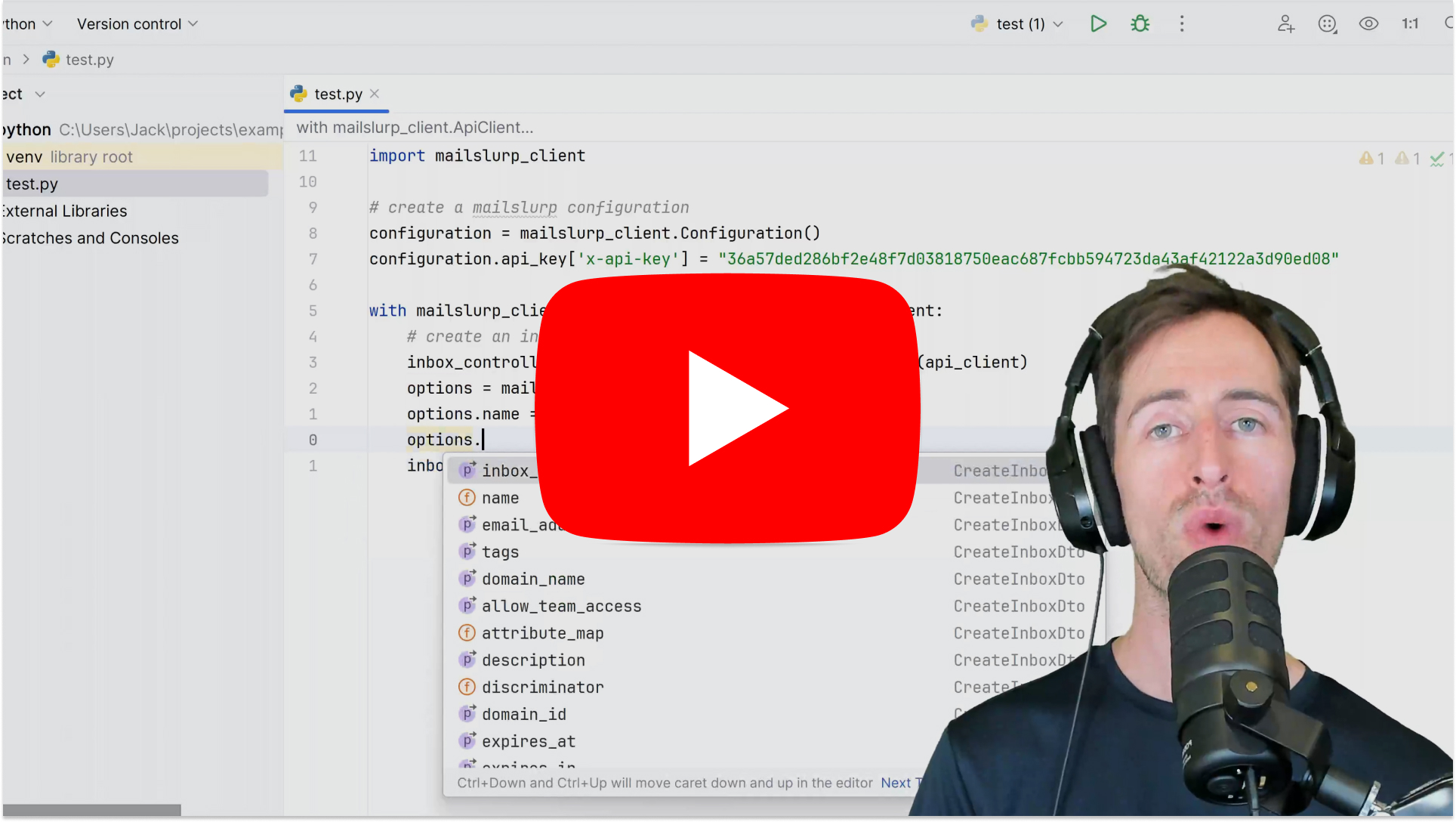
This section describes how to get up and running with the Python client.
See the examples page for more examples and use with common frameworks such as Django, Flask and Pytest.
See the method documentation for a list of all functions or jump to common controllers below:
First you'll need an API Key. Create a free account and copy the key from your dashboard.
MailSlurp has an official PyPI package called mailslurp-client. It supports Python version 2 and 3.
pip install mailslurp-client
On some systems you may need to install distutils. If you encounter a CERTIFICATE_VERIFY_VALID error you can install certifi and certifi-win32 for Windows:
pip install python-certifi-win32
Once installed you can import mailslurp_client and create a configuration with your API Key.
import mailslurp_client

configuration = mailslurp_client.Configuration()
configuration.api_key["x-api-key"] = YOUR_API_KEY
Then you can create API controller instances using the configuration:
with mailslurp_client.ApiClient(configuration) as api_client:
    api_instance = mailslurp_client.InboxControllerApi(api_client)
See the controllers overview for all API methods.
MailSlurp can be used to create email addresses than can send and receive real emails, SMS, and attachments in Python.
Create an inbox using the inbox controller:
inbox_controller = mailslurp_client.InboxControllerApi(api_client)
inbox = inbox_controller.create_inbox_with_defaults()
self.assertTrue("@mailslurp" in inbox.email_address)
You can pass options using the CreateInboxOptions class:
options = mailslurp_client.CreateInboxDto()
options.name = "Test inbox"
options.inbox_type = "SMTP_INBOX"
inbox = inbox_controller.create_inbox_with_options(options)
self.assertTrue("@mailslurp" in inbox.email_address)
See the inbox controller for more methods.
smtp_access = inbox_controller.get_imap_smtp_access(inbox_id=inbox.id)
self.assertIsNotNone(smtp_access.secure_smtp_server_host)
# configure smtp client using access details
from smtplib import SMTP

with SMTP(
    host=smtp_access.secure_smtp_server_host,
    port=smtp_access.secure_smtp_server_port,
) as smtp:
    msg = "Subject: Test subject

This is the body"
    smtp.login(
        user=smtp_access.secure_smtp_username,
        password=smtp_access.secure_smtp_password,
    )
    smtp.sendmail(
        from_addr=inbox.email_address,
        to_addrs=[inbox.email_address],
        msg=msg,
    )
    smtp.quit()
List inboxes using the inbox controller:
inboxes = inbox_controller.get_all_inboxes(page=0)

# pagination properties
self.assertTrue(inboxes.total_pages > 0)
self.assertTrue(inboxes.total_elements > 0)

# view contents
self.assertIsNotNone(inboxes.content[0].email_address)
inbox = inbox_controller.get_inbox(inbox_id=inbox.id)
self.assertTrue("@mailslurp" in inbox.email_address)

# get by email address
inbox_by_email = inbox_controller.get_inbox_by_email_address(
    inbox.email_address
)
self.assertTrue(inbox_by_email.exists)

# get by name
inbox_by_name = inbox_controller.get_inbox_by_name(inbox.name)
self.assertTrue(inbox_by_name.exists)
inbox_controller.delete_inbox(inbox_id=inbox.id)
To send attachments first upload the attachments as base64 encoded strings and use the returned attachment IDs when sending.
import base64

attachment_controller = mailslurp_client.AttachmentControllerApi(api_client)
options = mailslurp_client.UploadAttachmentOptions(
    filename="test.txt",
    content_type="text/plain",
    base64_contents=base64.b64encode("Hello world".encode("utf-8")).decode(
        "utf-8"
    ),
)
attachment_ids = attachment_controller.upload_attachment(options)
self.assertTrue(len(attachment_ids) == 1)
Send emails with the inbox controller:
send_options = mailslurp_client.SendEmailOptions(
    to=[recipient.email_address],
    subject="Hello",
    body="Here is your email body",
    attachments=attachment_ids,
)
sent = inbox_controller.send_email_and_confirm(
    inbox_id=inbox.id, send_email_options=send_options
)
self.assertTrue(sent.sent_at is not None)
Use the wait for controller to wait for an expected email count to be satisfied and then return those emails.
wait_for_controller = mailslurp_client.WaitForControllerApi(api_client)
email = wait_for_controller.wait_for_latest_email(
    inbox_id=inbox.id, timeout=60_000, unread_only=True
)
self.assertTrue("Hello" in email.subject)
matching_emails = wait_for_controller.wait_for_matching_emails(
    inbox_id=inbox.id,
    timeout=60_000,
    unread_only=False,
    match_options=mailslurp_client.MatchOptions(
        conditions=[
            mailslurp_client.ConditionOption(
                condition="HAS_ATTACHMENTS", value="TRUE"
            )
        ],
        matches=[
            mailslurp_client.MatchOption(
                field="SUBJECT", should="CONTAIN", value="Hello"
            )
        ],
    ),
    count=1,
)
self.assertTrue(len(matching_emails) > 0)
attachment_content = attachment_controller.download_attachment_as_base64_encoded(email.attachments[0])
attachment_metadata = attachment_controller.get_attachment_info(email.attachments[0])
self.assertEqual(attachment_metadata.content_type, "text/plain")
email_controller = mailslurp_client.EmailControllerApi(api_client)
email = email_controller.get_email(email_id=email_id)
self.assertTrue("Hello" in email.subject)
You can verify email addresses with MailSlurp. This will perform SMTP queries for the email address on your behalf.
def test_validate_email(self):
    with mailslurp_client.ApiClient(configuration) as api_client:
        mailserver_controller = mailslurp_client.MailServerControllerApi(api_client)
        verify_options = mailslurp_client.VerifyEmailAddressOptions(email_address="test@gmail.com")
        result = mailserver_controller.verify_email_address(verify_options=verify_options)
        assert result.error is None
        assert result.is_valid is True
See the guides page or the examples or the Method Documentation for full usage.
FAQs
Official MailSlurp Python SDK Email API
We found that mailslurp-client demonstrated a healthy version release cadence and project activity because the last version was released less than a year ago. It has 1 open source maintainer collaborating on the project.
Did you know?

Socket for GitHub automatically highlights issues in each pull request and monitors the health of all your open source dependencies. Discover the contents of your packages and block harmful activity before you install or update your dependencies.
Security News
Season’s greetings from Socket, and here’s to a calm end of year: clean dependencies, boring pipelines, no surprises.

Research
/Security News
Impostor NuGet package Tracer.Fody.NLog typosquats Tracer.Fody and its author, using homoglyph tricks, and exfiltrates Stratis wallet JSON/passwords to a Russian IP address.

Security News
Deno 2.6 introduces deno audit with a new --socket flag that plugs directly into Socket to bring supply chain security checks into the Deno CLI.