

Security News
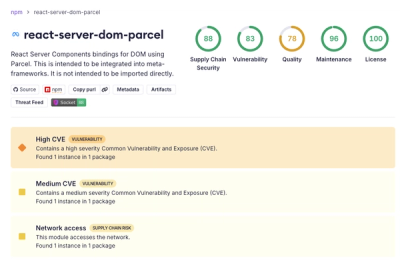
New React Server Components Vulnerabilities: DoS and Source Code Exposure
New DoS and source code exposure bugs in React Server Components and Next.js: what’s affected and how to update safely.
By Sarah Gooding - Dec 12, 2025
mysqlengine
Advanced tools
Created to be used in a project, this package is published to github for ease of management and installation across different modules.
Install from PyPi
pip install mysqlengine
Install from github
pip install git+https://github.com/AresJef/MysqlEngine.git
MysqlEngine is a Python/Cython hybrid library that provides a high-performance, programmatic interface to MySQL. It provides:
MysqlEngine is built on top of SQLCyCli. Because SQLCyCli already delivers solid and high-performance connectivity, MysqlEngine can concentrate on its higher-level features.
SQLCyCli.errors.MySQLError.import asyncio
from mysqlengine import Database, Table, Pool
from mysqlengine import Column, Index, Define, PrimaryKey
# Difine Table
class User(Table):
id: Column = Column(Define.BIGINT(unsigned=True, auto_increment=True))
name: Column = Column(Define.VARCHAR(255))
pk: PrimaryKey = PrimaryKey("id")
idx: Index = Index("name")
class Product(Table):
id: Column = Column(Define.BIGINT(unsigned=True, auto_increment=True))
product_name: Column = Column(Define.VARCHAR(255))
product_price: Column = Column(Define.DECIMAL(12, 2))
pk: PrimaryKey = PrimaryKey("id")
idx: Index = Index("product_name")
# Define Database
class MyDatabase(Database):
user: User = User()
product: Product = Product()
# Instanciate Database
pool = Pool(host="localhost", user="root", password="Password_123456")
db = MyDatabase("db", pool)
# Synchronize Demo
def sync_demo(db: MyDatabase) -> None:
db.Initialize() # Initialize 'db'
db.ShowDatabases()
db.user.ShowCreateTable()
db.user.ShowMetadata()
db.user.Insert().Columns(db.user.name).Values(1).Execute(
["John", "Sarah"], many=True
)
db.Select("*").From(db.user).Execute() # ((1, 'John'), (2, 'Sarah'))
db.Drop() # Drop 'db'
sync_demo(db)
# Asynchronize Demo
async def async_demo(db: MyDatabase) -> None:
await db.aioInitialize() # Initialize 'db'
await db.aioShowDatabases()
await db.user.aioShowCreateTable()
await db.user.aioShowMetadata()
await db.user.Insert().Columns(db.user.name).Values(1).aioExecute(
["John", "Sarah"], many=True
)
await db.Select("*").From(db.user).aioExecute() # ((1, 'John'), (2, 'Sarah'))
await db.aioDrop() # Drop 'db'
asyncio.run(async_demo(db))
import asyncio
from mysqlengine import Pool, Database, Table, TempTable
from mysqlengine import Column, Index, Define, PrimaryKey


class MyTable(Table):
    id: Column = Column(Define.BIGINT(unsigned=True, auto_increment=True))
    name: Column = Column(Define.VARCHAR(255))
    pk: PrimaryKey = PrimaryKey("id")


class MyTempTable(TempTable):
    id: Column = Column(Define.BIGINT(unsigned=True, auto_increment=True))
    name: Column = Column(Define.VARCHAR(255))
    pk: PrimaryKey = PrimaryKey("id")


class MyDatabase(Database):
    tb: MyTable = MyTable()


pool = Pool(host="localhost", user="root", password="Password_123456")
db = MyDatabase("db", pool)
db.Drop(True)

# Synchronize Demo
def sync_demo(db: MyDatabase) -> None:
    db.Initialize()  # Initialize 'db'
    db.tb.Insert().Columns("name").Values(1).Execute(["John", "Sarah"], many=True)
    with db.transaction() as conn:
        with db.CreateTempTable(conn, "temp_tb", MyTempTable()) as tmp:
            tmp.Insert().Columns("name").Select("name").From(db.tb).Execute()
            tmp.Select("*").Execute()  # ((1, 'John'), (2, 'Sarah'))
    # temporary table is automatically dropped
    db.Drop()  # Drop 'db'

sync_demo(db)

# Asynchronize Demo
async def async_demo(db: MyDatabase) -> None:
    await db.aioInitialize()  # Initialize 'db'
    await db.tb.Insert().Columns("name").Values(1).aioExecute(
        ["John", "Sarah"], many=True
    )
    async with db.transaction() as conn:
        async with db.CreateTempTable(conn, "temp_tb", MyTempTable()) as tmp:
            await tmp.Insert().Columns("name").Select("name").From(db.tb).aioExecute()
            await tmp.Select("*").aioExecute()  # ((1, 'John'), (2, 'Sarah'))
    # temporary table is automatically dropped
    await db.aioDrop()  # Drop 'db'

asyncio.run(async_demo(db))
import asyncio
from mysqlengine import Pool, Database, TimeTable
from mysqlengine import Column, Index, Define, PrimaryKey


class MyTimeTable(TimeTable):
    id: Column = Column(Define.BIGINT(unsigned=True, auto_increment=True))
    name: Column = Column(Define.VARCHAR(255))
    dt: Column = Column(Define.DATETIME())
    pk: PrimaryKey = PrimaryKey("id", "dt")


class MyDatabase(Database):
    tb: MyTimeTable = MyTimeTable("dt", "YEAR", "2024-01-01", "2025-01-01")


pool = Pool(host="localhost", user="root", password="Password_123456")
db = MyDatabase("db", pool)
db.Drop(True)

# Synchronize Demo
def sync_demo(db: MyDatabase) -> None:
    db.Initialize()  # Initialize 'db'
    db.tb.Insert().Columns("name", "dt").Values(2).Execute(
        [("John", "2024-02-01"), ("Sarah", "2025-02-01")], many=True
    )
    db.tb.ShowPartitionRows()  # {'past': 0, 'y2024': 1, 'y2025': 1, 'future': 0}
    db.tb.ExtendToTime(end_with="2026-02-01")
    db.tb.ShowPartitionRows()  # {'past': 0, 'y2024': 1, 'y2025': 1, 'y2026': 0, 'future': 0}
    db.tb.DropToTime(start_from="2025-01-01")
    db.tb.ShowPartitionRows()  # {'past': 0, 'y2025': 1, 'y2026': 0, 'future': 0}
    db.Drop()  # Drop 'db'

sync_demo(db)

# Asynchronize Demo
async def async_demo(db: MyDatabase) -> None:
    await db.aioInitialize()  # Initialize 'db'
    await db.tb.Insert().Columns("name", "dt").Values(2).aioExecute(
        [("John", "2024-02-01"), ("Sarah", "2025-02-01")], many=True
    )
    await db.tb.aioShowPartitionRows()  # {'past': 0, 'y2024': 1, 'y2025': 1, 'future': 0}
    await db.tb.aioExtendToTime(end_with="2026-02-01")
    await db.tb.aioShowPartitionRows()  # {'past': 0, 'y2024': 1, 'y2025': 1, 'y2026': 0, 'future': 0}
    await db.tb.aioDropToTime(start_from="2025-01-01")
    await db.tb.aioShowPartitionRows()  # {'past': 0, 'y2025': 1, 'y2026': 0, 'future': 0}
    await db.aioDrop()  # Drop 'db'

asyncio.run(async_demo(db))
MysqlEngine is based on several open-source repositories.
FAQs
A Cython-Accelerated, Pythonic MySQL ORM & Query Builder
We found that mysqlengine demonstrated a healthy version release cadence and project activity because the last version was released less than a year ago. It has 1 open source maintainer collaborating on the project.
Did you know?

Socket for GitHub automatically highlights issues in each pull request and monitors the health of all your open source dependencies. Discover the contents of your packages and block harmful activity before you install or update your dependencies.
Security News
New DoS and source code exposure bugs in React Server Components and Next.js: what’s affected and how to update safely.

Security News
Socket CEO Feross Aboukhadijeh joins Software Engineering Daily to discuss modern software supply chain attacks and rising AI-driven security risks.
Security News
GitHub has revoked npm classic tokens for publishing; maintainers must migrate, but OpenJS warns OIDC trusted publishing still has risky gaps for critical projects.