


Security News
Deno 2.6 + Socket: Supply Chain Defense In Your CLI
Deno 2.6 introduces deno audit with a new --socket flag that plugs directly into Socket to bring supply chain security checks into the Deno CLI.
By Sarah Gooding - Dec 12, 2025
normalurl
Advanced tools
Convenient utility to parse and normalize urls.
from normalurl import *
print(parse_url('localhost'))
print(parse_url('localhost:12345'))
print(normalize_url('localhost', scheme='http', port='1122'))
print(parse_normalized_url('localhost:12345', scheme='http', port='1122'))
URL(scheme='', hostname='localhost', port='', path='', query='', fragment='', netloc='localhost', username='', password='')
URL(scheme='', hostname='localhost', port=12345, path='', query='', fragment='', netloc='localhost:12345', username='', password='')
http://localhost:1122
URL(scheme='http', hostname='localhost', port=12345, path='', query='', fragment='', netloc='localhost:12345', username='', password='')
Function normalize_url(url: Union[str, URL, ParseResult], *, scheme: str = '', hostname: str = '', port: str = '', path: str = '', query: str = '', fragment: str = '', username: str = '', password: str = '') -> str ensures each element of url has non-empy value otherwise sets default one.
Just do nothing:
print(normalize_url('localhost'))
localhost
Ensure url describes scheme and port. If not persist user http scheme and port 1122.
print(normalize_url('localhost', scheme='http', port='1122'))
print(normalize_url('https://localhost', scheme='http', port='1122'))
print(normalize_url('localhost:12345', scheme='http', port='1122'))
print(normalize_url('https://localhost:12345', scheme='http', port='1122'))
http://localhost:1122
https://localhost:1122
http://localhost:12345
https://localhost:12345
Function parse_url(url: str) -> URL parse url elements in named tuple structure URL. Default value for each element is empty string ''.
Parsed elements are:
print(parse_url('localhost'))
print(parse_url('localhost:12345'))
print(parse_url('http://example.org'))
print(parse_url('https://example.org:8080/user/search?name=Bob&age=30#profile'))
print(parse_url('https://admin:123@example.org:8080/user/search?name=Bob&age=30#profile'))
URL(scheme='', hostname='localhost', port='', path='', query='', fragment='', netloc='localhost', username='', password='')
URL(scheme='', hostname='localhost', port=12345, path='', query='', fragment='', netloc='localhost:12345', username='', password='')
URL(scheme='http', hostname='example.org', port='', path='', query='', fragment='', netloc='example.org', username='', password='')
URL(scheme='https', hostname='example.org', port=8080, path='/user/search', query='name=Bob&age=30', fragment='profile', netloc='example.org:8080', username='', password='')
URL(scheme='https', hostname='example.org', port=8080, path='/user/search', query='name=Bob&age=30', fragment='profile', netloc='admin:123@example.org:8080', username='admin', password='123')
Function parse_normalized_url(url: Union[str, ParseResult], *, scheme: str = '', hostname: str = '', port: str = '', path: str = '', query: str = '', fragment: str = '', username: str = '', password: str = '') -> URL works exactly like normalize_url + parse_url - normalizes url then parses it.
Ensure url describes scheme and port. If not persist user http scheme and port 1122.
print(parse_normalized_url('localhost', scheme='http', port='1122'))
print(parse_normalized_url('https://localhost', scheme='http', port='1122'))
print(parse_normalized_url('localhost:12345', scheme='http', port='1122'))
print(parse_normalized_url('https://localhost:12345', scheme='http', port='1122'))
URL(scheme='http', hostname='localhost', port=1122, path='', query='', fragment='', netloc='localhost:1122', username='', password='')
URL(scheme='https', hostname='localhost', port=1122, path='', query='', fragment='', netloc='localhost:1122', username='', password='')
URL(scheme='http', hostname='localhost', port=12345, path='', query='', fragment='', netloc='localhost:12345', username='', password='')
URL(scheme='https', hostname='localhost', port=12345, path='', query='', fragment='', netloc='localhost:12345', username='', password='')
Because urlib does not cover some common edge cases.
Just rewrite the first example with urllib:
from urllib.parse import urlparse

print(urlparse('localhost'))
print(urlparse('localhost:12345'))
ParseResult(scheme='', netloc='', path='localhost', params='', query='', fragment='')
ParseResult(scheme='localhost', netloc='', path='12345', params='', query='', fragment='')
As you can see, urllib considers localhost as path while it is actually hostname. Moreover, <host>:<port> are parsed as scheme (like http) for localhost and path for port which is absolutely wrong.
FAQs
Convenient utility to parse and normalize urls.
We found that normalurl demonstrated a healthy version release cadence and project activity because the last version was released less than a year ago. It has 1 open source maintainer collaborating on the project.
Did you know?

Socket for GitHub automatically highlights issues in each pull request and monitors the health of all your open source dependencies. Discover the contents of your packages and block harmful activity before you install or update your dependencies.
Security News
Deno 2.6 introduces deno audit with a new --socket flag that plugs directly into Socket to bring supply chain security checks into the Deno CLI.
Security News
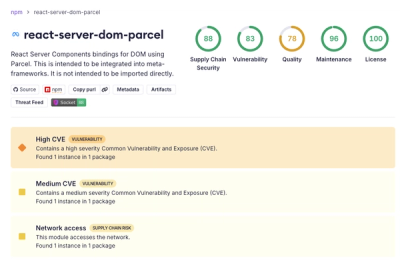
New DoS and source code exposure bugs in React Server Components and Next.js: what’s affected and how to update safely.

Security News
Socket CEO Feross Aboukhadijeh joins Software Engineering Daily to discuss modern software supply chain attacks and rising AI-driven security risks.