


Security News
Deno 2.6 + Socket: Supply Chain Defense In Your CLI
Deno 2.6 introduces deno audit with a new --socket flag that plugs directly into Socket to bring supply chain security checks into the Deno CLI.
By Sarah Gooding - Dec 12, 2025
omniconfig
Advanced tools
Python package for parsing configurations from YAML and TOML and command-line interface.
Python package for parsing configurations from YAML and TOML files with the command-line interface.
You can install omniconfig using pip:
pip install omniconfig
git clone https://github.com/synxlin/omniconfig
cd omniconfig
conda env create -f environment.yml
poetry install
Decorator configclass in omniconfig package can help build argument parser from dataclass in dataclasses. Here is an example:
from dataclasses import dataclass, field
from typing import Any, Callable

import omniconfig


@omniconfig.configclass
@dataclass
class EvalConfig:
    """Evaluation Config class.

    Attributes:
        num_gpus (int): the number of GPUs. Defaults to ``8``.
    """

    num_gpus: int = 8


@omniconfig.configclass
@dataclass
class QuantConfig:
    """Quantization config class.

    Attributes:
        dtype (str): Quantization data type. Defaults to ``"torch.float16"``.
        group_shape (list[int]): Quantization group shape. Defaults to ``(1, -1)``.
    """

    dtype: str = "torch.float16"
    group_shape: list[int] = (1, -1)

    @classmethod
    def update_get_arguments(
        cls: type["QuantConfig"],
        *,
        overwrites: dict[str, Callable | None] | None = None,
        defaults: dict[str, Any] | None = None,
    ) -> tuple[dict[str, Callable | None], dict[str, Any]]:
        """Get the arguments for the quantization configuration."""
        overwrites = overwrites or {}
        defaults = defaults or {}
        overwrites.setdefault(
            "group_shape",
            lambda parser: parser.add_argument(
                "--group-shape",
                nargs="+",
                type=int,
                default=defaults.get("group_shape", (1, -1)),
                help="Quantization group shape",
            ),
        )
        return overwrites, defaults


@omniconfig.configclass
@dataclass
class ModelConfig:
    """Model Config class.

    Attributes:
        name (str): the model name.
        group (str): the model family.
    """

    name: str
    family: str = field(init=False, default="")

    def __post_init__(self):
        self.family = self.name.split("-")[0]


@omniconfig.configclass
@dataclass
class QuantizedModelConfig(ModelConfig):
    """Quantized Model Config class.

    Attributes:
        name (str): the model name.
        group (str): the model group.
        quant (QuantConfig): quantization configuration. Defaults to ``None``.
    """

    quant: QuantConfig | None = None


@omniconfig.configclass
@dataclass
class Config:
    """Config class.

    Attributes:
        model (QuantizedModelConfig): the quantized model config.
        eval (EvalConfig): the evaluation config.
    """

    model: QuantizedModelConfig
    eval: EvalConfig

    @staticmethod
    def parse_args(args: Any = None) -> tuple["Config", dict[str, dict], list[str]]:
        """Parse arguments.

        Args:
            args (list[str], optional): Arguments to parse. Defaults to ``None``.

        Returns:
            tuple[Config, dict[str, dict], list[str]]: Configs from the parsed arguments,
                                                       parsed yaml configs, and unknown arguments.
        """
        parser = omniconfig.ConfigParser("Evaluate Quantized Model")
        parser.add_config(Config)
        config, parsed_args, unknown_args = parser.parse_known_args(args)
        assert isinstance(config, Config)
        return config, parsed_args, unknown_args

    @staticmethod
    def dump_default(path: str = "default.yaml") -> None:
        """Dump default configuration to a yaml file.

        Args:
            path (str, optional): The path to save the default configuration. Defaults to ``"default.yaml"``.
        """
        parser = omniconfig.ConfigParser("Evaluate Quantized Model")
        parser.add_config(Config)
        parser.dump_default(path)

def main(args: Any = None) -> None:  # noqa: C901
    """Evaluate Quantized Model with the given arguments.

    Args:
        args (list[str], optional): Arguments to parse. Defaults to ``None``.
    """
    config, parsed_args, unknown_args = Config.parse_args(args)
    ...
In the example above, configclass will automatically generate the following flags for command-line argument parser:
usage: Evaluate Quantized Model [-h] [--model-name MODEL_NAME] [--model-enable-quant] [--model-quant-dtype MODEL_QUANT_DTYPE] [--model-quant-group-shape MODEL_QUANT_GROUP_SHAPE [MODEL_QUANT_GROUP_SHAPE ...]]
                                [--eval-num-gpus EVAL_NUM_GPUS]
                                [cfgs ...]

positional arguments:
  cfgs                  config file(s)

options:
  -h, --help            show this help message and exit
  --model-name MODEL_NAME
                        the model name for model.
  --model-enable-quant  Enable quant for model. Default: False.
  --model-quant-dtype MODEL_QUANT_DTYPE
                        Quantization data type for model_quant. Default: torch.float16.
  --model-quant-group-shape MODEL_QUANT_GROUP_SHAPE [MODEL_QUANT_GROUP_SHAPE ...]
                        Quantization group shape for model_quant. Default: (1, -1).
  --eval-num-gpus EVAL_NUM_GPUS
                        the number of GPUs for eval. Default: 8.
Note that
configclasswill automatically extract help message from the docstring of the class.
configclasswill always set the first positional argument as paths to config files. Current supported config file type is YAML and TOML. An example YAML config should be like:
model:
  name: llama2-7b
  enable_quant: true
  quant:
    dtype: sint8
    group_shape:
    - 1
    - -1
eval:
  num_gpus: 8
in
QuantConfig, we overwrite the command-line parser for fieldgroup_shapeby overriding the classmethodupdate_get_arguments. We can also add any other field inside the classmethodupdate_get_argumentsand override the classmethodupdate_from_dictto handle these extra fields.
in
ModelConfig, the fieldfamilyis set withinit=False, and thusconfigclasswill not generate parser forfamilyfield.
class
QuantizedModelConfiginherited fromModelConfig, thus it will also inherited all fields fromModelConfig.
in
QuantizedModelConfig, the fieldquantis a type ofOptional[QuantConfig], and thus, the parser will automatically add a--model-enable-quantto help set fieldquanttoNone.
FAQs
Python package for parsing configurations from YAML and TOML and command-line interface.
We found that omniconfig demonstrated a healthy version release cadence and project activity because the last version was released less than a year ago. It has 1 open source maintainer collaborating on the project.
Did you know?

Socket for GitHub automatically highlights issues in each pull request and monitors the health of all your open source dependencies. Discover the contents of your packages and block harmful activity before you install or update your dependencies.
Security News
Deno 2.6 introduces deno audit with a new --socket flag that plugs directly into Socket to bring supply chain security checks into the Deno CLI.
Security News
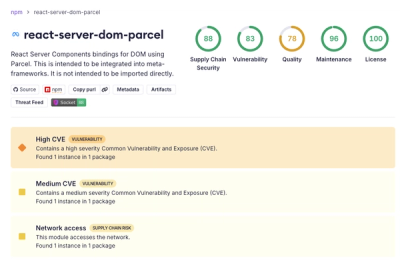
New DoS and source code exposure bugs in React Server Components and Next.js: what’s affected and how to update safely.

Security News
Socket CEO Feross Aboukhadijeh joins Software Engineering Daily to discuss modern software supply chain attacks and rising AI-driven security risks.