

Security News
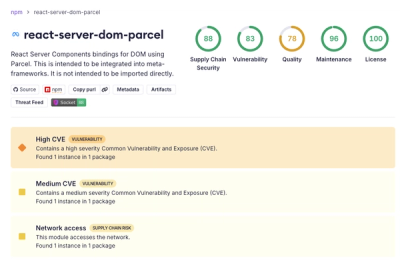
New React Server Components Vulnerabilities: DoS and Source Code Exposure
New DoS and source code exposure bugs in React Server Components and Next.js: what’s affected and how to update safely.
By Sarah Gooding - Dec 12, 2025
ops-scenario
Advanced tools
Python library providing a state-transition testing API for Operator Framework charms.
ops-scenario is a Python library that provides state-transition testing for
Ops charms. These tests are higher level than
typical unit tests, but run at similar speeds and are the recommended approach
for testing charms within requiring a full Juju installation.
Test are written in the arrange/act/assert pattern, arranging an object representing the current Juju state, acting by emulating an event from Juju, and then asserting on the (simulated) output Juju state.
Here's a test that verifies that a unit is active after the start event, with a very minimal initial state:
from ops import testing

# 'src/charm.py' typically contains the charm class.
from charm import MyCharm

def test_start():
    ctx = testing.Context(MyCharm)
    state_in = testing.State()
    state_out = ctx.run(ctx.on.start(), state_in)
    assert state_out.unit_status == testing.ActiveStatus()
More comprehensive tests will include relations, containers, secrets, and other components in the input state, and assertions against both the output state and the context. The 'act' stage remains a simple single call, although additional arguments may be required for the event, such as the relation or container that triggered it. For example:
import pytest
from ops import testing

from charm import MyCharm

@pytest.mark.parametrize(
    'leader',
    [pytest.param(True, id='leader'), pytest.param(False, id='non-leader')],
)
def test_(leader: bool):
    # Arrange:
    ctx = testing.Context(MyCharm)
    relation = testing.Relation('db', local_app_data={'hostname': 'example.com'})
    peer_relation = testing.PeerRelation('peer')
    container = testing.Container('workload', can_connect=True)
    relation_secret = testing.Secret({'certificate': 'xxxxxxxx'})
    user_secret = testing.Secret({'username': 'admin', 'password': 'xxxxxxxx'})
    config = {'port': 8443, 'admin-credentials': 'secret:1234'}
    state_in = testing.State(
        leader=leader,
        config=config,
        relations={relation, peer_relation},
        containers={container},
        secrets={relation_secret, user_secret},
        unit_status=testing.BlockedStatus(),
        workload_version='1.0.1',
    )

    # Act:
    state_out = ctx.run(ctx.on.relation_changed(relation), state_in)

    # Assert:
    assert testing.JujuLogLine(level='INFO', message='Distributing secret.') in ctx.juju_log
    peer_relation_out = state_out.get_relation(peer_relation.id)
    assert peer_relation_out.peers_data[0] == {'secret_id': relation_secret.id}
You don't have to use pytest for your charm tests, but it's what we recommend.
pytest's assert-based approach is a straightforward way to write tests, and
its fixtures are helpful for structuring setup and teardown.
For charm tests, install the testing framework by adding the testing extra of
ops in your unit testing environment. For example, in pyproject.toml:
[dependency-groups]
test = ['ops[testing]<4.0']
Ops checks if ops-scenario is installed, and, if so, makes the classes
(such as Context, State, and Relation) available in the ops.testing
namespace. Use from ops import testing rather than importing the scenario
package.
ops-scenario supports the same platforms and Python versions as ops itself.
testing object works. These
docs are also available via the standard Python help() functionality and in
your IDE.ops-scenario is a member of the Charming family. It's an open source project
that warmly welcomes community contributions, suggestions, fixes and
constructive feedback.
Anyone can contribute to ops and ops-scenario. It's best to start by
opening an issue with a clear
description of the problem or feature request, but you can also
open a pull request directly.
Read our guide for more details on how to work on and
contribute to ops-scenario.
Currently, releases of ops-scenario are done in lockstep with releases of ops
itself, with matching minor and bugfix release numbers. The ops documentation
outlines how to create a new release.
FAQs
Python library providing a state-transition testing API for Operator Framework charms.
We found that ops-scenario demonstrated a healthy version release cadence and project activity because the last version was released less than a year ago. It has 4 open source maintainers collaborating on the project.
Did you know?

Socket for GitHub automatically highlights issues in each pull request and monitors the health of all your open source dependencies. Discover the contents of your packages and block harmful activity before you install or update your dependencies.
Security News
New DoS and source code exposure bugs in React Server Components and Next.js: what’s affected and how to update safely.

Security News
Socket CEO Feross Aboukhadijeh joins Software Engineering Daily to discuss modern software supply chain attacks and rising AI-driven security risks.
Security News
GitHub has revoked npm classic tokens for publishing; maintainers must migrate, but OpenJS warns OIDC trusted publishing still has risky gaps for critical projects.