


Security News
Deno 2.6 + Socket: Supply Chain Defense In Your CLI
Deno 2.6 introduces deno audit with a new --socket flag that plugs directly into Socket to bring supply chain security checks into the Deno CLI.
By Sarah Gooding - Dec 12, 2025
oracledb
Advanced tools
The python-oracledb driver is the widely used, open-source Python extension module allowing Python programs to connect directly to Oracle Database with no extra libraries needed. The module is built with Cython for safety and speed. It is lightweight and high-performance. It is stable, well tested, and has comprehensive documentation. The module is maintained by Oracle.
The module conforms to the Python Database API 2.0 specification with a considerable number of additions and a couple of minor exclusions, see the feature list. It is used by many Python frameworks, SQL generators, ORMs, and libraries.
Python-oracledb has a rich feature set which is easy to use. It gives you control over SQL and PL/SQL statement execution; for working with data frames; for fast data ingestion; for calling NoSQL-style document APIs; for message queueing; for receiving database notifications; and for starting and stopping the database. It also has high availability and security features. Synchronous and concurrent coding styles are supported. Database operations can optionally be pipelined.
Python-oracledb is the successor to the now obsolete cx_Oracle driver.
Run:
python -m pip install oracledb --upgrade
See python-oracledb Installation for details.
Examples can be found in the /samples directory and the Python and Oracle Database Tutorial.
A basic example:
import oracledb
import getpass

un = "scott"                  # Sample database username
cs = "localhost/orclpdb"      # Sample database connection string
# cs = "localhost/freepdb1"   # For Oracle Database Free users
# cs = "localhost/orclpdb1"   # Some databases may have this service
pw = getpass.getpass(f"Enter password for {un}@{cs}: ")

with oracledb.connect(user=un, password=pw, dsn=cs) as connection:
    with connection.cursor() as cursor:
        sql = "select sysdate from dual"
        for r in cursor.execute(sql):
            print(r)
Python versions 3.9 through 3.14.
Pre-built packages are available on PyPI and other repositories.
Source code is also available.
Previous versions of python-oracledb supported older Python versions.
Oracle Client libraries are optional.
Thin mode: By default python-oracledb runs in a 'Thin' mode which connects directly to Oracle Database.
Thick mode: Some advanced Oracle Database functionality is currently only available when optional Oracle Client libraries are loaded by python-oracledb. Libraries are available in the free Oracle Instant Client packages. Python-oracledb can use Oracle Client libraries versions 11.2 through 23, inclusive.
Oracle Database
Thin mode: Oracle Database 12.1 (or later) is required.
Thick mode: Oracle Database 9.2 (or later) is required, depending on the Oracle Client library version. Oracle Database's standard client-server version interoperability allows connection to both older and newer databases. For example when python-oracledb uses Oracle Client 19 libraries, then it can connect to Oracle Database 11.2 or later.
See the python-oracledb Documentation and Release Notes.
Questions can be asked in GitHub Discussions.
Problem reports can be raised in GitHub Issues.
See /tests
This project welcomes contributions from the community. Before submitting a pull request, please review our contribution guide.
Please consult the security guide for our responsible security vulnerability disclosure process.
See LICENSE, THIRD_PARTY_LICENSES, and NOTICE.
FAQs
Python interface to Oracle Database
We found that oracledb demonstrated a healthy version release cadence and project activity because the last version was released less than a year ago. It has 2 open source maintainers collaborating on the project.
Did you know?

Socket for GitHub automatically highlights issues in each pull request and monitors the health of all your open source dependencies. Discover the contents of your packages and block harmful activity before you install or update your dependencies.
Security News
Deno 2.6 introduces deno audit with a new --socket flag that plugs directly into Socket to bring supply chain security checks into the Deno CLI.
Security News
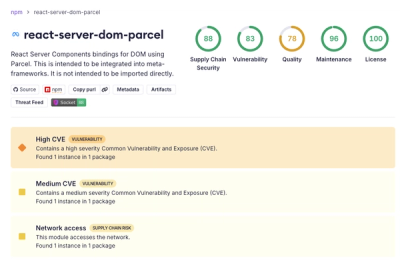
New DoS and source code exposure bugs in React Server Components and Next.js: what’s affected and how to update safely.

Security News
Socket CEO Feross Aboukhadijeh joins Software Engineering Daily to discuss modern software supply chain attacks and rising AI-driven security risks.