

Security News
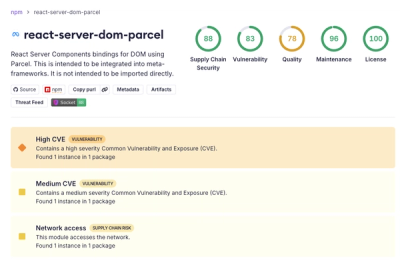
New React Server Components Vulnerabilities: DoS and Source Code Exposure
New DoS and source code exposure bugs in React Server Components and Next.js: what’s affected and how to update safely.
By Sarah Gooding - Dec 12, 2025
ormlambda
Advanced tools
ORM designed to interact with the database (currently with MySQL) using lambda functions and nested functions



This ORM is designed to connect with a MySQL server, facilitating the management of various database queries. Built with flexibility and efficiency in mind, this ORM empowers developers to interact with the database using lambda functions, allowing for concise and expressive query construction.
from decouple import config
from ormlambda.databases.my_sql import MySQLRepository
USERNAME = config("USERNAME")
PASSWORD = config("PASSWORD")
HOST = config("HOST")
database = MySQLRepository(user=USERNAME, password=PASSWORD, database="sakila", host=HOST)
from ormlambda import ORM
from ormlambda import create_engine

from models.address import Address
from test.config import config_dict

db = create_engine('mysql://root:1234@localhost:3306/sakila')

AddressModel = ORM(Address, db)

result = AddressModel.select()
The result var will be of type tuple[Address, ...]
For those cases where you need to pass the database configuration from a dict, you can use MySQLArgs TypedDict object to improve type annotations.
from ormlambda.databases.my_sql.types import MySQLArgs

config_dict: MySQLArgs = {
    "user": DB_USERNAME,
    "password": DB_PASSWORD,
    "host": DB_HOST,
    "database": DB_DATABASE,
}
db = MySQLRepository(**config_dict)
Once the AddressModel class is created, we will not only be able to access all the information in that table, but also all the information in all the tables that have foreign keys related to it."
from models.address import Address
from ormlambda import create_engine, ORM

db = create_engine('mysql://root:1234@localhost:3306/sakila')


AddressModel = ORM(Address, db)

result = AddressModel.where(lambda x: x.City.Country.country.regex(r"^[aA]")).select(
    lambda address: (
        address,
        address.City,
        address.City.Country,
    ),
)
The result var will be of type tuple[tuple[Address], tuple[City], tuple[Country]].
If we were used select_one method, we retrieved tuple[Address, City, Country].
where conditionWe can use lambda function that returns an iterable to pass the iterable like.
result = AddressModel.where(
    lambda x: [
        x.address_id >= 10,
        x.address_id <= 30,
    ]
).select()
Additionally, we can filter by others tables. For example, we can return all addresses for each city where country_id = 87 (Spain)
result = AddressModel.where(lambda x: x.City.Country.country_id == 87).select()
We can also return Address, City or Country if needed.
result = AddressModel.where(lambda x: x.City.Country.country_id == 87).select(lambda x: (x, x.City, x.City.Country))
where methodLOWER = 10
UPPER = 30
AddressModel.where(lambda x:
[
x.address_id >= LOWER,
x.address_id <= UPPER,
]
).select()
The easiest way to add or delete data in your database is by using its appropiate methods. You just need to instantiate an object with the data and pass it to the method
address = Address(address_id=1, address="C/ ...", phone="XXXXXXXXX", postal_code="28026")

AddressModel.insert(address)
You can use either the properties of the same object or str values.
AddressModel.where(lambda x: x.address_id == 1).update(
    {
        Address.phone: "YYYYYYYYY",
        Address.postal_code: "28030",
    }
)

AddressModel.where(lambda x: x.address_id == 1).update(
    {
        "phone": "YYYYYYYYY",
        "postal_code": "28030",
    }
)
AddressModel.where(lambda x: x.address_id == 1).delete()
The most important aspect when creating classes to map database tables is to consider the importance of typing the variables that should behave as columns. In other words, variables that are typed will be those that are passed to the class constructor. This is why both __table_name__ and variables that reference foreign classes, are not given a specific data tpye.
For example, imagine you have three Table in your database: Addres, City and Country. Each of them has its own Foreing keys.
Address has a FK relationship with City.
City has a FK relationship with Country.
The easiest way to map your tables is:
from datetime import datetime
from ormlambda import (
    Table,
    Column,
    ForeignKey,
)

class Country(Table):
    __table_name__ = "country"

    country_id: Column[int] = Column(int, is_primary_key=True)
    country: Column[str]
    last_update: Column[datetime]


class City(Table):
    __table_name__ = "city"

    city_id: Column[int] = Column(int, is_primary_key=True)
    city: Column[str]
    country_id: Column[int]
    last_update: Column[datetime]

    Country = ForeignKey["City", Country](Country, lambda ci, co: ci.country_id == co.country_id)


class Address(Table):
    __table_name__ = "address"

    address_id: Column[int] = Column(int, is_primary_key=True)
    address: Column[str]
    address2: Column[str]
    district: Column[str]
    city_id: Column[int]
    postal_code: Column[str]
    phone: Column[str]
    location: Column[str]
    last_update: Column[datetime] = Column(datetime, is_auto_generated=True)

    City = ForeignKey["Address", City](City, lambda a, c: a.city_id == c.city_id)
We can use various methods such as where, limit, offset, order, etc...
where methodTo retrieve all Address object where the fk reference to the City table, and the fk reference to the Country table have a country_id value greater or equal than 50, ordered in descending order, then:
result = (
    AddressModel
    .order(lambda a: a.address_id, order_type="DESC")
    .where(lambda x: x.City.Country.country_id >= 50)
    .select()
)
Also you can use ConditionType enum for regular expressions and get, for example, all rows from a different table where the Country name starts with A, limited to 100:
response = (
    AddressModel
    .order(lambda x: x.address_id, order_type="DESC")
    .where(lambda x: x.City.Country.country.regex(r"^[A]"))
    .limit(100)
    .select(lambda a: (
            a,
            a.City,
            a.City.Country,
        )
    )
)


for a,c,co in response:
    print(a.address_id)
    print(c.city_id)
    print(co.country)
In the example above, we see that the result var returns a tuple of tuples. However, we can simplify the result var when needed by passing flavour attribute in select method to get a tuple of the specified data type.
result = (
    AddressModel.where(lambda x: x.City.Country.country.regex(r"^[A]"))
    .limit(100)
    .select(lambda a: (
            a.address_id,
            a.City.city_id,
            a.City.Country.country_id,
            a.City.Country.country,
        ),
        flavour=dict,
    )
)
with this approach, we will obtain a dictionary where the key will be the concatenation between the selected table name and the column name specified in the lambda function, to avoid overwritting data from tables that sharing column names.
res = AddressModel.max(lambda x: x.address_id)
res = AddressModel.min(lambda x: x.address_id)
res = AddressModel.sum(lambda x: x.address_id)
res = AddressModel.count(lambda x: x.address_id)
The concat method allows you to concatenate multiple columns or values into a single string. This is particularly useful for creating derived fields in your queries.
response = (
    ORM(Address, db)
    .where(lambda x: x.City.Country.country.regex(r"^Spain"))
    .first(
        lambda x: (
            x.address,
            x.City.city,
            Concat(("Address: ", x.address, " - city: ", x.City.city, " - country: ", x.City.Country.country)),
        ),
        flavour=dict,
    )
)

{
    "address": "939 Probolinggo Loop",
    "city": "A Coruña (La Coruña)",
    "concat": "Address: 939 Probolinggo Loop - city: A Coruña (La Coruña) - country: Spain",
}
As you can see in the response, the result is a dictionary where the keys are a combination of the table name and the column name. This is done to avoid collisions with columns from other tables that might have the same name.
Another elegant approach to adjust the response and obtain an object is by using the flavour attribute. You can pass a callable object, which will be used to instantiate it with the returned data.
The groupby method is used to filter results based on aggregate functions.
from ormlambda import Column, ORM, create_engine
from test.config import DATABASE_URL


class Response(BaseModel):
    district: str
    count: int

engine= create_engine(DATABASE_URL)
model = ORM(Address,engine)

res = (
    self.model
    .groupby(lambda x: x.district)
    .select(lambda x:
        (
            x.district,
            Count(x.address),
        ),
        flavour=Response,
    )
)
The having method is used to filter results based on aggregate functions. It is typically used in conjunction with group by clauses.
res = (
    model
    .groupby(lambda x: x.district)
    .having(lambda x: x.count > 4)
    .select(lambda x:
        (
            x.district,
            Count(x.address,alias="count"),
        ),
        flavour=Response,
    )
)
You can utilize BaseModel from Pydantic to create structured response models. This allows you to define the expected structure of your data, ensuring type safety and validation.
You can create a custom response model by subclassing BaseModel. In this model, you define the fields that you expect in your response, along with their types.
class AddressCombine(BaseModel):
    address: str
    city: str
    country: str

    model_config: ConfigDict = {"extra": "forbid"}

db = create_engine('mysql://root:1234@localhost:3306/sakila')

select = (
    ORM(Address, db)
    .order(lambda x: x.City.Country.country, "DESC")
    .limit(10)
    .where(lambda x: x.City.Country.country == "Spain")
    .first(lambda x:
        (
            x.address,
            x.City.city,
            x.City.Country.country,
        ),
        flavour=AddressCombine,
    )
)
Once you execute the query, the result will be an instance of your custom model. You can access the fields directly, ensuring that the data adheres to the structure you defined.
print(select.address)
print(select.city)
print(select.country)
You can also use aggregation methods to create more informative queries.
result = AddressModel.select_one(lambda x: (
                Min(x.address_id),
                Max(x.address_id),
                Count(x.address_id),
            ),flavour=dict
        )
Getting something like
# {
#     "min": 1,
#     "max": 605,
#     "count": 603,
# }
You also can use custom alias for each method
AddressModel.select_one(lambda x:
    (
        Min(x.address_id),
        Max(x.address_id, alias="custom-max"),
        Count(x.address_id),
    ),
    flavour=dict,
)

# {
#     "min": 1,
#     "custom-max": 605,
#     "count": 603,
# }
FAQs
ORM designed to interact with the database (currently with MySQL) using lambda functions and nested functions
We found that ormlambda demonstrated a healthy version release cadence and project activity because the last version was released less than a year ago. It has 1 open source maintainer collaborating on the project.
Did you know?

Socket for GitHub automatically highlights issues in each pull request and monitors the health of all your open source dependencies. Discover the contents of your packages and block harmful activity before you install or update your dependencies.
Security News
New DoS and source code exposure bugs in React Server Components and Next.js: what’s affected and how to update safely.

Security News
Socket CEO Feross Aboukhadijeh joins Software Engineering Daily to discuss modern software supply chain attacks and rising AI-driven security risks.

Security News
GitHub has revoked npm classic tokens for publishing; maintainers must migrate, but OpenJS warns OIDC trusted publishing still has risky gaps for critical projects.