




Security News
Deno 2.6 + Socket: Supply Chain Defense In Your CLI
Deno 2.6 introduces deno audit with a new --socket flag that plugs directly into Socket to bring supply chain security checks into the Deno CLI.
By Sarah Gooding - Dec 12, 2025
parsys-requests-unixsocket
Advanced tools
.. image:: https://badge.fury.io/py/requests-unixsocket.svg :target: https://badge.fury.io/py/requests-unixsocket :alt: Latest Version on PyPI
.. image:: https://github.com/msabramo/requests-unixsocket/actions/workflows/tests.yml/badge.svg :target: https://github.com/msabramo/requests-unixsocket/actions/workflows/tests.yml
Use requests <http://docs.python-requests.org/>_ to talk HTTP via a UNIX domain socket
Explicit ++++++++
You can use it by instantiating a special Session object:
.. code-block:: python
import json

import requests_unixsocket

session = requests_unixsocket.Session()

r = session.get('http+unix://%2Fvar%2Frun%2Fdocker.sock/info')
registry_config = r.json()['RegistryConfig']
print(json.dumps(registry_config, indent=4))
Implicit (monkeypatching) +++++++++++++++++++++++++
Monkeypatching allows you to use the functionality in this module, while making
minimal changes to your code. Note that in the above example we had to
instantiate a special requests_unixsocket.Session object and call the
get method on that object. Calling requests.get(url) (the easiest way
to use requests and probably very common), would not work. But we can make it
work by doing monkeypatching.
You can monkeypatch globally:
.. code-block:: python
import requests_unixsocket

requests_unixsocket.monkeypatch()

r = requests.get('http+unix://%2Fvar%2Frun%2Fdocker.sock/info')
assert r.status_code == 200
or you can do it temporarily using a context manager:
.. code-block:: python
import requests_unixsocket

with requests_unixsocket.monkeypatch():
    r = requests.get('http+unix://%2Fvar%2Frun%2Fdocker.sock/info')
    assert r.status_code == 200
Abstract namespace sockets ++++++++++++++++++++++++++
To connect to an abstract namespace socket <https://utcc.utoronto.ca/~cks/space/blog/python/AbstractUnixSocketsAndPeercred>_
(Linux only), prefix the name with a NULL byte (i.e.: \0) - e.g.:
.. code-block:: python
import requests_unixsocket

session = requests_unixsocket.Session()
res = session.get('http+unix://\0test_socket/get')
print(res.text)
For an example program that illustrates this, see
examples/abstract_namespace.py in the git repo. Since abstract namespace
sockets are specific to Linux, the program will only work on Linux.
HTTPie <https://httpie.org/>_ that allows you to interact with UNIX domain socketsFAQs
Use requests to talk HTTP via a UNIX domain socket
We found that parsys-requests-unixsocket demonstrated a healthy version release cadence and project activity because the last version was released less than a year ago. It has 1 open source maintainer collaborating on the project.
Did you know?

Socket for GitHub automatically highlights issues in each pull request and monitors the health of all your open source dependencies. Discover the contents of your packages and block harmful activity before you install or update your dependencies.
Security News
Deno 2.6 introduces deno audit with a new --socket flag that plugs directly into Socket to bring supply chain security checks into the Deno CLI.
Security News
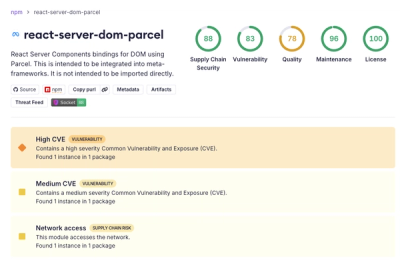
New DoS and source code exposure bugs in React Server Components and Next.js: what’s affected and how to update safely.

Security News
Socket CEO Feross Aboukhadijeh joins Software Engineering Daily to discuss modern software supply chain attacks and rising AI-driven security risks.