


Product
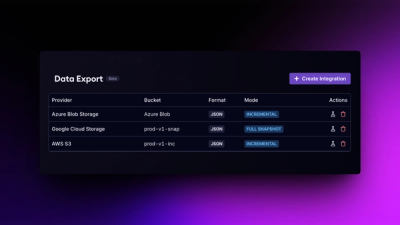
Introducing Data Exports
Export Socket alert data to your own cloud storage in JSON, CSV, or Parquet, with flexible snapshot or incremental delivery.
By Ola Adekola - Apr 23, 2026
pymaybe
Advanced tools
.. image:: https://travis-ci.org/ekampf/pymaybe.svg?branch=master :target: https://travis-ci.org/ekampf/pymaybe
.. image:: https://coveralls.io/repos/ekampf/pymaybe/badge.svg?branch=master&service=github :target: https://coveralls.io/github/ekampf/pymaybe?branch=master
.. image:: https://img.shields.io/pypi/v/pymaybe.svg :target: https://pypi.python.org/pypi/pymaybe
A Python implementation of the Maybe pattern.
::
pip install pymaybe
::
from pymaybe import maybe
first_name = maybe(deep_hash)['account']['user_profile']['first_name'].or_else("<unknown>")
Maybe monad is a programming pattern that allows to treat None values that same way as non-none values. This is done by wrapping the value, which may or may not be None to, a wrapper class.
The implementation includes two classes: Maybe and Something. Something represents a value while Nothing represents a None value. There's also a method maybe which wraps a regular value and and returns Something or Nothing instance.
::
>>> maybe("I'm a value")
"I'm a value"

>>> maybe(None);
None
Both Something and Nothing implement 4 methods allowing you to test their real value: is_some, is_none, get and or_else
::
>>> maybe("I'm a value").is_some()
True

>>> maybe("I'm a value").is_none()
False

>>> maybe(None).is_some()
False

>>> maybe(None).is_none()
True

>>> maybe("I'm a value").get()
"I'm a value"

>>> maybe("I'm a value").or_else(lambda: "No value")
"I'm a value"

>>> maybe(None).get()
Traceback (most recent call last):
...
Exception: No such element

>>> maybe(None).or_else(lambda: "value")
'value'

>>> maybe(None).or_else("value")
'value'
In addition, Something and Nothing implement the Python magic methods allowing you to treat them as dictionaries:
:: >>> nested_dict = maybe(nested_dict) >>> nested_dict['store']['name'] 'MyStore'
>>> nested_dict['store']['address']
None

>>> nested_dict['store']['address']['street'].or_else('No Address Specified')
'No Address Specified'
All other method calls on Something are forwarded to its real value:
::
>>> maybe('VALUE').lower()
'value'

>>> maybe(None).invalid().method().or_else('unknwon')
'unknwon'
The Maybe pattern helps you avoid nasty try..except blocks. Consider the following code:
:: try: url = rss.load_feeds()[0].url.domain except (TypeError, IndexError, KeyError, AttributeError): url = "planetpython.org"
With Maybe you could simply do:
::
url = maybe(rss).load_feeds()[0]['url'].domain.or_else("planetpython.org")
Getting the current logged in user's name. Without maybe:
::
def get_user_zipcode():
    address = getattr(request.user, 'address', None)
    if address:
        return getattr(address, 'zipcode', '')

    return ''
With maybe:
::
def get_user_zipcode():
    return maybe(request.user).address.zipcode.or_else('')
Option (Scala) <http://www.scala-lang.org/api/current/scala/Option.html>_Maybe (Java) <https://github.com/npryce/maybe-java>_Maybe pattern (Python recipe) <http://code.activestate.com/recipes/577248-maybe-pattern/>_Data.Maybe (Haskell) <http://www.haskell.org/ghc/docs/latest/html/libraries/base/Data-Maybe.html>_Maybe (Ruby) <https://github.com/bhb/maybe>_Copyright 2015 - Eran Kampf <http://www.developerzen.com>_
GitHub <http://www.github.com/ekampf/pymaybe>_FAQs
A Python implementation of the Maybe pattern.
We found that pymaybe demonstrated a healthy version release cadence and project activity because the last version was released less than a year ago. It has 1 open source maintainer collaborating on the project.
Did you know?

Socket for GitHub automatically highlights issues in each pull request and monitors the health of all your open source dependencies. Discover the contents of your packages and block harmful activity before you install or update your dependencies.
Product
Export Socket alert data to your own cloud storage in JSON, CSV, or Parquet, with flexible snapshot or incremental delivery.
Research
/Security News
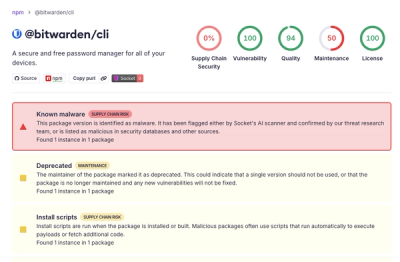
Bitwarden CLI 2026.4.0 was compromised in the Checkmarx supply chain campaign after attackers abused a GitHub Action in Bitwarden’s CI/CD pipeline.

Research
/Security News
Docker and Socket have uncovered malicious Checkmarx KICS images and suspicious code extension releases in a broader supply chain compromise.