


Security News
Deno 2.6 + Socket: Supply Chain Defense In Your CLI
Deno 2.6 introduces deno audit with a new --socket flag that plugs directly into Socket to bring supply chain security checks into the Deno CLI.
By Sarah Gooding - Dec 12, 2025
pymoca
Advanced tools

A Modelica to computer algebra system (CAS) translator written in Python.


Pymoca can be used in applications that need to translate Modelica mathematical models into other forms. Pymoca can "flatten" a model containing a connected set of components defined by object-oriented Modelica classes into a set of variables and simultaneous equations that are easier to further process for analysis or simulation. It is particularly suited to provide Modelica models in symbolic form to computer algebra systems. A common use in this context is to provide differential and algebraic equations for use in optimal control problems. Pymoca can translate Modelica to CasADi, SymPy, and ModelicaXML, but most development and usage has been with CasADi.
For parser support without backend dependencies:
pip install pymoca
Other options are:
pip install "pymoca[casadi]"    # CasADi backend dependencies
pip install "pymoca[sympy]"     # SymPy backend dependencies
pip install "pymoca[lxml]"      # ModelicaXML backend dependencies

pip install "pymoca[examples]"  # To run Jupyter notebook examples in the repo

pip install "pymoca[all]"       # All of the above
Pymoca reads and understands Modelica code (pymoca.parser) and provides access to an internal representation of the code called an Abstract Syntax Tree or AST (pymoca.ast). The AST is further processed to generate output in various formats (pymoca.backends). The pymoca.tree module provides functionality to transform the AST into a form that can be more easily used by the backends to generate the target output. In particular, pymoca.tree provides classes and functions to convert a hierarchical, object-oriented Modelica model of connected components into a "flat" system of equations and associated variables, parameters, and constants. Pymoca error checking is not always complete or easy to understand, so it is better to develop the Modelica code with other tools and then use Pymoca for translation.
The test suite contains examples showing how to use Pymoca and the subset of Modelica that it currently supports.
Here is an example using a simple spring and damper model from the test suite:
from pprint import pprint

import pymoca.parser
import pymoca.backends.casadi.generator as casadi_backend


MODELICA_MODEL = """
model Spring
    Real x, v_x;
    parameter Real c = 0.1;
    parameter Real k = 2;
equation
    der(x) = v_x;
    der(v_x) = -k*x - c*v_x;
end Spring;
"""

print("Modelica Model:\n", MODELICA_MODEL)

print("\nEquations from the parsed AST in a JSON representation:")
ast = pymoca.parser.parse(MODELICA_MODEL)
pprint(ast.to_json(ast.classes["Spring"].equations))

print("\nGenerated CasADi model:")
casadi_model = casadi_backend.generate(ast, "Spring")
print(casadi_model)
Some more interesting examples are in Jupyter notebooks:
See the GitHub Projects for plans. In particular, see the Info Panel in the Modelica Flattening project for an overview of a project getting some current focus. Breaking API changes are expected.
FAQs
A Modelica to computer algebra system (CAS) translator.
We found that pymoca demonstrated a healthy version release cadence and project activity because the last version was released less than a year ago. It has 5 open source maintainers collaborating on the project.
Did you know?

Socket for GitHub automatically highlights issues in each pull request and monitors the health of all your open source dependencies. Discover the contents of your packages and block harmful activity before you install or update your dependencies.
Security News
Deno 2.6 introduces deno audit with a new --socket flag that plugs directly into Socket to bring supply chain security checks into the Deno CLI.
Security News
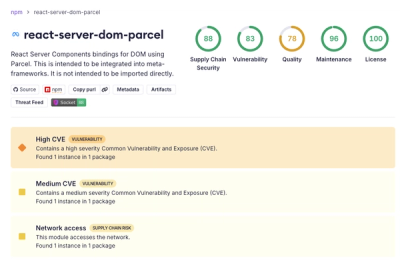
New DoS and source code exposure bugs in React Server Components and Next.js: what’s affected and how to update safely.

Security News
Socket CEO Feross Aboukhadijeh joins Software Engineering Daily to discuss modern software supply chain attacks and rising AI-driven security risks.