


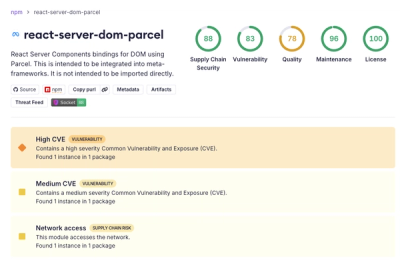
Security News
New React Server Components Vulnerabilities: DoS and Source Code Exposure
New DoS and source code exposure bugs in React Server Components and Next.js: what’s affected and how to update safely.
By Sarah Gooding - Dec 12, 2025
quickchart-io
Advanced tools


A Python client for the quickchart.io image charts web service.
Use the quickchart.py library in this project, or install through pip:
pip install quickchart.io
This library provides a QuickChart class. Import and instantiate it. Then set properties on it and specify a Chart.js config:
from quickchart import QuickChart

qc = QuickChart()
qc.width = 500
qc.height = 300
qc.config = {
    "type": "bar",
    "data": {
        "labels": ["Hello world", "Test"],
        "datasets": [{
            "label": "Foo",
            "data": [1, 2]
        }]
    }
}
Use get_url() on your quickchart object to get the encoded URL that renders your chart:
print(qc.get_url())
# https://quickchart.io/chart?c=%7B%22chart%22%3A+%7B%22type%22%3A+%22bar%22%2C+%22data%22%3A+%7B%22labels%22%3A+%5B%22Hello+world%22%2C+%22Test%22%5D%2C+%22datasets%22%3A+%5B%7B%22label%22%3A+%22Foo%22%2C+%22data%22%3A+%5B1%2C+2%5D%7D%5D%7D%7D%7D&w=600&h=300&bkg=%23ffffff&devicePixelRatio=2.0&f=png
If you have a long or complicated chart, use get_short_url() to get a fixed-length URL using the quickchart.io web service (note that these URLs only persist for a short time unless you have a subscription):
print(qc.get_short_url())
# https://quickchart.io/chart/render/f-a1d3e804-dfea-442c-88b0-9801b9808401
The URLs will render an image of a chart:
Chart.js sometimes relies on Javascript functions (e.g. for formatting tick labels). There are a couple approaches:
examples/simple_example_with_function.py.QuickChartFunction class. See examples/using_quickchartfunction.py for a full example.A short example using QuickChartFunction:
qc = QuickChart()
qc.config = {
    "type": "bar",
    "data": {
        "labels": ["A", "B"],
        "datasets": [{
            "label": "Foo",
            "data": [1, 2]
        }]
    },
    "options": {
        "scales": {
            "yAxes": [{
                "ticks": {
                    "callback": QuickChartFunction('(val) => val + "k"')
                }
            }],
            "xAxes": [{
                "ticks": {
                    "callback": QuickChartFunction('''function(val) {
                      return val + '???';
                    }''')
                }
            }]
        }
    }
}

print(qc.get_url())
You can set the following properties:
The actual Chart.js chart configuration.
Width of the chart image in pixels. Defaults to 500
Height of the chart image in pixels. Defaults to 300
Format of the chart. Defaults to png. svg is also valid.
The background color of the chart. Any valid HTML color works. Defaults to #ffffff (white). Also takes rgb, rgba, and hsl values.
The device pixel ratio of the chart. This will multiply the number of pixels by the value. This is usually used for retina displays. Defaults to 1.0.
The version of Chart.js to use. Acceptable values are documented here. Usually used to select Chart.js 3+.
Override the host of the chart render server. Defaults to quickchart.io.
Set an API key that will be included with the request.
There are two ways to get a URL for your chart object.
Returns a URL that will display the chart image when loaded.
Uses the quickchart.io web service to create a fixed-length chart URL that displays the chart image. Returns a URL such as https://quickchart.io/chart/render/f-a1d3e804-dfea-442c-88b0-9801b9808401.
Note that short URLs expire after a few days for users of the free service. You can subscribe to keep them around longer.
Returns the bytes representing the chart image.
Writes the chart image to a file path.
Checkout the examples directory to see other usage.
FAQs
A client for quickchart.io, a service that generates static chart images
We found that quickchart-io demonstrated a healthy version release cadence and project activity because the last version was released less than a year ago. It has 1 open source maintainer collaborating on the project.
Did you know?

Socket for GitHub automatically highlights issues in each pull request and monitors the health of all your open source dependencies. Discover the contents of your packages and block harmful activity before you install or update your dependencies.
Security News
New DoS and source code exposure bugs in React Server Components and Next.js: what’s affected and how to update safely.

Security News
Socket CEO Feross Aboukhadijeh joins Software Engineering Daily to discuss modern software supply chain attacks and rising AI-driven security risks.
Security News
GitHub has revoked npm classic tokens for publishing; maintainers must migrate, but OpenJS warns OIDC trusted publishing still has risky gaps for critical projects.