


Security News
Deno 2.6 + Socket: Supply Chain Defense In Your CLI
Deno 2.6 introduces deno audit with a new --socket flag that plugs directly into Socket to bring supply chain security checks into the Deno CLI.
By Sarah Gooding - Dec 12, 2025
rdbmpy
Advanced tools
rdbmpy is a lightweight CLI tool to create, apply and rollback SQL migration files across multiple databases (PostgreSQL, MySQL, SQLite and SQL Server).
It works with plain SQL files (no ORM required). Each migration file should contain an UP section (applied) and a DOWN section (rollback), separated by the marker =====DOWN.
pymssql) might need additional build steps.Note for builds on Python 3.8 (when necessary):
Before installing dependencies, create and activate a virtualenv and pre-install compatible build dependencies:
python3 -m venv .venv
. .venv/bin/activate
pip install --upgrade pip setuptools wheel
# pre-install a compatible setuptools_scm required by some build backends
pip install "setuptools_scm[toml]>=5.0,<9.0"
pip install -r requirements.txt
This step avoids conflicts such as setuptools_scm==9.2.2 is incompatible with setuptools_scm[toml]>=5.0,<9.0 that can occur when building packages from sdist.
Install from PyPI:
pip install rdbmpy
Initialize a project (creates migrations/ and the migrations table in the DB):
rdbmpy setup --driver pgsql --dbstring="user:password@localhost:5432/mydb"
Create a migration:
rdbmpy create --driver pgsql --migration_name add_users_table
Edit the file under migrations/ and add your UP SQL, then =====DOWN and the rollback SQL.
Apply pending migrations:
rdbmpy exec --driver pgsql --dbstring="user:password@localhost:5432/mydb"
Rollback a migration (provide the migration file name or identifier):
rdbmpy rollback --driver pgsql --migration_name=20251208113351_add_users_table --dbstring="user:password@localhost:5432/mydb"
You can provide your connection string either with the environment variable DATABASE_MIGRATION_URL or with --dbstring on each command.
Environment variable example:
export DATABASE_MIGRATION_URL="user:password@localhost:5432/mydb"
Or use a .env file in your project root:
DATABASE_MIGRATION_URL=user:password@localhost:5432/mydb
--dbstring takes precedence for the single command invocation.
rdbmpy setup --driver <driver> [--dbstring] — create migrations/ and ensure the migrations table exists.rdbmpy create --driver <driver> --migration_name <name> — create a new migration file.rdbmpy exec|execute --driver <driver> [--dbstring] — apply all pending migrations.rdbmpy rollback --driver <driver> --migration_name <name> [--dbstring] — execute the DOWN section for the specified migration.Notes:
--driver must be one of pgsql, mysql, sqlite, sqlserver.--migration_name is required for create and rollback. It is not used by exec.PostgreSQL
# create
rdbmpy create --driver pgsql --migration_name add_users_table --dbstring="user:password@localhost:5432/testdb"

# exec
rdbmpy exec --driver pgsql --dbstring="user:password@localhost:5432/testdb"

# rollback
rdbmpy rollback --driver pgsql --migration_name=20251208113351_add_users_table --dbstring="user:password@localhost:5432/testdb"
MySQL
# create
rdbmpy create --driver mysql --migration_name add_users_table --dbstring="user:password@localhost:3306/testdb"

# exec
rdbmpy exec --driver mysql --dbstring="user:password@localhost:3306/testdb"

# rollback
rdbmpy rollback --driver mysql --migration_name=20251208120251_add_users_table --dbstring="user:password@localhost:3306/testdb"
SQL Server
# create
rdbmpy create --driver sqlserver --migration_name add_users_table --dbstring="sa:Your_password123@localhost:1433/testdb"

# exec
rdbmpy exec --driver sqlserver --dbstring="sa:Your_password123@localhost:1433/testdb"

# rollback
rdbmpy rollback --driver sqlserver --migration_name=20251208121019_add_users_table --dbstring="sa:Your_password123@localhost:1433/testdb"
SQLite (file)
# create
rdbmpy create --driver sqlite --migration_name add_users_table --dbstring="/absolute/path/to/sqlite.db"

# exec
rdbmpy exec --driver sqlite --dbstring="/absolute/path/to/sqlite.db"

# rollback
rdbmpy rollback --driver sqlite --migration_name=20251208120000_add_users_table --dbstring="/absolute/path/to/sqlite.db"
Use =====DOWN to separate apply/rollback parts. The UP section is applied; the DOWN section is used for rollback.
Example migration file:
-- UP
CREATE TABLE users (
    id SERIAL PRIMARY KEY,
    name VARCHAR(100)
);

=====DOWN

DROP TABLE users;
If you use SQL Server, install the Microsoft ODBC driver and pyodbc (requires system packages):
# Add Microsoft GPG key to a keyring
curl https://packages.microsoft.com/keys/microsoft.asc | gpg --dearmor | sudo tee /usr/share/keyrings/microsoft.gpg > /dev/null

# Add Microsoft package source and reference the keyring
curl https://packages.microsoft.com/config/ubuntu/$(lsb_release -rs)/prod.list | sudo tee /etc/apt/sources.list.d/mssql-release.list
sudo sed -i 's|deb |deb [signed-by=/usr/share/keyrings/microsoft.gpg] |' /etc/apt/sources.list.d/mssql-release.list

sudo apt-get update
sudo ACCEPT_EULA=Y apt-get install -y msodbcsql18 unixodbc-dev

# Install pyodbc via extra
pip install rdbmpy[sqlserver]
--dbstring format or DATABASE_MIGRATION_URL value.msodbcsql18 and unixodbc-dev are installed and pyodbc is available in your Python environment.Contributions are welcome. Open an issue or submit a PR. Add tests for new features and follow existing code style.
See LICENSE.txt.
Forked from py-migrate-db
FAQs
A Python package for managing database migrations with PostgreSQL, MySQL, and SQL Server
We found that rdbmpy demonstrated a healthy version release cadence and project activity because the last version was released less than a year ago. It has 1 open source maintainer collaborating on the project.
Did you know?

Socket for GitHub automatically highlights issues in each pull request and monitors the health of all your open source dependencies. Discover the contents of your packages and block harmful activity before you install or update your dependencies.
Security News
Deno 2.6 introduces deno audit with a new --socket flag that plugs directly into Socket to bring supply chain security checks into the Deno CLI.
Security News
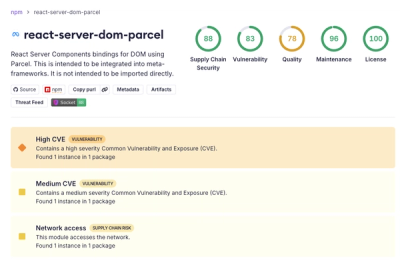
New DoS and source code exposure bugs in React Server Components and Next.js: what’s affected and how to update safely.

Security News
Socket CEO Feross Aboukhadijeh joins Software Engineering Daily to discuss modern software supply chain attacks and rising AI-driven security risks.