



Security News
Deno 2.6 + Socket: Supply Chain Defense In Your CLI
Deno 2.6 introduces deno audit with a new --socket flag that plugs directly into Socket to bring supply chain security checks into the Deno CLI.
By Sarah Gooding - Dec 12, 2025
ret
Advanced tools
A pure-python command-line regular expression tool for stream filtering, extracting, and parsing.
.. image:: https://codecov.io/gh/ThatXliner/ret/branch/master/graph/badge.svg?token=6B5AWYTL1O :target: https://codecov.io/gh/ThatXliner/ret
A pure-python command-line regular expression tool for stream filtering, and extracting, designed to be minimal with an intuitive command-line interface.
You can install this via
.. code-block:: bash
$ python3 -m pip install ret
✨🍰✨
or using pipx
.. code-block:: bash
$ pipx install ret
✨🍰✨
Ret is pure python (tested on python 3.6+) with no dependencies.
That way, you can get a clean uninstall.
.. note::
If you want to install the bleeding edge version of ret, right when it gets pushed to master, see `here <https://github.com/ThatXliner/ret/blob/master/CONTRIBUTING.md#development-installation>`_ for instructions.
Example
You can use ``ret`` to extract text via regex capture groups:

.. code-block:: bash

    $ git branch
    * master
    $ git branch | ret "\* (\w+)" s --group 1
    master

...finding all occurrences of a pattern:

.. code-block:: bash

    $ ls | ret ".*\.py" findall
    foo.py
    bar.py

and even all occurrences of a pattern **with capture groups**:

.. code-block:: bash

    $ ls | ret "(.*)\.py" findall --group 1
    foo
    bar


While those may seem untypical use cases, I have found myself using ``Ret`` countless times.

Here's a one-liner for uninstalling unnecessary stuff for ``pip``:

.. code-block:: bash

   $ pip list --not-required | ret ".+\n.+\n((?:\n|.)+)" f -g 1 | ret "([^\s]+)\s+.+\n" f -g 1 | xargs pip uninstall --yes


Another case
Imagine this: you have just downloaded a bunch of tarballs, and have ran
.. code-block:: bash
for x in $(grep ".+.tar.gz"); do tar -xzf $x; done
Now you just want to cd into all of the extracted files, run :code:./configure && make && make install.
You could use ret to get the names of the extracted files, just from the tarballs' names. Like this:
.. code-block:: bash
$ ls | grep ".+.tar.gz" foo.tar.gz bar.tar.gz foobar.tar.gz extractme.tar.gz
$ ls | ret "(.+).tar.gz" f -g 1 foo bar foobar extractme
and with that combined, we can do
.. code-block:: bash
$ for x in (ls | ret "(.+).tar.gz" f -g 1); do { cd $x && ./configure && make && make install && cd -}; done ✨🍰✨
A life saver.
And remember, this is python regex: a very powerful regular expression engine.
The possibilities of usage are endless.
Demonstration
.. image:: https://raw.githubusercontent.com/ThatXliner/ret/master/assets/demo.svg
   :alt: Demonstration photo


Background
-------------
I love ``grep``. But grep isn't really for text extraction.

For example, you cannot extract regexes via capture groups.

Since I wanted that functionality, I decided to build this, ``Ret``.

Why the name?
Ret is an acronym for r\ egular e\ xpression t\ ool.
Why it can't replace grep
``Ret`` originally was designed to provide some features ``grep`` lacks.
It never intended to replace good ol' ``grep``.

Grep is great for searching directories while
``ret`` (currently) can only read from a file or stdin.

Furthermore, you cannot guarantee that ``ret`` is installed on the machine.

Also, ``Ret`` relies on the (slow) python regex engine.

What about sed?
~~~~~~~~~~~~~~~~
Sed is for find-and-replacing streams. Ret's different. But together, you can do some powerful things


Feel free to contribute!
FAQs
A pure-python command-line regular expression tool for stream filtering, extracting, and parsing.
We found that ret demonstrated a healthy version release cadence and project activity because the last version was released less than a year ago. It has 1 open source maintainer collaborating on the project.
Did you know?

Socket for GitHub automatically highlights issues in each pull request and monitors the health of all your open source dependencies. Discover the contents of your packages and block harmful activity before you install or update your dependencies.
Security News
Deno 2.6 introduces deno audit with a new --socket flag that plugs directly into Socket to bring supply chain security checks into the Deno CLI.
Security News
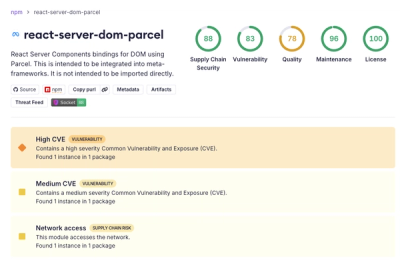
New DoS and source code exposure bugs in React Server Components and Next.js: what’s affected and how to update safely.

Security News
Socket CEO Feross Aboukhadijeh joins Software Engineering Daily to discuss modern software supply chain attacks and rising AI-driven security risks.