






Product
Introducing Custom Tabs for Org Alerts
Create and share saved alert views with custom tabs on the org alerts page, making it easier for teams to return to consistent, named filter sets.
By André Staltz - Jan 20, 2026
solarfactors
Advanced tools
2D View Factor Model to calculate the irradiance incident on various surfaces of PV arrays
This repository is a fork of SunPower/pvfactors <https://github.com/sunpower/pvfactors>_,
a 2-D view factor model for simulating front- and rear-side irradiance for
bifacial PV systems.
This fork exists so that the pvfactors model can continue to be used with
pvlib python <https://github.com/pvlib/pvlib-python>_ even though the original
repository is no longer maintained. The objective is to provide a working
dependency for the existing pvfactors functionality currently in pvlib python.
Documentation for this fork can be found at Read the Docs <https://solarfactors.readthedocs.io>_.
The project can be installed from PyPI using pip install solarfactors. Note
that the package is still used from python under the pvfactors name, i.e.
with from pvfactors.geometry import OrderedPVArray.
|Logo|
|GHActions| |License| |PyPI-Status| |PyPI-Versions|
pvfactors is a tool used by PV professionals to calculate the irradiance incident on surfaces of a photovoltaic array. It relies on the use of 2D geometries and view factors integrated mathematically into systems of equations to account for reflections between all of the surfaces.
pvfactors was originally ported from the SunPower developed 'vf_model' package, which was introduced at the IEEE PV Specialist Conference 44 2017 (see [#pvfactors_paper]_ and link_ to paper).
This fork, pvlib/solarfactors <https://github.com/pvlib/solarfactors>_ is maintained by the pvlib project with contributions from the pvlib community.
.. contents:: Table of contents :backlinks: top :local:
The documentation of this fork can be found here <https://solarfactors.readthedocs.io>.
It includes a lot of tutorials that describe the different ways of using solarfactors.
Given some timeseries inputs:
.. code:: python
from datetime import datetime import pandas as pd
df_inputs = pd.DataFrame( {'solar_zenith': [20., 50.], 'solar_azimuth': [110., 250.], 'surface_tilt': [10., 20.], 'surface_azimuth': [90., 270.], 'dni': [1000., 900.], 'dhi': [50., 100.], 'albedo': [0.2, 0.2]}, index=[datetime(2017, 8, 31, 11), datetime(2017, 8, 31, 15)]) df_inputs
+---------------------+--------------+---------------+--------------+-----------------+--------+-------+--------+ | | solar_zenith | solar_azimuth | surface_tilt | surface_azimuth | dni | dhi | albedo | +=====================+==============+===============+==============+=================+========+=======+========+ | 2017-08-31 11:00:00 | 20.0 | 110.0 | 10.0 | 90.0 | 1000.0 | 50.0 | 0.2 | +---------------------+--------------+---------------+--------------+-----------------+--------+-------+--------+ | 2017-08-31 15:00:00 | 50.0 | 250.0 | 20.0 | 270.0 | 900.0 | 100.0 | 0.2 | +---------------------+--------------+---------------+--------------+-----------------+--------+-------+--------+
And some PV array parameters
.. code:: python
pvarray_parameters = { 'n_pvrows': 3, # number of pv rows 'pvrow_height': 1, # height of pvrows (measured at center / torque tube) 'pvrow_width': 1, # width of pvrows 'axis_azimuth': 0., # azimuth angle of rotation axis 'gcr': 0.4, # ground coverage ratio }
The user can quickly create a PV array with pvfactors, and manipulate it with the engine
.. code:: python
from pvfactors.geometry import OrderedPVArray
pvarray = OrderedPVArray.init_from_dict(pvarray_parameters)
.. code:: python
from pvfactors.engine import PVEngine
engine = PVEngine(pvarray)
engine.fit(df_inputs.index, df_inputs.dni, df_inputs.dhi, df_inputs.solar_zenith, df_inputs.solar_azimuth, df_inputs.surface_tilt, df_inputs.surface_azimuth, df_inputs.albedo)
The user can then plot the PV array geometry at any given time of the simulation:
.. code:: python
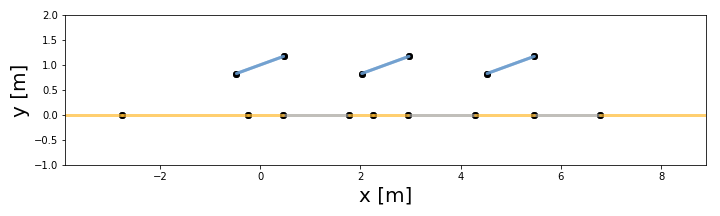
f, ax = plt.subplots(figsize=(10, 5)) pvarray.plot_at_idx(1, ax) plt.show()
.. image:: https://raw.githubusercontent.com/SunPower/pvfactors/master/docs/sphinx/_static/pvarray.png
It is then very easy to run simulations using the defined engine:
.. code:: python
pvarray = engine.run_full_mode(fn_build_report=lambda pvarray: pvarray)
And inspect the results thanks to the simple geometry API
.. code:: python
print("Incident irradiance on front surface of middle pv row: {} W/m2"
      .format(pvarray.ts_pvrows[1].front.get_param_weighted('qinc')))
print("Reflected irradiance on back surface of left pv row: {} W/m2"
      .format(pvarray.ts_pvrows[0].back.get_param_weighted('reflection')))
print("Isotropic irradiance on back surface of right pv row: {} W/m2"
      .format(pvarray.ts_pvrows[2].back.get_param_weighted('isotropic')))
.. parsed-literal::
Incident irradiance on front surface of middle pv row: [1034.968  886.377] W/m2
Reflected irradiance on back surface of left pv row: [112.139  86.404] W/m2
Isotropic irradiance on back surface of right pv row: [0.116 1.849] W/m2
The users can also create a "report" while running the simulations that will rely on the simple API shown above, and which will look like whatever the users want.
.. code:: python
# Create a function that will build a report
def fn_report(pvarray): return {'total_incident_back': pvarray.ts_pvrows[1].back.get_param_weighted('qinc'),
                                'total_absorbed_back': pvarray.ts_pvrows[1].back.get_param_weighted('qabs')}

# Run full mode simulation
report = engine.run_full_mode(fn_build_report=fn_report)

# Print results (report is defined by report function passed by user)
df_report = pd.DataFrame(report, index=df_inputs.index)
df_report
+---------------------+---------------------+---------------------+ | | total_incident_back | total_absorbed_back | +=====================+=====================+=====================+ | 2017-08-31 11:00:00 | 106.627832 | 103.428997 | +---------------------+---------------------+---------------------+ | 2017-08-31 15:00:00 | 79.668878 | 77.278812 | +---------------------+---------------------+---------------------+
solarfactors is currently compatible and tested with Python 3.11 and Shapely 2.0.6, and is available in PyPI <https://pypi.org/project/solarfactors/>. The easiest way to install solarfactors is to use pip as follows:
.. code:: sh
$ pip install solarfactors
The package wheel files are also available in the release section_ of the Github repository.
Requirements are automatically installed when running pip install solarfactors. Here is a list of important dependencies:
numpy <https://pypi.python.org/pypi/numpy>_pvlib-python <https://pypi.python.org/pypi/pvlib>_shapely <https://pypi.python.org/pypi/Shapely>_ (version >= 2.0)If you use solarfactors in a published work, cite the following paper:
.. parsed-literal::
Anoma, M., Jacob, D., Bourne, B.C., Scholl, J.A., Riley, D.M. and Hansen, C.W., 2017. View Factor Model and Validation for Bifacial PV and Diffuse Shade on Single-Axis Trackers. In 44th IEEE Photovoltaic Specialist Conference.
Contributions are needed in order to improve solarfactors.
If you wish to contribute, you can start by forking and cloning the repository, and then installing solarfactors using pip_ in the root folder of the package:
.. code:: sh
$ pip install .
To install the package in editable mode, you can use:
.. code:: sh
$ pip install -e .
Testing +++++++
Install test dependencies using the test extra:
.. code:: sh
$ pip install .[test]
Then run the tests using:
.. code:: sh
$ python -m pytest
You will need to close manually the plots that are generated during the tests, unless you define the CI environment variable, which will disable the tests that generate plots.
Releasing +++++++++
When releasing pvfactors, you will need to run a couple of build commands. First make sure to activate your virtual environment if any, then:
git tag -a vX.X.X, and write a tag message. You can then push that tag to Github so that it will appear there.make build-docs. When done running, you should be able to open build/sphinx/html/index.html, and confirm that the version displayed is the same as the one from the git tag. You can deploy by copying the content of of the build/sphinx/html/ folder into the gh-pages branch of the repo (make sure to keep the .nojekyll file that's already present).make build-package. When done running, you should be able to open dist/ and see both a whl file and and tar file. Make sure that their names include the correct git tag you created. Please confirm that the whl file was built correctly by installing it locally and testing the newly released updates. You can deploy by 1) making a Github release from the tag you created and pushed, and including the files in dist/ in the release. 2) The last step is to publish a release in PyPI, for which you can use twine and the command twine upload dist/*.. [#pvfactors_paper] Anoma, M., Jacob, D., Bourne, B. C., Scholl, J. A., Riley, D. M., & Hansen, C. W. (2017). View Factor Model and Validation for Bifacial PV and Diffuse Shade on Single-Axis Trackers. In 44th IEEE Photovoltaic Specialist Conference.
.. _link: https://pdfs.semanticscholar.org/ebb2/35e3c3796b158e1a3c45b40954e60d876ea9.pdf
.. _tutorials: https://solarfactors.readthedocs.io/en/latest/tutorials/index.html
.. _full mode: https://solarfactors.readthedocs.io/en/latest/theory/problem_formulation.html#full-simulations
.. _fast mode: https://solarfactors.readthedocs.io/en/latest/theory/problem_formulation.html#fast-simulations
.. _pip: https://pip.pypa.io/en/stable/
.. _release section: https://github.com/pvlib/solarfactors/releases
.. |Logo| image:: https://github.com/pvlib/solarfactors/blob/main/docs/sphinx/_static/logo_small.png?raw=true :target: https://solarfactors.readthedocs.io/en/latest/index.html
.. |GHActions| image:: https://github.com/pvlib/solarfactors/actions/workflows/test.yml/badge.svg?branch=main :target: https://github.com/pvlib/solarfactors/actions/workflows/test.yml?query=branch%3Amain
.. |License| image:: https://img.shields.io/badge/License-BSD%203--Clause-blue.svg :target: https://github.com/pvlib/solarfactors/blob/main/LICENSE
.. |PyPI-Status| image:: https://img.shields.io/pypi/v/solarfactors.svg :target: https://pypi.org/project/solarfactors/
.. |PyPI-Versions| image:: https://img.shields.io/pypi/pyversions/solarfactors.svg?logo=python&logoColor=white :target: https://pypi.org/project/solarfactors/
FAQs
2D View Factor Model to calculate the irradiance incident on various surfaces of PV arrays
We found that solarfactors demonstrated a healthy version release cadence and project activity because the last version was released less than a year ago. It has 0 open source maintainers collaborating on the project.
Did you know?

Socket for GitHub automatically highlights issues in each pull request and monitors the health of all your open source dependencies. Discover the contents of your packages and block harmful activity before you install or update your dependencies.
Product
Create and share saved alert views with custom tabs on the org alerts page, making it easier for teams to return to consistent, named filter sets.

Product
Socket’s Rust and Cargo support is now generally available, providing dependency analysis and supply chain visibility for Rust projects.

Security News
Chrome 144 introduces the Temporal API, a modern approach to date and time handling designed to fix long-standing issues with JavaScript’s Date object.