


Security News
Deno 2.6 + Socket: Supply Chain Defense In Your CLI
Deno 2.6 introduces deno audit with a new --socket flag that plugs directly into Socket to bring supply chain security checks into the Deno CLI.
By Sarah Gooding - Dec 12, 2025
sqlnosql
Advanced tools
Push semi-structured data (e.g. JSON documents) into a database with a minimum of fuss. Includes validation and schema migration.
sqlnosql gets you from nosql to, well... sql. It takes a JSON schema <http://json-schema.org/>__ and it turns it into any of:
It can also take JSON data and insert it into your database -- either from the commandline or from Python.
Type in sqlnosql --help on the command line for more information.
sqlnosql will translate JSON types into SQL types and it will
flatten down nested data structures so that e.g.
{"supplies": {"medical": "string"}} becomes a supplies_medical
column with type TEXT.
sqlnosql is useful in ETL processes where you might have a bunch of
data in flat files or a nosql database that you want to get into a
proper SQL database for analysis purposes.
If your database supports it, sqlnosql will keep arrays intact. In particular, Postgres has an ARRAY type. However, keep in mind that native arrays can only contain a single, simple type, like strings or numbers. Complex types will automatically be reduced to simple types by sqlnosql. By default it does this by simply serializing them to JSON.
Similarly, if your JSON schema specifies objects that don't have any specifically defined properties, these too will be serialized into strings.
Keep in mind that your JSON schema must be exhaustive. Fields not in your schema will not become columns and will be ignored.
Because you probably ain't gonna need it, there's no support for data normalization, that is, no support for splitting out your data into separate tables that are connected through foreign keys.
Alembic might seem overwhelming at first, especially for those who are
not from a Python background but would simply like to use the migration
feature of sqlnosql. Don't worry, it's really rather easy to get
started.
Figure out where you'd like to keep your migration code, probably a
subdirectory of your general code repo, and do
alembic init <revisions_dir>. Now open alembic.ini and look for
sqlalchemy.url -- that's where you should enter the authentication
for and location to your database.
(Alternatively, it is also possible to keep this information in environment variables, which we will explain later.)
Now open <revisions_dir>/env.py, look for the line that says
target_metadata = None and change it to something like
.. code:: python
import json
import sqlnosql
from sqlalchemy import MetaData

schema = json.load(open('path/to/schema.json'))
target_metadata = MetaData()
table = sqlnosql.schema.create_table(schema, target_metadata, pk='my_primary_key_column')
And that's all there is to it in terms of setup.
Now, to create a new revision (a.k.a. migration), run
alembic revision --autogenerate. Alembic will generate a Python file
containing upgrade and download functions. It will tell you the
path to this file, and before applying the migration you will want to
check that file to make sure the database operations it suggests are
correct, and if not, make the necessary adjustments.
Finally, to run the migration, do alembic upgrade head.
For more details on Alembic, take a look at the Alembic tutorial <http://alembic.readthedocs.org/en/latest/tutorial.html>__.
FAQs
Push semi-structured data (e.g. JSON documents) into a database with a minimum of fuss. Includes validation and schema migration.
We found that sqlnosql demonstrated a healthy version release cadence and project activity because the last version was released less than a year ago. It has 1 open source maintainer collaborating on the project.
Did you know?

Socket for GitHub automatically highlights issues in each pull request and monitors the health of all your open source dependencies. Discover the contents of your packages and block harmful activity before you install or update your dependencies.
Security News
Deno 2.6 introduces deno audit with a new --socket flag that plugs directly into Socket to bring supply chain security checks into the Deno CLI.
Security News
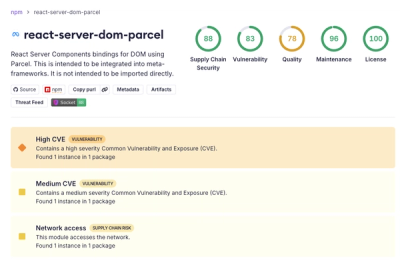
New DoS and source code exposure bugs in React Server Components and Next.js: what’s affected and how to update safely.

Security News
Socket CEO Feross Aboukhadijeh joins Software Engineering Daily to discuss modern software supply chain attacks and rising AI-driven security risks.