


Research
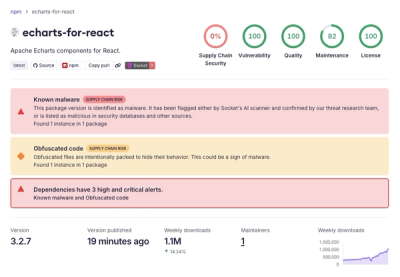
Active Supply Chain Attack Compromises @antv Packages on npm
Active npm supply chain attack compromises @antv packages in a fast-moving malicious publish wave tied to Mini Shai-Hulud.
By Socket Research Team - May 19, 2026
stockpyl
Advanced tools


Stockpyl is a Python package for inventory optimization. It implements classical single-node inventory models like the economic order quantity (EOQ), newsvendor, and Wagner-Whitin problems. It also contains algorithms for multi-echelon inventory optimization (MEIO) under both stochastic-service model (SSM) and guaranteed-service model (GSM) assumptions.
Most of the models and algorithms implemented in Stockpyl are discussed in the textbook Fundamentals of Supply Chain Theory (FoSCT) by Snyder and Shen, Wiley, 2019, 2nd ed. Most of them are much older; see FoSCT for references to original sources.
For a tutorial, see Snyder, L. V., "Stockpyl: A Python Package for Inventory Optimization and Simulation," in: Bish, E. K. and H. Balasubramanian, INFORMS TutORials in Operations Research, 156–197, 2023. The associated Jupyter notebooks are at notebooks/.
For lots of details, read the docs.
Solve the newsvendor problem with a holding (overage) cost of 2, a stockout (underage) cost of 18, and demands that are normally distributed with a mean of 120 and a standard deviation of 10:
>>> from stockpyl.newsvendor import newsvendor_normal
>>> S, cost = newsvendor_normal(holding_cost=2, stockout_cost=18, demand_mean=120, demand_sd=10)
>>> S
132.815515655446
>>> cost
35.09966638649737
Use Chen and Zheng's (1994) algorithm (based on Clark and Scarf (1960)) to optimize a 3-node serial system under the stochastic-service model (SSM):
>>> from stockpyl.ssm_serial import optimize_base_stock_levels
>>> S_star, C_star = optimize_base_stock_levels(
...     num_nodes=3,
...     echelon_holding_cost=[4, 3, 1],
...     lead_time=[1, 1, 2],
...     stockout_cost=40,
...     demand_mean=10,
...     demand_standard_deviation=2
... )
>>> S_star
{1: 12.764978727246302, 2: 23.49686681508743, 3: 46.28013742779933}
>>> C_star
86.02533221942987
Simulate the same system using the optimal base-stock levels:
Optimize committed service times (CSTs) for a tree network under the guaranteed-service model (GSM) using Graves and Willems' (2000) dynamic programming algorithm:
>>> from stockpyl.gsm_tree import optimize_committed_service_times
>>> from stockpyl.instances import load_instance
>>> # Load a named instance, Example 6.5 from FoSCT.
>>> tree = load_instance("example_6_5")
>>> opt_cst, opt_cost = optimize_committed_service_times(tree)
>>> opt_cst
{1: 0, 3: 0, 2: 0, 4: 1}
>>> opt_cost
8.277916867529369
If you have feedback or encounter problems, please report them on the Stockpyl GitHub Issues Page. (If you are not comfortable using GitHub for this purpose, feel free to e-mail me. My contact info is on my webpage.)
Stockpyl is open-source and released under the MIT License.
If you'd like to cite the Stockpyl package, you can use the following BibTeX entry:
@misc{stockpyl,
    title={Stockpyl},
    author={Snyder, Lawrence V.},
    year={2023},
    url={https://github.com/LarrySnyder/stockpyl}
}
FAQs
A Python package for inventory optimization and simulation
We found that stockpyl demonstrated a healthy version release cadence and project activity because the last version was released less than a year ago. It has 1 open source maintainer collaborating on the project.
Did you know?

Socket for GitHub automatically highlights issues in each pull request and monitors the health of all your open source dependencies. Discover the contents of your packages and block harmful activity before you install or update your dependencies.
Research
Active npm supply chain attack compromises @antv packages in a fast-moving malicious publish wave tied to Mini Shai-Hulud.
Security News
/Research
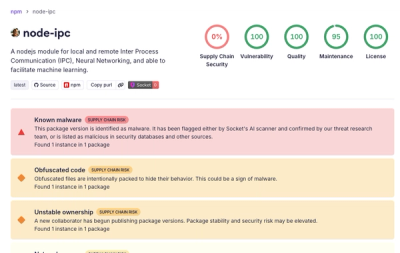
Socket detected malicious node-ipc versions with obfuscated stealer/backdoor behavior in a developing npm supply chain attack.

Security News
TeamPCP and BreachForums are promoting a Shai-Hulud supply chain attack contest with a $1,000 prize for the biggest package compromise.