

Security News
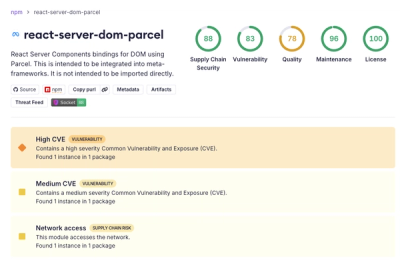
New React Server Components Vulnerabilities: DoS and Source Code Exposure
New DoS and source code exposure bugs in React Server Components and Next.js: what’s affected and how to update safely.
By Sarah Gooding - Dec 12, 2025
streamdown
Advanced tools

Terminal streaming markdown that rocks
Streamdown works with any streaming markdown such as simonw's llm or even something basic like curl.
It's designed for compatibility with the wide variety of markdown from various LLM models.
It supports standard piping and files as arguments like any normal pager but can also run as a wrapper so you retain full keyboard interactivity. Arrow keys, control, alt, all still work.
$ pip install streamdown
Watch Streamdown run over a FIFO pipe through tee in tmux on an M4 using BitNet. This is run straight. No clever unbuffering tricks. You can see the unstructured content on the right and the realtime Streamdown render on the left.
Other renderers inject line breaks when copying code that wraps around. Streamdown's better and now you are too!
Set PrettyBroken and PrettyPad to False in your toml (see below) to make Streamdown ensure code is always cleanly mouse copyable
Here's kitty and alacritty.
The optional Clipboard feature puts the final codeblock into your clipboard. See below for details.
Here's the Savebrace feature with screen-query and sq-picker from llmehelp. You can have an ongoing conversation in tmux with your terminal session. Then use popups and fzf to insert command or coding blocks all with a keystroke.
This allows you to interactively debug in a way that the agent doesn't just wander off doing silly things.
It takes about 2 minutes to set up and about 0.2s to use. Fast, fluid and free.
Compare how streamdown wraps and spaces this tabular Chinese description of programming languages to other leading markdown renderers.
Only one generates the text without truncation. 很美!
For instance, here is the latex plugin doing math inside a table:
It is designed for AI and can be used to do parser based sophisticated pipelines and routing, cracking open various monolithic AI solutions to permit them to integrate. Think of it as output level routing at the semantic level.
You can also just use it like a normal person.
The location it's stored is platform specific and can be seen with the -h flag. If this file does not exist upon first run, it will be created with default values.
Here are the sections:
[style]
Defines the base Hue (H), Saturation (S), and Value (V) from which all other palette colors are derived. This can also be specified at runtime via command line arguments. See below!
The default values are at the beginning of the source.
HSV: [ 0.0 - 1.0, 0.0 - 1.0, 0.0 - 1.0 ]Dark: Multipliers for background elements, code blocks.Grey: Multipliers for blockquote and thinkblock.Mid: Multipliers for inline code backgrounds, table headers.Symbol: Multipliers for list bullets, horizontal rules, links.Head: Multipliers for level 3 headers.Bright: Multipliers for level 2 headers.Margin (integer, default: 2): The left and right indent for the output.Width (integer, default: 0): Along with the Margin, Width specifies the base width of the content, which when set to 0, means use the terminal width. See #6 for more detailsPrettyPad (boolean, default: true): Uses a unicode vertical pad trick to add a half height background to code blocks. This makes copy/paste have artifacts. See #2. I like it on. But that's just mePrettyBroken (boolean, default: true): This will break the copy/paste assurance above. The output is much prettier, but it's also broken. So it's pretty broken. Works nicely with PrettyPad.ListIndent (integer, default: 2): This is the recursive indent for the list styles.Syntax (string, default native): This is the syntax highlighting theme which come via pygments.Example:
[style]
PrettyPad = true
PrettyBroken = true
HSV = [0.7, 0.5, 0.5]
Dark = { H = 1.0, S = 1.2, V = 0.25 } # Make dark elements less saturated and darker
Symbol = { H = 1.0, S = 1.8, V = 1.8 } # Make symbols more vibrant
[features]
Controls optional features:
CodeSpaces (boolean, default: true): Enables detection of code blocks indented with 4 spaces. Set to false to disable this detection method (triple-backtick blocks still work).Clipboard (boolean, default: true): Enables copying the last code block encountered to the system clipboard using OSC 52 escape sequences upon exit. Set to false to disable.Logging (boolean, default: false): Enables logging to tmpdir (/tmp/sd) of the raw markdown for debugging and bug reporting. The logging uses an emoji as a record separator so the actual streaming delays can be simulated and replayed. If you use the filename based invocation, that is to say, sd <filename>, this type of logging is always off.Savebrace (boolean, default: true): Saves the code blocks of a conversation to the append file $TMP/sd/$UID/savebrace so you can fzf or whatever you want through it. See how it's used in DAY50's sidechat.Example:
[features]
CodeSpaces = false
Clipboard = false
The most exciting feature here is --exec with it you can do full readline support like this:
$ sd --exec "llm chat"
And now you have all your readline stuff. It's pretty great. (Also see the DAY50 shellwrap project.)
It's also worth noting that things like the -c aren't "broken" with regard to file input. You can do something like this:
$ sd -c <(echo "[style]\nMargin=10")
To override the margin.
usage: sd [-h] [-l LOGLEVEL] [-b BASE] [-c CONFIG] [-w WIDTH] [-e EXEC]
          [-s SCRAPE] [filenameList ...]

Streamdown is a streaming markdown renderer for modern terminals.
https://github.com/day50-dev/Streamdown

paths:
  config                /home/chris/.config/streamdown/config.toml
  logs                  /tmp/sd/1000

positional arguments:
  filenameList          Input file to process (also takes stdin)

optional arguments:
  -h, --help            show this help message and exit
  -l LOGLEVEL, --loglevel LOGLEVEL
                        Set the logging level
  -b BASE, --base BASE  Set the hsv base: h,s,v
  -c CONFIG, --config CONFIG
                        Use a custom config override
  -w WIDTH, --width WIDTH
                        Set the width WIDTH
  -e EXEC, --exec EXEC  Wrap a program EXEC for more 'proper' i/o handling
  -s SCRAPE, --scrape SCRAPE
                        Scrape code snippets to a directory SCRAPE
  -v, --version         Show version information
Note: Some features are not supported on some OSs. Please file a ticket if you need a feature on your platform that isn't working.
Do this
$ ./streamdown/sd.py tests/*md
After the git clone least one of these should work, hopefully. it's using the modern uv pip tool but is also backwards compatible to the pip3 install -r requirements.txt flow.
$ pipx install -e .
$ pip install -e .
$ uv pip install -e .
Explore the rest of DAY50. Feel free to follow us, there's some exciting stuff coming.
FAQs
A streaming markdown renderer for modern terminals with syntax highlighting
We found that streamdown demonstrated a healthy version release cadence and project activity because the last version was released less than a year ago. It has 1 open source maintainer collaborating on the project.
Did you know?

Socket for GitHub automatically highlights issues in each pull request and monitors the health of all your open source dependencies. Discover the contents of your packages and block harmful activity before you install or update your dependencies.
Security News
New DoS and source code exposure bugs in React Server Components and Next.js: what’s affected and how to update safely.

Security News
Socket CEO Feross Aboukhadijeh joins Software Engineering Daily to discuss modern software supply chain attacks and rising AI-driven security risks.
Security News
GitHub has revoked npm classic tokens for publishing; maintainers must migrate, but OpenJS warns OIDC trusted publishing still has risky gaps for critical projects.