


Security News
Deno 2.6 + Socket: Supply Chain Defense In Your CLI
Deno 2.6 introduces deno audit with a new --socket flag that plugs directly into Socket to bring supply chain security checks into the Deno CLI.
By Sarah Gooding - Dec 12, 2025
telegram-init-data
Advanced tools



A Python library for working with Telegram Mini Apps initialization data. This library provides utilities to parse, validate, and sign init data on the server side, similar to the official @telegram-apps/init-data-node package.
pip install telegram-init-data
For FastAPI integration:
pip install telegram-init-data[fastapi]
from telegram_init_data import validate, parse

# Your bot token from @BotFather
bot_token = "YOUR_BOT_TOKEN"

# Init data string from Telegram Mini App
init_data = "query_id=AAHdF6IQAAAAAN0XohDhrOrc&user=%7B%22id%22%3A279058397%2C%22first_name%22%3A%22Vladislav%22%2C%22last_name%22%3A%22Kibenko%22%2C%22username%22%3A%22vdkfrost%22%2C%22language_code%22%3A%22ru%22%2C%22is_premium%22%3Atrue%7D&auth_date=1662771648&hash=c501b71e775f74ce10e377dea85a7ea24ecd640b223ea86dfe453e0eaed2e2b2"

try:
    # Validate the init data
    validate(init_data, bot_token)
    print("✅ Init data is valid!")

    # Parse the init data
    parsed_data = parse(init_data)
    print(f"User: {parsed_data['user']['first_name']}")

except Exception as e:
    print(f"❌ Validation failed: {e}")
from fastapi import FastAPI, Depends, HTTPException
from telegram_init_data import validate, parse

app = FastAPI()

def verify_init_data(init_data: str) -> dict:
    """Dependency to verify and parse init data"""
    bot_token = "YOUR_BOT_TOKEN"

    try:
        validate(init_data, bot_token)
        return parse(init_data)
    except Exception as e:
        raise HTTPException(status_code=401, detail=str(e))

@app.post("/user/profile")
async def get_profile(init_data: dict = Depends(verify_init_data)):
    user = init_data.get("user")
    if not user:
        raise HTTPException(status_code=400, detail="User data not found")

    return {"user_id": user["id"], "name": user["first_name"]}
from telegram_init_data import sign, is_valid
from datetime import datetime

# Create test init data
test_data = {
    "query_id": "test_query_id",
    "user": {
        "id": 123456789,
        "first_name": "John",
        "last_name": "Doe",
        "username": "johndoe",
        "language_code": "en"
    },
    "auth_date": datetime.now()
}

# Sign the data
signed_data = sign(test_data, bot_token, datetime.now())
print(f"Signed data: {signed_data}")

# Check if data is valid (returns boolean)
if is_valid(signed_data, bot_token):
    print("✅ Data is valid")
else:
    print("❌ Data is invalid")
validate(value, token, options=None)Validates Telegram Mini App init data.
Parameters:
value (str | dict): Init data to validatetoken (str): Bot token from @BotFatheroptions (dict, optional): Validation options
expires_in (int): Expiration time in seconds (default: 86400)Raises:
SignatureMissingError: When hash parameter is missingAuthDateInvalidError: When auth_date is invalid or missingExpiredError: When init data has expiredSignatureInvalidError: When signature verification failsis_valid(value, token, options=None)Checks if init data is valid without raising exceptions.
Returns: bool - True if valid, False otherwise
parse(value)Parses init data string into structured Python object.
Parameters:
value (str | dict): Init data to parseReturns: InitData - Parsed init data object
sign(data, token, auth_date, options=None)Signs init data for testing/development.
Parameters:
data (dict): Data to signtoken (str): Bot tokenauth_date (datetime): Authentication dateoptions (dict, optional): Signing optionsReturns: str - Signed init data as URL-encoded string
InitDataclass InitData(TypedDict):
query_id: Optional[str]
user: Optional[User]
receiver: Optional[User]
chat: Optional[Chat]
chat_type: Optional[ChatType]
chat_instance: Optional[str]
start_param: Optional[str]
can_send_after: Optional[int]
auth_date: int
hash: str
signature: Optional[str]
Userclass User(TypedDict):
id: int
first_name: str
last_name: Optional[str]
username: Optional[str]
language_code: Optional[str]
is_bot: Optional[bool]
is_premium: Optional[bool]
added_to_attachment_menu: Optional[bool]
allows_write_to_pm: Optional[bool]
photo_url: Optional[str]
Chatclass Chat(TypedDict):
id: int
type: ChatType
title: Optional[str]
username: Optional[str]
photo_url: Optional[str]
TelegramInitDataError: Base exception classAuthDateInvalidError: Invalid or missing auth_dateSignatureInvalidError: Invalid signatureSignatureMissingError: Missing signature/hashExpiredError: Init data has expiredoptions = {
"expires_in": 3600, # 1 hour expiration instead of default 24 hours
}
validate(init_data, bot_token, options)
options = {
    "expires_in": 0,  # Disable expiration check
}

validate(init_data, bot_token, options)
Run tests with pytest:
# Install development dependencies
pip install -e .[dev]

# Run tests
pytest

# Run with coverage
pytest --cov=telegram_init_data --cov-report=html
from fastapi import FastAPI, Depends, HTTPException, Header
from telegram_init_data import validate, parse, is_valid

app = FastAPI()

def get_init_data(authorization: str = Header(None)):
    """Extract and validate init data from Authorization header"""
    if not authorization:
        raise HTTPException(status_code=401, detail="Authorization header missing")

    if not authorization.startswith("tma "):
        raise HTTPException(status_code=401, detail="Invalid authorization format")

    init_data = authorization[4:]  # Remove "tma " prefix
    bot_token = "YOUR_BOT_TOKEN"

    if not is_valid(init_data, bot_token):
        raise HTTPException(status_code=401, detail="Invalid init data")

    return parse(init_data)

@app.get("/me")
async def get_current_user(init_data: dict = Depends(get_init_data)):
    """Get current user info"""
    user = init_data.get("user")
    if not user:
        raise HTTPException(status_code=400, detail="User data not found")

    return {
        "id": user["id"],
        "name": user.get("first_name", ""),
        "username": user.get("username"),
        "is_premium": user.get("is_premium", False)
    }

@app.post("/settings")
async def update_settings(
    settings: dict,
    init_data: dict = Depends(get_init_data)
):
    """Update user settings"""
    user = init_data.get("user")
    # Save settings for user["id"]
    return {"status": "success"}
# Clone the repository
git clone https://github.com/telegram-init-data/telegram-init-data-python.git
cd telegram-init-data-python

# Create virtual environment
python -m venv venv
source venv/bin/activate  # On Windows: venv\Scripts\activate

# Install in development mode
pip install -e .[dev]

# Run tests
pytest

# Format code
black telegram_init_data tests
isort telegram_init_data tests

# Type checking
mypy telegram_init_data
MIT License. See LICENSE for details.
See CHANGELOG.md for details about changes in each version.
If you have questions or need help:
Developed with ❤️ by Imran Gadzhiev to support Telegram Mini Apps developers.
FAQs
Python library for working with Telegram Mini Apps initialization data
We found that telegram-init-data demonstrated a healthy version release cadence and project activity because the last version was released less than a year ago. It has 1 open source maintainer collaborating on the project.
Did you know?

Socket for GitHub automatically highlights issues in each pull request and monitors the health of all your open source dependencies. Discover the contents of your packages and block harmful activity before you install or update your dependencies.
Security News
Deno 2.6 introduces deno audit with a new --socket flag that plugs directly into Socket to bring supply chain security checks into the Deno CLI.
Security News
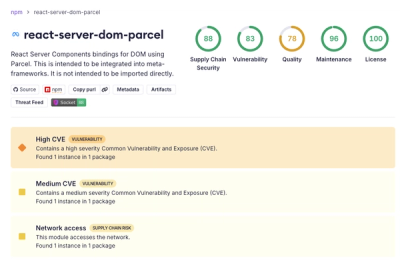
New DoS and source code exposure bugs in React Server Components and Next.js: what’s affected and how to update safely.

Security News
Socket CEO Feross Aboukhadijeh joins Software Engineering Daily to discuss modern software supply chain attacks and rising AI-driven security risks.