

Research
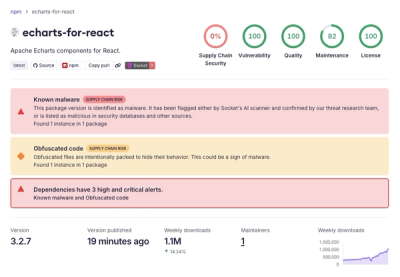
Active Supply Chain Attack Compromises @antv Packages on npm
Active npm supply chain attack compromises @antv packages in a fast-moving malicious publish wave tied to Mini Shai-Hulud.
By Socket Research Team - May 19, 2026
tracelet
Advanced tools




Tracelet is a Python library for tracking machine learning experiments. It works with popular backends like MLflow, Weights & Biases, ClearML, and AIM, and can automatically detect hyperparameters from your code.
pip install tracelet
Install backend support as needed:
pip install tracelet[mlflow]     # For MLflow
pip install tracelet[wandb]      # For Weights & Biases
pip install tracelet[clearml]    # For ClearML
pip install tracelet[aim]        # For AIM
pip install tracelet[all]        # Everything
from tracelet import Experiment

# Start tracking
exp = Experiment(name="my_experiment", backend=["mlflow"])
exp.start()

# Train your model
for epoch in range(10):
    loss = train_model()
    exp.log_metric("loss", loss, epoch)

exp.stop()
from tracelet import Experiment

# Enable automagic to detect hyperparameters automatically
exp = Experiment(name="auto_experiment", backend=["wandb"], automagic=True)
exp.start()

# Define hyperparameters normally - they're captured automatically
learning_rate = 0.001
batch_size = 32

# Your training code here
for epoch in range(epochs):
    loss = train_model()
    # Metrics logged automatically if using TensorBoard

exp.stop()
from tracelet import Experiment
import pytorch_lightning as pl

# Add to existing Lightning code
exp = Experiment(name="lightning_model", backend=["clearml"], automagic=True)
exp.start()

# Your existing code - all self.log() calls tracked automatically
trainer = pl.Trainer(max_epochs=10)
trainer.fit(model, datamodule)

exp.stop()
# Log to multiple backends simultaneously
exp = Experiment(
    name="comparison",
    backend=["mlflow", "wandb", "clearml"]
)
Set defaults with environment variables:
export TRACELET_PROJECT="my_project"
export TRACELET_BACKEND="mlflow"
export TRACELET_ENABLE_AUTOMAGIC="true"
Or programmatically:
from tracelet.settings import TraceletSettings

settings = TraceletSettings(
    project="my_project",
    backend=["mlflow"],
    enable_automagic=True,
    track_system=True
)
The examples/ directory contains runnable examples:
01_manual_tracking/ - Basic usage examples02_automagic_tracking/ - Automatic hyperparameter detection03_backend_integrations/ - Backend-specific features05_lightning_automagic/ - PyTorch Lightning integrationcd examples
python 01_manual_tracking/01_basic_manual.py
git clone https://github.com/prassanna-ravishankar/tracelet.git
cd tracelet
uv sync
uv run pytest
Apache License 2.0 - see LICENSE file.
FAQs
Tracelet is an automagic pytorch metric exporter
We found that tracelet demonstrated a healthy version release cadence and project activity because the last version was released less than a year ago. It has 1 open source maintainer collaborating on the project.
Did you know?

Socket for GitHub automatically highlights issues in each pull request and monitors the health of all your open source dependencies. Discover the contents of your packages and block harmful activity before you install or update your dependencies.
Research
Active npm supply chain attack compromises @antv packages in a fast-moving malicious publish wave tied to Mini Shai-Hulud.
Security News
/Research
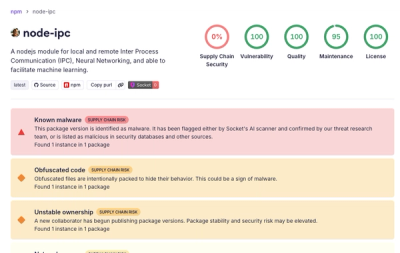
Socket detected malicious node-ipc versions with obfuscated stealer/backdoor behavior in a developing npm supply chain attack.

Security News
TeamPCP and BreachForums are promoting a Shai-Hulud supply chain attack contest with a $1,000 prize for the biggest package compromise.