

Product
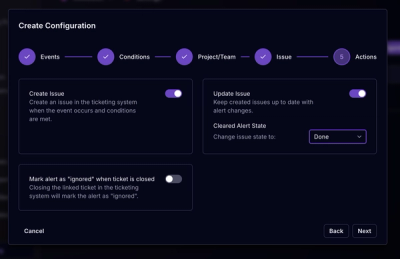
Socket for Jira Is Now Available
Socket for Jira lets teams turn alerts into Jira tickets with manual creation, automated ticketing rules, and two-way sync.
By Jeppe Hasseriis - Apr 20, 2026
treys
Advanced tools
A pure Python poker hand evaluation library
::
[ 3 ❤ ] , [ 3 ♠ ]
::
$ pip install treys
Treys is a Python 3 port of
Deuces <https://github.com/worldveil/deuces>__ based on the initial work in
msaindon’s <https://github.com/msaindon/deuces>__ fork. Deuces was written
by Will Drevo <http://willdrevo.com/>__ for the MIT Pokerbots Competition.
Treys is lightweight and fast. All lookups are done with bit arithmetic and dictionary lookups. That said, Treys won’t beat a C implemenation (~250k eval/s) but it is useful for situations where Python is required or where bots are allocated reasonable thinking time (human time scale).
Treys handles 5, 6, and 7 card hand lookups. The 6 and 7 card lookups are done by combinatorially evaluating the 5 card choices.
Treys is easy to set up and use.
.. code:: python
from treys import Card card = Card.new('Qh')
Card objects are represented as integers to keep Treys performant and lightweight.
Now let’s create the board and an example Texas Hold’em hand:
.. code:: python
board = [ Card.new('Ah'), Card.new('Kd'), Card.new('Jc') ] hand = [ Card.new('Qs'), Card.new('Th') ]
Pretty print card integers to the terminal:
::
Card.print_pretty_cards(board + hand) [ A ❤ ] , [ K ♦ ] , [ J ♣ ] , [ Q ♠ ] , [ T ❤ ]
If you have termcolor <http://pypi.python.org/pypi/termcolor>__
installed, they will be colored as well.
Otherwise move straight to evaluating your hand strength:
.. code:: python
from treys import Evaluator evaluator = Evaluator() print(evaluator.evaluate(board, hand)) 1600
Hand strength is valued on a scale of 1 to 7462, where 1 is a Royal Flush and 7462 is unsuited 7-5-4-3-2, as there are only 7642 distinctly ranked hands in poker.
If you want to deal out cards randomly from a deck, you can also do that with Treys:
.. code:: python
from treys import Deck deck = Deck() board = deck.draw(5) player1_hand = deck.draw(2) player2_hand = deck.draw(2)
and print them:
::
Card.print_pretty_cards(board) [ 4 ♣ ] , [ A ♠ ] , [ 5 ♦ ] , [ K ♣ ] , [ 2 ♠ ] Card.print_pretty_cards(player1_hand) [ 6 ♣ ] , [ 7 ❤ ] Card.print_pretty_cards(player2_hand) [ A ♣ ] , [ 3 ❤ ]
Let’s evaluate both hands strength, and then bin them into classes, one for each hand type (High Card, Pair, etc)
.. code:: python
p1_score = evaluator.evaluate(board, player1_hand) p2_score = evaluator.evaluate(board, player2_hand) p1_class = evaluator.get_rank_class(p1_score) p2_class = evaluator.get_rank_class(p2_score)
or get a human-friendly string to describe the score,
::
print("Player 1 hand rank = %d (%s)\n" % (p1_score, evaluator.class_to_string(p1_class))) Player 1 hand rank = 6330 (High Card)
print("Player 2 hand rank = %d (%s)\n" % (p2_score, evaluator.class_to_string(p2_class))) Player 2 hand rank = 1609 (Straight)
or, coolest of all, get a blow-by-blow analysis of the stages of the game with relation to hand strength:
::
hands = [player1_hand, player2_hand] evaluator.hand_summary(board, hands)
========== FLOP ========== Player 1 hand = High Card, percentage rank among all hands = 0.893192 Player 2 hand = Pair, percentage rank among all hands = 0.474672 Player 2 hand is currently winning.
========== TURN ========== Player 1 hand = High Card, percentage rank among all hands = 0.848298 Player 2 hand = Pair, percentage rank among all hands = 0.452292 Player 2 hand is currently winning.
========== RIVER ========== Player 1 hand = High Card, percentage rank among all hands = 0.848298 Player 2 hand = Straight, percentage rank among all hands = 0.215626
========== HAND OVER ========== Player 2 is the winner with a Straight
FAQs
treys is a pure Python poker hand evaluation library
We found that treys demonstrated a healthy version release cadence and project activity because the last version was released less than a year ago. It has 1 open source maintainer collaborating on the project.
Did you know?

Socket for GitHub automatically highlights issues in each pull request and monitors the health of all your open source dependencies. Discover the contents of your packages and block harmful activity before you install or update your dependencies.
Product
Socket for Jira lets teams turn alerts into Jira tickets with manual creation, automated ticketing rules, and two-way sync.
Company News
Socket won two 2026 Reppy Awards from RepVue, ranking in the top 5% of all sales orgs. AE Alexandra Lister shares what it's like to grow a sales career here.

Security News
NIST will stop enriching most CVEs under a new risk-based model, narrowing the NVD's scope as vulnerability submissions continue to surge.