

Company News
Socket Has Acquired Secure Annex
Socket has acquired Secure Annex to expand extension security across browsers, IDEs, and AI tools.
By Feross Aboukhadijeh - Apr 28, 2026
underthesea-core
Advanced tools


Underthesea Core is a powerful extension of the popular natural language processing library Underthesea, which includes a range of efficient data preprocessing tools and machine learning models for training. Built with Rust for optimal performance, Underthesea Core offers fast processing speeds and is easy to implement, with Python bindings for seamless integration into existing projects. This extension is an essential tool for developers looking to build high-performance NLP systems that deliver accurate and reliable results.
pip install underthesea-core
Current version: 2.0.0
Train a CRF model with L-BFGS optimization:
from underthesea_core import CRFTrainer, CRFTagger

# Prepare training data
# X: list of sequences, each sequence is a list of feature lists (one per token)
# y: list of label sequences
X_train = [
    [["word=Tôi", "is_upper=False"], ["word=yêu", "is_upper=False"], ["word=Việt", "is_upper=True"], ["word=Nam", "is_upper=True"]],
    [["word=Hà", "is_upper=True"], ["word=Nội", "is_upper=True"], ["word=đẹp", "is_upper=False"]],
]
y_train = [
    ["O", "O", "B-LOC", "I-LOC"],
    ["B-LOC", "I-LOC", "O"],
]

# Create trainer with L-BFGS optimizer
trainer = CRFTrainer(
    loss_function="lbfgs",  # L-BFGS with OWL-QN (recommended)
    l1_penalty=1.0,         # L1 regularization
    l2_penalty=0.001,       # L2 regularization
    max_iterations=100,
    verbose=1
)

# Train and get model
model = trainer.train(X_train, y_train)
print(f"Labels: {model.get_labels()}")
print(f"Features: {model.num_state_features()}")

# Save model
model.save("ner_model.bin")
Load a trained model and make predictions:
from underthesea_core import CRFTagger, CRFModel

# Load model and create tagger
model = CRFModel.load("ner_model.bin")
tagger = CRFTagger.from_model(model)

# Or load directly
tagger = CRFTagger()
tagger.load("ner_model.bin")

# Predict labels for a sequence
features = [
    ["word=Tôi", "is_upper=False"],
    ["word=sống", "is_upper=False"],
    ["word=ở", "is_upper=False"],
    ["word=Hà", "is_upper=True"],
    ["word=Nội", "is_upper=True"],
]
labels = tagger.tag(features)
print(labels)  # ['O', 'O', 'O', 'B-LOC', 'I-LOC']

# Get labels with score
labels, score = tagger.tag_with_score(features)
print(f"Labels: {labels}, Score: {score}")

# Get marginal probabilities
marginals = tagger.marginals(features)
print(f"Marginals shape: {len(marginals)}x{len(marginals[0])}")
Extract features from tokenized sentences:
from underthesea_core import CRFFeaturizer

features = ["T[-1]", "T[0]", "T[1]"]
dictionary = set(["sinh viên"])
featurizer = CRFFeaturizer(features, dictionary)
sentences = [[["sinh", "X"], ["viên", "X"], ["đi", "X"], ["học", "X"]]]
featurizer.process(sentences)
# [[['T[-1]=BOS', 'T[0]=sinh', 'T[1]=viên'],
#   ['T[-1]=sinh', 'T[0]=viên', 'T[1]=đi'],
#   ['T[-1]=viên', 'T[0]=đi', 'T[1]=học'],
#   ['T[-1]=đi', 'T[0]=học', 'T[1]=EOS']]]
| Parameter | Type | Default | Description |
|---|---|---|---|
| loss_function | str | "lbfgs" | "lbfgs" (recommended) or "perceptron" |
| l1_penalty | float | 0.0 | L1 regularization coefficient |
| l2_penalty | float | 0.01 | L2 regularization coefficient |
| max_iterations | int | 100 | Maximum training iterations |
| learning_rate | float | 0.1 | Learning rate (perceptron only) |
| averaging | bool | True | Use averaged perceptron |
| verbose | int | 1 | Verbosity (0=quiet, 1=progress, 2=detailed) |
| Method | Description |
|---|---|
tag(features) | Predict labels for a sequence |
tag_with_score(features) | Predict labels with sequence score |
marginals(features) | Get marginal probabilities |
labels() | Get all label names |
num_labels() | Get number of labels |
| Method | Description |
|---|---|
save(path) | Save model to file |
load(path) | Load model from file |
get_labels() | Get all label names |
num_state_features() | Get number of state features |
num_transition_features() | Get number of transition features |
FAQs
Underthesea Core
We found that underthesea-core demonstrated a healthy version release cadence and project activity because the last version was released less than a year ago. It has 1 open source maintainer collaborating on the project.
Did you know?

Socket for GitHub automatically highlights issues in each pull request and monitors the health of all your open source dependencies. Discover the contents of your packages and block harmful activity before you install or update your dependencies.
Company News
Socket has acquired Secure Annex to expand extension security across browsers, IDEs, and AI tools.

Research
/Security News
Socket is tracking cloned Open VSX extensions tied to GlassWorm, with several updated from benign-looking sleepers into malware delivery vehicles.
Product
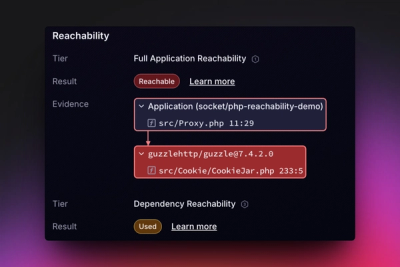
Reachability analysis for PHP is now available in experimental, helping teams identify which vulnerabilities are actually exploitable.