


Security News
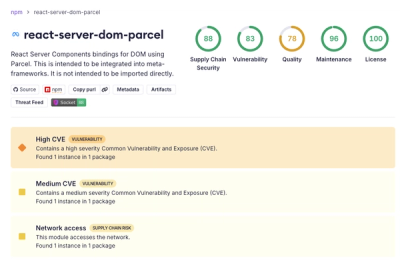
New React Server Components Vulnerabilities: DoS and Source Code Exposure
New DoS and source code exposure bugs in React Server Components and Next.js: what’s affected and how to update safely.
By Sarah Gooding - Dec 12, 2025
urlgenie
Advanced tools
Python package to make URL extraction, generalization, validation, and filtration easy.

It is a python package based on research involving over 2 million URLs, designed to handle URLs in a flexible manner for data-driven projects.
It checks the given URL input, validates it against the URL regex, identifies each component of the URL and processes it according to the set flags.
First things first, you need to install URL Genie by running the following command in your terminal:
python -m pip install urlgenie
That's it! Now you can use URL Genie in your code.
Let's first import the package and create an object of it to access its features.
from urlgenie import  UrlGenie
from pprint import pprint

genie = UrlGenie()
Let's try to give a sample input url and get it generalized.
url = "test.something.com/hello?somequery=True#someFragment"
gen = genie.generalize(url)
print(gen)
Would return https://test.something.com/hello as the output.
It detects that the schema is missing and adds it. By default, it removes the query (starts with ?) and fragment (starts with #).
As explained previously, URL Genie breaks down the URL, identifies the components and allows you to form the URL as per your needs.
This can be achieved using the flags (boolean parameters) and is explained here: flags.md.
Below are the different use cases where URL Genie might come in handy.
Just provide a string text and URL Genie will extract a dict containing emails and socials for you.
text = """
This is a good email: sample@gmail.com and this is a bad email: sample@image.png.
Another would be an email with a custom domain: sample@example.com.
Sample facebook facebook.com/sample1, lets try with fb domain: fb.com/sample2.
Lets add a bad facebook: fb.com/profile.php?
Lets add 2 twitter formats: x.com/sample and twitter.com/sample with same handles.
How about a linkedin pub? linkedin.com/pub/aravind-p-r/24/324/185?_l=en_US.
Let's also add its in url: linkedin.com/in/aravind-p-r-18532424/"""
result_dict = genie.extract_from_text(text)
pprint(result_dict)
This would return:
{'email': {'sample@example.com', 'sample@gmail.com'},
 'facebook': {'fb.com/sample2.', 'facebook.com/sample1', 'fb.com/profile.php'},
 'instagram': set(),
 'linkedin': {'linkedin.com/in/aravind-p-r-18532424', 'linkedin.com/pub/aravind-p-r/24/324/185'},
 'phone': set(),
 'twitter': {'x.com/sample', 'twitter.com/sample'}}
As you can see, it has strict regexes which prevented the bad email (sample@image.png) from being extracted.
But it has extracted fb.com/profile.php which is not really a URL we want since it does not lead to any person / organization / page.
Also, there are duplicates for twitter having the same handle and are not really in a standardized format.
For that, we can validate the given extract to remove invalid data and standardize the valid ones.
result_dict = genie.extract_from_text(text)
validated_dict = genie.validate_result_dict(result_dict)
pprint(validated_dict)
This would return:
{'email': {'sample@example.com', 'sample@gmail.com'},
 'facebook': {'https://www.facebook.com/sample1', 'https://www.facebook.com/sample2.'},
 'instagram': set(),
 'linkedin': {'https://www.linkedin.com/in/aravind-p-r-18532424'},
 'phone': set(),
 'twitter': {'https://twitter.com/sample'}}
With this, we have removed the duplicates, invalid URLs like fb.com/profile.php, generalized URLs such as LinkedIn PUB to IN.
When you scrape websites for contact info, you might get a lot of emails, and not all of them would be related to the organization.
To filter out the ones which are not related to the organization, we can use the email validation.
result_dict = genie.extract_from_text(text)
validated_dict = genie.validate_result_dict(result_dict, url = "https://www.example.com/ContactUs")
pprint(validated_dict)
This would return:
{'email': {'sample@example.com'},
 'facebook': {'https://www.facebook.com/sample1', 'https://www.facebook.com/sample2.'},
 'instagram': set(),
 'linkedin': {'https://www.linkedin.com/in/aravind-p-r-18532424'},
 'phone': set(),
 'twitter': {'https://twitter.com/sample'}}
Now, we have removed the sample@gmail.com which is not related to the organization's URL we have provided.
This would prove to be helpful when making scrapers or processing and cleaning data.
You can filter out valid URLs, invalid URLs and invalid socials when you have data in bulk to deal with.
For this example, we would be using data stored in a CSV.
Test.CSV
url
badbadwebsite?!,something
fb.com/people/hello
twitter.com/intent
https://x.com/intent/follow?original_referer=®ion=follow_link&screen_name=elonmusk&tw_p=followbutton&variant=2&mx=2
anotherbadwebsite???
Test.py*
import pandas as pd
from pprint import pprint
from urlgenie import  UrlGenie

#-Reading the CSV-#
df = pd.read_csv("test.csv", encoding = "utf-8")

#-Creating UrlGenie object with custom texts for Bad Url and Socials, and TLD validation-#
genie = UrlGenie(bad_url = "Bad Url", bad_social = "Bad Social", proper_tlds = True)

#-Applying the generalize function and creating a new column-#
df["gen"] = df["url"].apply(genie.generalize)

#-Printing the updated dataframe-#
pprint(df)
Would return:
                                                 url                             gen
0                                    badbadwebsite?!                         Bad Url
1                                fb.com/people/hello  https://www.facebook.com/hello
2                                 twitter.com/intent                      Bad Social
3                                random.haz/somePath                         Bad Url
4  https://x.com/intent/follow?original_referer=&...    https://twitter.com/elonmusk
5                               anotherbadwebsite???                         Bad Url
As you can see, we got genrealized URLs for the valid ones and Bad Url, Bad Social for the invalid ones.
The reason why random.haz was deemed as invalid is due to the proper_tlds flag which verified the tld 'haz' agaisnt over 1400 TLDs.
As for the twitter one, intent is not a valid twitter page, hence a valid url but an invalid social.
Just a simple click but would help me out ;)
FAQs
Python package to make URL extraction, generalization, validation, and filtration easy.
We found that urlgenie demonstrated a healthy version release cadence and project activity because the last version was released less than a year ago. It has 1 open source maintainer collaborating on the project.
Did you know?

Socket for GitHub automatically highlights issues in each pull request and monitors the health of all your open source dependencies. Discover the contents of your packages and block harmful activity before you install or update your dependencies.
Security News
New DoS and source code exposure bugs in React Server Components and Next.js: what’s affected and how to update safely.

Security News
Socket CEO Feross Aboukhadijeh joins Software Engineering Daily to discuss modern software supply chain attacks and rising AI-driven security risks.

Security News
GitHub has revoked npm classic tokens for publishing; maintainers must migrate, but OpenJS warns OIDC trusted publishing still has risky gaps for critical projects.