


Company News
Socket Has Acquired Secure Annex
Socket has acquired Secure Annex to expand extension security across browsers, IDEs, and AI tools.
By Feross Aboukhadijeh - Apr 28, 2026
attestor
Advanced tools
Validations and policies for immutable Ruby objects






I like the ActiveModel::Validations more than any other part of the whole Rails. The more I like it the more painful the problem that it mutates validated objects.
Every time you run validations, the collection of object's #errors is cleared and populated with new messages. So you can't validate frozen (immutable) objects without magic tricks.
To solve the problem, the attestor gem:
Instead of collecting errors inside the object, the module defines two instance methods:
validate! raises an exception (Attestor::InvalidError), that carries errors outside of the object.validate - the safe version of validate!. It rescues from the exception and returns a report object, that carries the exception as well as its error messages.In both cases the inspected object stays untouched (and can be made immutable).
Add this line to your application's Gemfile:
# Gemfile
gem "attestor"
Then execute:
bundle
Or add it manually:
gem install attestor
Declare validation in the same way as ActiveModel's .validate method does:
Transfer = Struct.new(:debet, :credit) do
  include Attestor::Validations

  validate :consistent

  private

  def consistent
    fraud = credit.sum - debet.sum
    invalid :inconsistent, fraud: fraud if fraud != 0
  end
end
Alternatively, you can describe validation in a block, executed in an instance's scope:
class Transfer
  # ...
  validate { invalid :inconsistent if credit.sum != debet.sum }
end
The #invalid method translates its argument and raises an exception with the resulting message.
# config/locales/en.yml
---
en:
  attestor:
    errors:
      transfer:
        inconsistent: "Credit differs from debet by %{fraud}"
To validate an object, use its #validate! method:
debet  = OpenStruct.new(sum: 100)
credit = OpenStruct.new(sum: 90)
fraud_transfer = Transfer.new(debet, credit)

begin
  transfer.validate!       # with the bang
rescue Attestor::InvalidError => error
  error.object == transfer # => true
  error.messages           # => ["Credit differs from debet by 10"]
end
Alternatively use the safe version #validate.
It rescues from an exception and returns a corresponding report:
report = transfer.validate  # without the bang

report.valid?               # => false
report.invalid?             # => true
report.object == transfer   # => true
report.messages             # => ["Credit differs from debet by 10"]
report.error                # => <Attestor::InvalidError ...>
Sometimes you need to validate the object agaist the subset of validations, not all of them.
To do this use :except and :only options of the .validate class method.
class Transfer
  # ...
  validate :consistent, except: :steal_of_money
end
Then call a #validate!/#validate methods with that context:
fraud_transfer.validate!                 # => InvalidError
fraud_transfer.validate! :steal_of_money # => PASSES!
You can use the same validator several times with different contexts. They will be used independently from each other.
class Transfer
  # ...

  validate :consistent, only: :fair_trade, :consistent
  validate :consistent, only: :legal

end
You can group validations that uses shared context:
class Transfer

  # This is the same as:
  #
  # validate :consistent, only: :fair_trade
  # validate :limited, only: :fair_trade
  validations only: :fair_trade do
    validate :consistent
    validate :limited
  end
end
Extract validator to an external object (policy), that responds to validate!.
ConsistentTransfer = Struct.new(:debet, :credit) do
  include Attestor::Validations

  def validate!
    invalid :inconsistent unless debet.sum == credit.sum
  end
end
Then use validates helper (with an "s" at the end):
class Transfer
  # ...
  validates { ConsistentTransfer.new(:debet, :credit) }
end
or by method name:
class Transfer
  # ...
  validates :consistent_transfer

  def consistent_transfer
    ConsistentTransfer.new(:debet, :credit)
  end
The difference between .validate :something and .validates :something methods is that:
.validate expects #something to make checks and raise error by itself.validates expects #something to respond to #validate!Basically the policy includes Attestor::Validations with additional methods to allow logical compositions.
To create a policy as a Struct use the builder:
ConsistencyPolicy = Attestor::Policy.new(:debet, :credit) do
  def validate!
    fraud = credit - debet
    invalid :inconsistent, fraud: fraud if fraud != 0
  end
end
If you doesn't need Struct, include Attestor::Policy to the class and initialize its arguments somehow else:
class ConsistencyPolicy
  include Attestor::Policy
  # ...
end
Policy objects can be used by validates method like other objects that respond to #validate!:
class Transfer
  # ...
  validates { ConsistencyPolicy.new(debet, credit) }
end
Policies (assertions) can be combined by logical methods.
Suppose we have two policy objects:
valid_policy.validate.valid?   # => true
invalid_policy.validate.valid? # => false
Use factory methods to provide compositions:
complex_policy = valid_policy.not
complex_policy.validate! # => fails

complex_policy = valid_policy.and(valid_policy, invalid_policy)
complex_policy.validate! # => fails

complex_policy = invalid_policy.or(invalid_policy, valid_policy)
complex_policy.validate! # => passes

complex_policy = valid_policy.xor(valid_poicy, valid_policy)
complex_policy.validate! # => fails

complex_policy = valid_policy.xor(valid_poicy, invalid_policy)
complex_policy.validate! # => passes
The or, and and xor methods called without argument(s) don't provide a policy object. They return lazy composer, expecting #not method.
complex_policy = valid_policy.and.not(invalid_policy, invalid_policy)
# this is the same as:
valid_policy.and(invalid_policy.not, invalid_policy.not)
If you prefer wrapping to chaining, use the Policy factory methods instead:
Policy.and(valid_policy, invalid_policy)
# this is the same as: valid_policy.and(invalid_policy)

Policy.or(valid_policy, invalid_policy)
# this is the same as: valid_policy.or(invalid_policy)

Policy.xor(valid_policy, invalid_policy)
# this is the same as: valid_policy.xor(invalid_policy)

Policy.not(valid_policy)
# this is the same as: valid_policy.not
As before, you can use any number of policies (except for negation of a single policy) at any number of nesting.
In a RSpec tests you can use spies for valid and invalid objects:
valid_spy is a spy that returns nil in response to #validate! and valid report in responce to #validate.invalid_spy raises on #validate! and returns invalid report in responce to #validate method call.require "attestor/rspec"
describe "something" do
let(:valid_object) { valid_spy }
let(:invalid_object) { invalid_spy }
# ...
end
To check whether an arbitrary object is valid, simply use #validate method's result:
expect(object.validate).to be_valid
expect(object.validate).to be_invalid
Tested under rubies compatible to rubies with API 1.9.3+:
Uses RSpec 3.0+ for testing and hexx-suit for dev/test tools collection.
git checkout -b my-new-feature)git commit -am '[UPDATE] Add some feature')git push origin my-new-feature)See the CHANGELOG
See the MIT LICENSE.
FAQs
Unknown package
We found that attestor demonstrated a not healthy version release cadence and project activity because the last version was released a year ago. It has 1 open source maintainer collaborating on the project.
Did you know?

Socket for GitHub automatically highlights issues in each pull request and monitors the health of all your open source dependencies. Discover the contents of your packages and block harmful activity before you install or update your dependencies.
Company News
Socket has acquired Secure Annex to expand extension security across browsers, IDEs, and AI tools.

Research
/Security News
Socket is tracking cloned Open VSX extensions tied to GlassWorm, with several updated from benign-looking sleepers into malware delivery vehicles.
Product
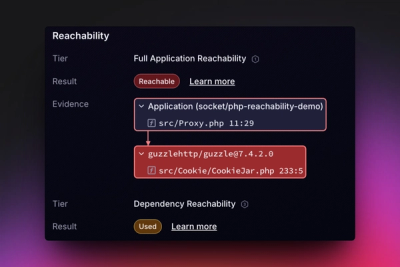
Reachability analysis for PHP is now available in experimental, helping teams identify which vulnerabilities are actually exploitable.