



Security News
CVE Volume Surges Past 48,000 in 2025 as WordPress Plugin Ecosystem Drives Growth
CVE disclosures hit a record 48,185 in 2025, driven largely by vulnerabilities in third-party WordPress plugins.
By Sarah Gooding - Jan 09, 2026
Quickly evaluate the security and health of any open source package.
dwlx
0.1.4
Live on PyPI
Blocked by Socket
This code implements an unprotected download-and-execute workflow (classic dropper). Without additional contextual controls, it poses a high security risk: it enables arbitrary remote code execution and silent delivery of binaries to user machines. Treat as malicious/untrusted unless run in a strictly controlled, auditable environment with upstream integrity guarantees.
mtmai
0.4.184
Live on PyPI
Blocked by Socket
This fragment intends to install and start KasmVNC by running many shell commands that create certs, write VNC password files, adjust group membership, and launch a VNC server. The primary security issues are unsafe shell interpolation (command injection risk), programmatic persistence of a possibly predictable password, execution with sudo based on unvalidated env vars, starting a VNC server exposed on 0.0.0.0 with disabled/basic auth, and multiple unsafe filesystem operations performed via shell. There is no clear evidence of obfuscated or direct exfiltration malware, but the behavior can provide an unauthorized remote access vector (backdoor-like) if used maliciously. Do not run this code without fixing shell usage, validating inputs, using secure randomly generated passwords, enforcing proper file permissions, and not disabling authentication.
opensees
0.0.52
Removed from PyPI
Blocked by Socket
The code contains significant security risks due to the potential for arbitrary code execution and dynamic library loading from untrusted sources. Proper input validation and sanitization are essential to mitigate these risks.
Live on PyPI for 125 days, 9 hours and 51 minutes before removal. Socket users were protected even while the package was live.
rvgrammar.core
2.0.0
by jishuangfei@outlook.com
Live on NuGet
Blocked by Socket
This assembly contains heavy obfuscation and an embedded runtime unpacker/loader: it reads encrypted resources, decrypts/unpacks string/tables and binary blobs, creates DynamicMethods and assigns delegates reflectively, and exposes native primitives (VirtualAlloc/WriteProcessMemory/OpenProcess/VirtualProtect) that allow process memory manipulation and potential code injection. Combined with the parser that can generate C# code from user input, this component is high-risk and potentially malicious or at minimum performing runtime unpacking/loader behavior unsuitable for a benign grammar-only package. I recommend treating this package as suspicious, auditing the embedded resources and runtime-unpacked payloads before usage, or blocking it entirely.
bluelamp-ai
1.0.2
Live on PyPI
Blocked by Socket
This file hides executable Python code in a base64+zlib blob and immediately executes it with exec. That pattern is high risk: it prevents code review and is frequently used for malicious purposes (backdoors, exfiltration, reverse shells). Treat the package as untrusted until the embedded payload is decoded and analyzed in a safe environment. Do not run this code in production.
localstack-ext
1.0.2
Live on PyPI
Blocked by Socket
This is malicious software that functions as a sophisticated backdoor daemon. It implements a multi-threaded HTTP server listening on ports 4600 and 4601 that accepts JSON POST requests from any network interface (0.0.0.0). The daemon provides remote code execution through a 'shell' operation that directly executes arbitrary commands via subprocess without validation or sanitization. It includes privilege escalation capabilities using sudo commands for network interface manipulation, creating dynamic network aliases with ifconfig. The malware can download files from S3 buckets to arbitrary locations with overwrite capability, start SSH forward proxies on privileged port 22, and manipulate system network configuration. Variable names are intentionally obfuscated (_A=True, _B='error', _G='uname -a') to hide the true nature of operations. The code includes mechanisms for remote termination via 'kill' operations and uses hardcoded AWS credential fallbacks. This backdoor provides attackers with extensive system access including shell command execution, file manipulation, network interface control, and SSH proxy services with root privileges.
hub-http
2.1.999
Removed from npm
Blocked by Socket
The code is performing malicious activities by exfiltrating sensitive system information to a remote server. This poses a significant security risk and should be considered as malware.
Live on npm for 1 hour and 32 minutes before removal. Socket users were protected even while the package was live.
vinayak
1.0.0
by vinayaky
Removed from npm
Blocked by Socket
The code is designed to establish a reverse shell, enabling remote command execution on the machine where the code runs. This poses a clear security threat and indicates malicious intent.
Live on npm for 4 days, 19 hours and 34 minutes before removal. Socket users were protected even while the package was live.
meutils
2025.12.22.13.39.27
Live on PyPI
Blocked by Socket
The source code contains suspicious and potentially malicious behavior by uploading arbitrary local files and detailed metadata to a remote server using hardcoded authentication tokens and device identifiers. This constitutes a significant security risk involving unauthorized data exfiltration and privacy violation. Although no direct malware payload like reverse shells or destructive actions are present, the code should be considered high risk and likely malicious due to its data exfiltration capabilities and lack of user transparency.
htps-curl
0.0.2
by realtek
Removed from npm
Blocked by Socket
The code exhibits multiple signs of malicious behavior, including the use of dynamic code execution, communication with an untrusted server, writing and executing files without user consent, and potential data exfiltration. These actions indicate a high security risk and potential malware.
Live on npm for 1 day, 9 hours and 12 minutes before removal. Socket users were protected even while the package was live.
eslint-config-scality
9.9.9
by hackthematrix
Removed from npm
Blocked by Socket
The code is malicious as it collects and sends sensitive system information to an external server without user consent. This poses a significant security risk.
Live on npm for 10 days, 1 hour and 37 minutes before removal. Socket users were protected even while the package was live.
gd-pc-common
8.9.9
by 0xsombra
Removed from npm
Blocked by Socket
The code exhibits malicious behavior by sending environment variables to an external server, which can lead to data theft. The code is not obfuscated but poses a high security risk.
sap-code-style-guides
1.1.0
by anwar.zaib8
Live on npm
Blocked by Socket
This code performs unauthorized data collection and exfiltration: it gathers sensitive host and package information (including /etc/passwd and /etc/hosts) and posts it to a hard-coded external server. This is malicious behavior in a package context (supply-chain/backdoor style). The module should not be used; treat as compromise and remove from any project, and investigate systems where it ran.
moirai
1.3.7
Live on PyPI
Blocked by Socket
This module contains critical security vulnerabilities: use of eval() on multiple untrusted inputs allows arbitrary code execution (RCE) in the process. Database persistence calls create an additional exfiltration path depending on DatabaseV1 behavior. The code should never eval untrusted data; instead it should parse structured, safe formats (e.g., JSON arrays) and validate types and shapes. Treat this code as unsafe to run on untrusted input until eval usage is removed or replaced with a safe parser/executor.
github.com/bishopfox/sliver
v1.5.40-0.20230803235709-59212f06fd5d
Live on Go Modules
Blocked by Socket
This file is a straightforward implementation of a stager generator front-end for the Sliver framework: it collects user input, optionally resolves hostnames interactively, and requests a Metasploit-based stager from an RPC backend, then writes or displays the result. There is no evidence in this snippet of obfuscation, credential theft, or hidden backdoors; however, its intended functionality is offensive (implant/payload generation) and therefore poses a significant security risk in most benign environments. Treat inclusion of this component in a supply chain with caution: it's designed to produce executable implants and depends on a backend that likely executes msfvenom/msfconsole.
github.com/snapcore/snapd
v0.0.0-20251017091036-83e212a62da2
Live on Go Modules
Blocked by Socket
This file contains exploit code that attempts to manipulate snapd via a specially-named client UNIX socket and a raw POST request to '/v2/create-user' with 'force-managed': True. The code creates a temporary UNIX domain socket with a pathname containing ';uid=0;' in /tmp, then connects to '/run/snapd[.]socket' and sends a crafted HTTP request to create a managed user account. This technique exploits snapd's socket pathname parsing to potentially escalate privileges or create unauthorized user accounts. The code appears to be based on a proof-of-concept exploit and could be dangerous if executed on systems running snapd.
softwareai
0.3.66
Live on PyPI
Blocked by Socket
This module automates creation of a repository in a hardcoded organization, uploads local files (including an entire directory tree) to that repository, and automatically grants admin permissions to three hardcoded GitHub accounts. While no code obfuscation or direct remote command-and-control is present, the behavior is dangerous: it can exfiltrate sensitive local files and confer high privileges to external users without user confirmation. Treat as high security risk. Recommendations: require explicit user consent and parameterization for organization and collaborators; restrict and validate uploaded paths (exclude secrets/patterns); validate and scope the token before use; add logging, confirmations, and robust error/rate-limit handling; remove hardcoded admin grants or make collaborators an explicit parameter with approval workflow.
ailever
0.3.172
Live on PyPI
Blocked by Socket
The code exhibits a dangerous remote code execution pattern: it downloads and immediately runs a remote Python payload without integrity checks, sandboxing, or input validation. This creates a severe supply-chain and runtime security risk. Recommended mitigations include removing dynamic downloads, validating payloads with cryptographic hashes or signatures, using safe subprocess invocations with argument lists, and implementing strict input sanitization. If remote functionality must remain, switch to a trusted-internal mechanism (e.g., plugin architecture with signed components, offline verification) and add robust error handling and logging.
ailever
0.2.687
Live on PyPI
Blocked by Socket
This script is a high-risk launcher: it unconditionally fetches Python code from a hardcoded remote repo and executes it locally via a shell-invoked Python process while passing unsanitized user inputs directly into the shell command. Even if the upstream repository is currently benign, the pattern enables trivial supply-chain compromise and shell injection. Mitigations: remove runtime download-and-exec; if fetching is necessary, pin and verify cryptographic hashes or signatures, validate content, avoid os.system (use subprocess with argument lists or importlib), sanitize inputs, and add error handling and logging. Treat this module as unsafe in security-sensitive environments until hardened.
fiinquant
0.11.14
Live on PyPI
Blocked by Socket
The code is highly obfuscated and uses exec to run an unknown payload, which is a significant security risk. The obfuscation and execution of unknown code suggest potential malicious intent.
passagemath-macaulay2
10.6.9
Removed from PyPI
Blocked by Socket
This install script performs a destructive filesystem operation (removing the katex directory) and then executes an unknown command. Even if not overtly labeled as malware, it poses a high risk: it can cause data loss and enables execution of arbitrary code. You should not run this without inspecting the package contents and verifying what `copy-files-from-to` refers to and why katex is being removed.
Live on PyPI for 5 hours and 32 minutes before removal. Socket users were protected even while the package was live.
iparapheur-utils-beta
0.0.1.post103532
Live on PyPI
Blocked by Socket
The code intentionally resets the Alfresco 'admin' account password to a hardcoded hash and restarts the Alfresco service. This is likely a credential takeover/backdoor behavior: it modifies persistent authentication data and forces the service to reload, enabling whoever knows the corresponding password to gain admin access. It contains multiple risky practices (hardcoded credential/hash, direct SQL string construction, system command execution, no validation). Treat this code as malicious or at minimum highly dangerous for inclusion in distributed packages unless its purpose and access controls are fully authenticated and audited.
dhp-logging-lib
7.2.7
by npm062884
Removed from npm
Blocked by Socket
The code exhibits malicious behavior by collecting and transmitting sensitive system information to an external server without user consent. This poses a high security risk and potential for data theft.
Live on npm for 10 days, 6 hours and 38 minutes before removal. Socket users were protected even while the package was live.
dwlx
0.1.4
Live on PyPI
Blocked by Socket
This code implements an unprotected download-and-execute workflow (classic dropper). Without additional contextual controls, it poses a high security risk: it enables arbitrary remote code execution and silent delivery of binaries to user machines. Treat as malicious/untrusted unless run in a strictly controlled, auditable environment with upstream integrity guarantees.
mtmai
0.4.184
Live on PyPI
Blocked by Socket
This fragment intends to install and start KasmVNC by running many shell commands that create certs, write VNC password files, adjust group membership, and launch a VNC server. The primary security issues are unsafe shell interpolation (command injection risk), programmatic persistence of a possibly predictable password, execution with sudo based on unvalidated env vars, starting a VNC server exposed on 0.0.0.0 with disabled/basic auth, and multiple unsafe filesystem operations performed via shell. There is no clear evidence of obfuscated or direct exfiltration malware, but the behavior can provide an unauthorized remote access vector (backdoor-like) if used maliciously. Do not run this code without fixing shell usage, validating inputs, using secure randomly generated passwords, enforcing proper file permissions, and not disabling authentication.
opensees
0.0.52
Removed from PyPI
Blocked by Socket
The code contains significant security risks due to the potential for arbitrary code execution and dynamic library loading from untrusted sources. Proper input validation and sanitization are essential to mitigate these risks.
Live on PyPI for 125 days, 9 hours and 51 minutes before removal. Socket users were protected even while the package was live.
rvgrammar.core
2.0.0
by jishuangfei@outlook.com
Live on NuGet
Blocked by Socket
This assembly contains heavy obfuscation and an embedded runtime unpacker/loader: it reads encrypted resources, decrypts/unpacks string/tables and binary blobs, creates DynamicMethods and assigns delegates reflectively, and exposes native primitives (VirtualAlloc/WriteProcessMemory/OpenProcess/VirtualProtect) that allow process memory manipulation and potential code injection. Combined with the parser that can generate C# code from user input, this component is high-risk and potentially malicious or at minimum performing runtime unpacking/loader behavior unsuitable for a benign grammar-only package. I recommend treating this package as suspicious, auditing the embedded resources and runtime-unpacked payloads before usage, or blocking it entirely.
bluelamp-ai
1.0.2
Live on PyPI
Blocked by Socket
This file hides executable Python code in a base64+zlib blob and immediately executes it with exec. That pattern is high risk: it prevents code review and is frequently used for malicious purposes (backdoors, exfiltration, reverse shells). Treat the package as untrusted until the embedded payload is decoded and analyzed in a safe environment. Do not run this code in production.
localstack-ext
1.0.2
Live on PyPI
Blocked by Socket
This is malicious software that functions as a sophisticated backdoor daemon. It implements a multi-threaded HTTP server listening on ports 4600 and 4601 that accepts JSON POST requests from any network interface (0.0.0.0). The daemon provides remote code execution through a 'shell' operation that directly executes arbitrary commands via subprocess without validation or sanitization. It includes privilege escalation capabilities using sudo commands for network interface manipulation, creating dynamic network aliases with ifconfig. The malware can download files from S3 buckets to arbitrary locations with overwrite capability, start SSH forward proxies on privileged port 22, and manipulate system network configuration. Variable names are intentionally obfuscated (_A=True, _B='error', _G='uname -a') to hide the true nature of operations. The code includes mechanisms for remote termination via 'kill' operations and uses hardcoded AWS credential fallbacks. This backdoor provides attackers with extensive system access including shell command execution, file manipulation, network interface control, and SSH proxy services with root privileges.
hub-http
2.1.999
Removed from npm
Blocked by Socket
The code is performing malicious activities by exfiltrating sensitive system information to a remote server. This poses a significant security risk and should be considered as malware.
Live on npm for 1 hour and 32 minutes before removal. Socket users were protected even while the package was live.
vinayak
1.0.0
by vinayaky
Removed from npm
Blocked by Socket
The code is designed to establish a reverse shell, enabling remote command execution on the machine where the code runs. This poses a clear security threat and indicates malicious intent.
Live on npm for 4 days, 19 hours and 34 minutes before removal. Socket users were protected even while the package was live.
meutils
2025.12.22.13.39.27
Live on PyPI
Blocked by Socket
The source code contains suspicious and potentially malicious behavior by uploading arbitrary local files and detailed metadata to a remote server using hardcoded authentication tokens and device identifiers. This constitutes a significant security risk involving unauthorized data exfiltration and privacy violation. Although no direct malware payload like reverse shells or destructive actions are present, the code should be considered high risk and likely malicious due to its data exfiltration capabilities and lack of user transparency.
htps-curl
0.0.2
by realtek
Removed from npm
Blocked by Socket
The code exhibits multiple signs of malicious behavior, including the use of dynamic code execution, communication with an untrusted server, writing and executing files without user consent, and potential data exfiltration. These actions indicate a high security risk and potential malware.
Live on npm for 1 day, 9 hours and 12 minutes before removal. Socket users were protected even while the package was live.
eslint-config-scality
9.9.9
by hackthematrix
Removed from npm
Blocked by Socket
The code is malicious as it collects and sends sensitive system information to an external server without user consent. This poses a significant security risk.
Live on npm for 10 days, 1 hour and 37 minutes before removal. Socket users were protected even while the package was live.
gd-pc-common
8.9.9
by 0xsombra
Removed from npm
Blocked by Socket
The code exhibits malicious behavior by sending environment variables to an external server, which can lead to data theft. The code is not obfuscated but poses a high security risk.
sap-code-style-guides
1.1.0
by anwar.zaib8
Live on npm
Blocked by Socket
This code performs unauthorized data collection and exfiltration: it gathers sensitive host and package information (including /etc/passwd and /etc/hosts) and posts it to a hard-coded external server. This is malicious behavior in a package context (supply-chain/backdoor style). The module should not be used; treat as compromise and remove from any project, and investigate systems where it ran.
moirai
1.3.7
Live on PyPI
Blocked by Socket
This module contains critical security vulnerabilities: use of eval() on multiple untrusted inputs allows arbitrary code execution (RCE) in the process. Database persistence calls create an additional exfiltration path depending on DatabaseV1 behavior. The code should never eval untrusted data; instead it should parse structured, safe formats (e.g., JSON arrays) and validate types and shapes. Treat this code as unsafe to run on untrusted input until eval usage is removed or replaced with a safe parser/executor.
github.com/bishopfox/sliver
v1.5.40-0.20230803235709-59212f06fd5d
Live on Go Modules
Blocked by Socket
This file is a straightforward implementation of a stager generator front-end for the Sliver framework: it collects user input, optionally resolves hostnames interactively, and requests a Metasploit-based stager from an RPC backend, then writes or displays the result. There is no evidence in this snippet of obfuscation, credential theft, or hidden backdoors; however, its intended functionality is offensive (implant/payload generation) and therefore poses a significant security risk in most benign environments. Treat inclusion of this component in a supply chain with caution: it's designed to produce executable implants and depends on a backend that likely executes msfvenom/msfconsole.
github.com/snapcore/snapd
v0.0.0-20251017091036-83e212a62da2
Live on Go Modules
Blocked by Socket
This file contains exploit code that attempts to manipulate snapd via a specially-named client UNIX socket and a raw POST request to '/v2/create-user' with 'force-managed': True. The code creates a temporary UNIX domain socket with a pathname containing ';uid=0;' in /tmp, then connects to '/run/snapd[.]socket' and sends a crafted HTTP request to create a managed user account. This technique exploits snapd's socket pathname parsing to potentially escalate privileges or create unauthorized user accounts. The code appears to be based on a proof-of-concept exploit and could be dangerous if executed on systems running snapd.
softwareai
0.3.66
Live on PyPI
Blocked by Socket
This module automates creation of a repository in a hardcoded organization, uploads local files (including an entire directory tree) to that repository, and automatically grants admin permissions to three hardcoded GitHub accounts. While no code obfuscation or direct remote command-and-control is present, the behavior is dangerous: it can exfiltrate sensitive local files and confer high privileges to external users without user confirmation. Treat as high security risk. Recommendations: require explicit user consent and parameterization for organization and collaborators; restrict and validate uploaded paths (exclude secrets/patterns); validate and scope the token before use; add logging, confirmations, and robust error/rate-limit handling; remove hardcoded admin grants or make collaborators an explicit parameter with approval workflow.
ailever
0.3.172
Live on PyPI
Blocked by Socket
The code exhibits a dangerous remote code execution pattern: it downloads and immediately runs a remote Python payload without integrity checks, sandboxing, or input validation. This creates a severe supply-chain and runtime security risk. Recommended mitigations include removing dynamic downloads, validating payloads with cryptographic hashes or signatures, using safe subprocess invocations with argument lists, and implementing strict input sanitization. If remote functionality must remain, switch to a trusted-internal mechanism (e.g., plugin architecture with signed components, offline verification) and add robust error handling and logging.
ailever
0.2.687
Live on PyPI
Blocked by Socket
This script is a high-risk launcher: it unconditionally fetches Python code from a hardcoded remote repo and executes it locally via a shell-invoked Python process while passing unsanitized user inputs directly into the shell command. Even if the upstream repository is currently benign, the pattern enables trivial supply-chain compromise and shell injection. Mitigations: remove runtime download-and-exec; if fetching is necessary, pin and verify cryptographic hashes or signatures, validate content, avoid os.system (use subprocess with argument lists or importlib), sanitize inputs, and add error handling and logging. Treat this module as unsafe in security-sensitive environments until hardened.
fiinquant
0.11.14
Live on PyPI
Blocked by Socket
The code is highly obfuscated and uses exec to run an unknown payload, which is a significant security risk. The obfuscation and execution of unknown code suggest potential malicious intent.
passagemath-macaulay2
10.6.9
Removed from PyPI
Blocked by Socket
This install script performs a destructive filesystem operation (removing the katex directory) and then executes an unknown command. Even if not overtly labeled as malware, it poses a high risk: it can cause data loss and enables execution of arbitrary code. You should not run this without inspecting the package contents and verifying what `copy-files-from-to` refers to and why katex is being removed.
Live on PyPI for 5 hours and 32 minutes before removal. Socket users were protected even while the package was live.
iparapheur-utils-beta
0.0.1.post103532
Live on PyPI
Blocked by Socket
The code intentionally resets the Alfresco 'admin' account password to a hardcoded hash and restarts the Alfresco service. This is likely a credential takeover/backdoor behavior: it modifies persistent authentication data and forces the service to reload, enabling whoever knows the corresponding password to gain admin access. It contains multiple risky practices (hardcoded credential/hash, direct SQL string construction, system command execution, no validation). Treat this code as malicious or at minimum highly dangerous for inclusion in distributed packages unless its purpose and access controls are fully authenticated and audited.
dhp-logging-lib
7.2.7
by npm062884
Removed from npm
Blocked by Socket
The code exhibits malicious behavior by collecting and transmitting sensitive system information to an external server without user consent. This poses a high security risk and potential for data theft.
Live on npm for 10 days, 6 hours and 38 minutes before removal. Socket users were protected even while the package was live.
Socket detects traditional vulnerabilities (CVEs) but goes beyond that to scan the actual code of dependencies for malicious behavior. It proactively detects and blocks 70+ signals of supply chain risk in open source code, for comprehensive protection.
Possible typosquat attack
Known malware
Suspicious Stars on GitHub
HTTP dependency
Git dependency
GitHub dependency
AI-detected potential malware
Obfuscated code
Telemetry
Protestware or potentially unwanted behavior
Critical CVE
High CVE
Medium CVE
Low CVE
Unpopular package
Minified code
Bad dependency semver
Wildcard dependency
Socket optimized override available
Deprecated
Unmaintained
License Policy Violation
Explicitly Unlicensed Item
Misc. License Issues
Copyleft License
No License Found
Ambiguous License Classifier
License exception
Non-permissive License
Unidentified License
Socket detects and blocks malicious dependencies, often within just minutes of them being published to public registries, making it the most effective tool for blocking zero-day supply chain attacks.
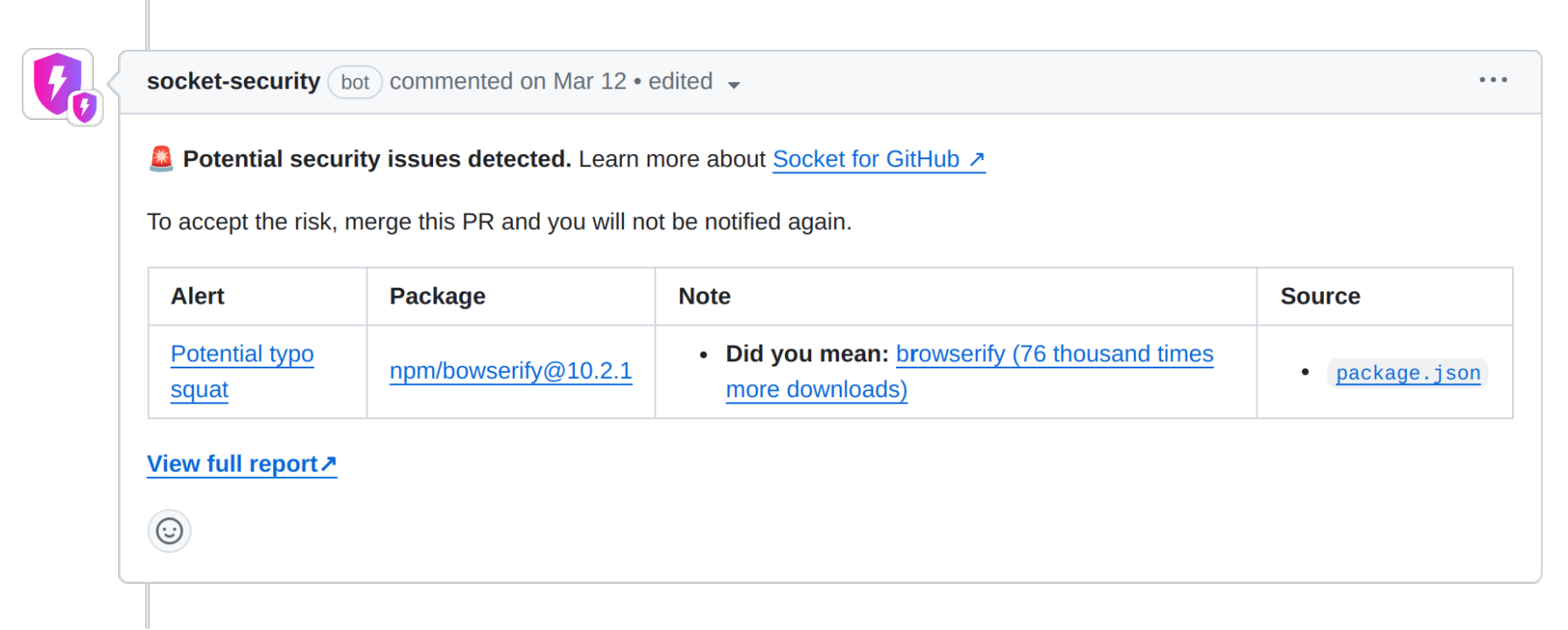
Socket is built by a team of prolific open source maintainers whose software is downloaded over 1 billion times per month. We understand how to build tools that developers love. But don’t take our word for it.

Nat Friedman
CEO at GitHub

Suz Hinton
Senior Software Engineer at Stripe
heck yes this is awesome!!! Congrats team 🎉👏

Matteo Collina
Node.js maintainer, Fastify lead maintainer
So awesome to see @SocketSecurity launch with a fresh approach! Excited to have supported the team from the early days.

DC Posch
Director of Technology at AppFolio, CTO at Dynasty
This is going to be super important, especially for crypto projects where a compromised dependency results in stolen user assets.

Luis Naranjo
Software Engineer at Microsoft
If software supply chain attacks through npm don't scare the shit out of you, you're not paying close enough attention.
@SocketSecurity sounds like an awesome product. I'll be using socket.dev instead of npmjs.org to browse npm packages going forward

Elena Nadolinski
Founder and CEO at Iron Fish
Huge congrats to @SocketSecurity! 🙌
Literally the only product that proactively detects signs of JS compromised packages.

Joe Previte
Engineering Team Lead at Coder
Congrats to @feross and the @SocketSecurity team on their seed funding! 🚀 It's been a big help for us at @CoderHQ and we appreciate what y'all are doing!

Josh Goldberg
Staff Developer at Codecademy
This is such a great idea & looks fantastic, congrats & good luck @feross + team!
The best security teams in the world use Socket to get visibility into supply chain risk, and to build a security feedback loop into the development process.

Scott Roberts
CISO at UiPath
As a happy Socket customer, I've been impressed with how quickly they are adding value to the product, this move is a great step!

Yan Zhu
Head of Security at Brave, DEFCON, EFF, W3C
glad to hear some of the smartest people i know are working on (npm, etc.) supply chain security finally :). @SocketSecurity

Andrew Peterson
CEO and Co-Founder at Signal Sciences (acq. Fastly)
How do you track the validity of open source software libraries as they get updated? You're prob not. Check out @SocketSecurity and the updated tooling they launched.
Supply chain is a cluster in security as we all know and the tools from Socket are "duh" type tools to be implementing. Check them out and follow Feross Aboukhadijeh to see more updates coming from them in the future.

Zbyszek Tenerowicz
Senior Security Engineer at ConsenSys
socket.dev is getting more appealing by the hour

Devdatta Akhawe
Head of Security at Figma
The @SocketSecurity team is on fire! Amazing progress and I am exciting to see where they go next.

Sebastian Bensusan
Engineer Manager at Stripe
I find it surprising that we don't have _more_ supply chain attacks in software:
Imagine your airplane (the code running) was assembled (deployed) daily, with parts (dependencies) from internet strangers. How long until you get a bad part?
Excited for Socket to prevent this

Adam Baldwin
VP of Security at npm, Red Team at Auth0/Okta
Congrats to everyone at @SocketSecurity ❤️🤘🏻

Nico Waisman
CISO at Lyft
This is an area that I have personally been very focused on. As Nat Friedman said in the 2019 GitHub Universe keynote, Open Source won, and every time you add a new open source project you rely on someone else code and you rely on the people that build it.
This is both exciting and problematic. You are bringing real risk into your organization, and I'm excited to see progress in the industry from OpenSSF scorecards and package analyzers to the company that Feross Aboukhadijeh is building!
Depend on Socket to prevent malicious open source dependencies from infiltrating your app.
Install the Socket GitHub App in just 2 clicks and get protected today.
Block 70+ issues in open source code, including malware, typo-squatting, hidden code, misleading packages, permission creep, and more.
Reduce work by surfacing actionable security information directly in GitHub. Empower developers to make better decisions.
Attackers have taken notice of the opportunity to attack organizations through open source dependencies. Supply chain attacks rose a whopping 700% in the past year, with over 15,000 recorded attacks.
Nov 23, 2025
Shai Hulud v2
Shai Hulud v2 campaign: preinstall script (setup_bun.js) and loader (setup_bin.js) that installs/locates Bun and executes an obfuscated bundled malicious script (bun_environment.js) with suppressed output.
Nov 05, 2025
Elves on npm
A surge of auto-generated "elf-stats" npm packages is being published every two minutes from new accounts. These packages contain simple malware variants and are being rapidly removed by npm. At least 420 unique packages have been identified, often described as being generated every two minutes, with some mentioning a capture the flag challenge or test.
Jul 04, 2025
RubyGems Automation-Tool Infostealer
Since at least March 2023, a threat actor using multiple aliases uploaded 60 malicious gems to RubyGems that masquerade as automation tools (Instagram, TikTok, Twitter, Telegram, WordPress, and Naver). The gems display a Korean Glimmer-DSL-LibUI login window, then exfiltrate the entered username/password and the host's MAC address via HTTP POST to threat actor-controlled infrastructure.
Mar 13, 2025
North Korea's Contagious Interview Campaign
Since late 2024, we have tracked hundreds of malicious npm packages and supporting infrastructure tied to North Korea's Contagious Interview operation, with tens of thousands of downloads targeting developers and tech job seekers. The threat actors run a factory-style playbook: recruiter lures and fake coding tests, polished GitHub templates, and typosquatted or deceptive dependencies that install or import into real projects.
Jul 23, 2024
Network Reconnaissance Campaign
A malicious npm supply chain attack that leveraged 60 packages across three disposable npm accounts to fingerprint developer workstations and CI/CD servers during installation. Each package embedded a compact postinstall script that collected hostnames, internal and external IP addresses, DNS resolvers, usernames, home and working directories, and package metadata, then exfiltrated this data as a JSON blob to a hardcoded Discord webhook.
Get our latest security research, open source insights, and product updates.
Security News
CVE disclosures hit a record 48,185 in 2025, driven largely by vulnerabilities in third-party WordPress plugins.

Security News
Socket CEO Feross Aboukhadijeh joins Insecure Agents to discuss CVE remediation and why supply chain attacks require a different security approach.

Security News
Tailwind Labs laid off 75% of its engineering team after revenue dropped 80%, as LLMs redirect traffic away from documentation where developers discover paid products.