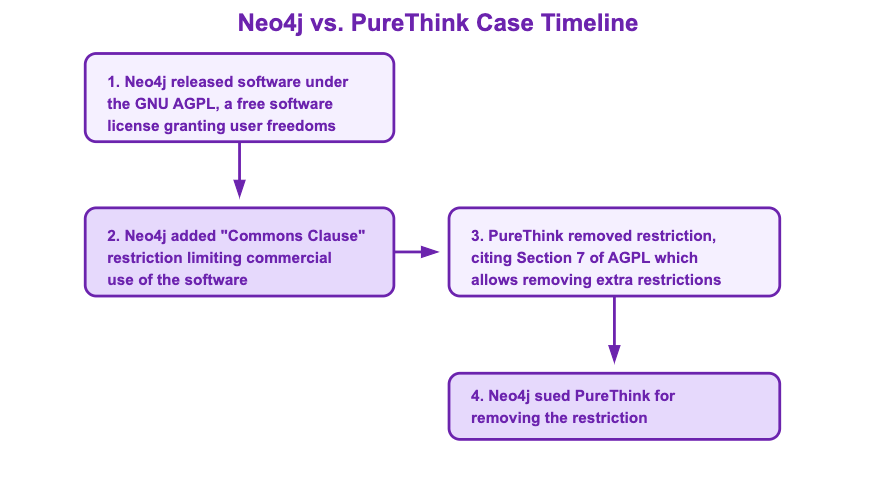
In a significant move for software freedom, the Free Software Foundation (FSF) has submitted a legal brief in an ongoing court case involving the misuse of their GNU Affero General Public License Version 3 (AGPLv3).
FSF, the organization behind popular open source licenses like the GPL, has filed an amicus brief (a "friend of the court" document) in the appeal of Neo4j, Inc. v. PureThink, LLC that's currently before the U.S. Court of Appeals for the Ninth Circuit.
This case touches on a fundamental principle of free software: companies cannot add restrictive terms to free software licenses while still claiming the benefits and protections of those licenses.
At the heart of the dispute is Neo4j’s attempt to modify the AGPL by appending the Commons Clause, an extra restriction that limits commercial use—a move the FSF argues is incompatible with the license’s intent. Under Section 7 of the AGPLv3, additional restrictions like this can be removed by users, ensuring that software licensed under AGPL remains truly free.
In the complaint, filed in 2018, Neo4j claims that PureThink and its successor, iGov Inc., continued using the Neo4j name and branding after their partnership was terminated, misleading customers into believing they were still affiliated. Neo4j also argues that PureThink, as a former Neo4j solution partner, was contractually prohibited from offering competing services or misrepresenting Neo4j’s open source licensing.
FSF Gets Involved with Amicus Brief Shooting Down Neo4j’s Claims About the AGPL#
The FSF had previously sent Neo4j a cease-and-desist letter in November 2023, stating that their approach violated the FSF's rights as maintainers of the AGPL with further explanation of its proper interpretation:
The AGPL explicitly permits the removal of additional restrictions.
The Commons Clause qualifies as such a restriction.
Therefore, licensees—including defendant PureThink—were within their rights to remove it.
Following this, Neo4j removed the infringing files from its repositories and stopped offering its software as free software under the AGPL.
The FSF stepped in with its own amicus brief because Neo4j’s legal filings contained misstatements about the FSF’s intent and the AGPL’s provisions.
FSF Executive Director Zoë Kooyman explained the decision:
The FSF previously pushed Neo4j to correct their abuse of the AGPL. Their misstatements and baseless arguments in their opposition have now compelled the FSF to step in again to set the record straight.
The FSF contends that courts should consider the original intent behind the AGPL when interpreting it. The Commons Clause directly contradicts the AGPL’s core purpose—which is to protect users' rights to freely use, modify, and share software.
This case could set an important precedent for how companies can (or cannot) modify open source licenses. If Neo4j prevails, it could weaken protections built into free software licenses and potentially allow companies to restrict freedoms while still benefiting from the free software ecosystem.
The FSF's executive director, Zoë Kooyman, emphasized, "The GNU licenses were designed to empower users and we will continue to make sure this is understood."
AGPL’s Growing Importance in Open Source Licensing#
Neo4j’s legal maneuvers are an attempt to emasculate the AGPL in the courts by pushing for additional restrictions that contradict its core principles, forcing the FSF to respond in defense of software freedom.
While the AGPL has recently faced setbacks in court, it has seen a renewed adoption among companies seeking to avoid the mistakes made by Elastic. After its move to restrictive relicensing in 2021, those who watched open source developers get burned by Elastic took note. Many are now choosing AGPL from the outset to protect their communities and prevent future licensing conflicts. Companies like MinIO, Grafana, Citus, Quickwit, and ParadeDB have embraced AGPL to ensure that their work remains open and cannot be co-opted by cloud vendors or corporations looking to impose proprietary restrictions. The FSF’s intervention in the Neo4j case is part of this broader effort to reassert the AGPL’s strength and reaffirm its role as a safeguard for free software.
The case is now before the Ninth Circuit Court of Appeals, which will determine whether Neo4j’s modifications to the AGPL were legally valid. You can read the FSF’s full amicus brief on its website.
Secure your dependencies with us
Socket proactively blocks malicious open source packages in your code.