

Security News
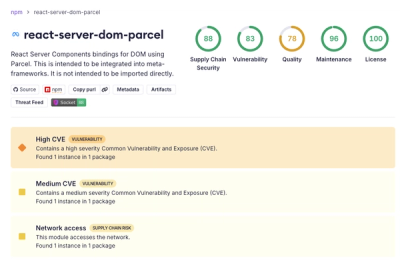
New React Server Components Vulnerabilities: DoS and Source Code Exposure
New DoS and source code exposure bugs in React Server Components and Next.js: what’s affected and how to update safely.
By Sarah Gooding - Dec 12, 2025
github.com/open-telemetry/opentelemetry-collector-contrib/receiver/elasticsearchreceiver
Advanced tools
| Status | |
|---|---|
| Stability | beta: metrics |
| Distributions | contrib |
| Issues |   |
| Code coverage |  |
| Code Owners | @jsirianni, @VihasMakwana, @rogercoll | Seeking more code owners! |
| Emeritus | @djaglowski |
This receiver queries the Elasticsearch node stats, cluster health and index stats endpoints in order to scrape metrics from a running Elasticsearch cluster.
Note: in the future, Elasticsearch will be instrumented with the OpenTelemetry Java SDK directly (https://github.com/elastic/elasticsearch/issues/109335). When this is complete, native OpenTelemetry metrics may be added for measuring cluster health, index statistics, and so on. Please subscribe to the linked issue to keep updated.
This receiver supports Elasticsearch versions 7.9+
If Elasticsearch security features are enabled, you must have either the monitor or manage cluster privilege.
See the Elasticsearch docs for more information on authorization and Security privileges.
The following settings are optional:
nodes (default: ["_all"]): Allows specifying node filters that define which nodes are scraped for node-level and cluster-level metrics. See the Elasticsearch documentation for allowed filters. If this option is left explicitly empty, then no node-level metrics will be scraped and cluster-level metrics will scrape only metrics related to cluster's health.skip_cluster_metrics (default: false): If true, cluster-level metrics will not be scraped.indices (default: ["_all"]): Allows specifying index filters that define which indices are scraped for index-level metrics. See the Elasticsearch documentation for allowed filters. If this option is left explicitly empty, then no index-level metrics will be scraped.endpoint (default = http://localhost:9200): The base URL of the Elasticsearch API for the cluster to monitor.username (no default): Specifies the username used to authenticate with Elasticsearch using basic auth. Must be specified if password is specified.password (no default): Specifies the password used to authenticate with Elasticsearch using basic auth. Must be specified if username is specified.collection_interval (default = 10s): This receiver collects metrics on an interval. This value must be a string readable by Golang's time.ParseDuration. On larger clusters, the interval may need to be lengthened, as querying Elasticsearch for metrics will take longer on clusters with more nodes.initial_delay (default = 1s): defines how long this receiver waits before starting.receivers:
elasticsearch:
metrics:
elasticsearch.node.fs.disk.available:
enabled: false
nodes: ["_local"]
skip_cluster_metrics: true
indices: [".geoip_databases"]
endpoint: http://localhost:9200
username: otel
password: password
collection_interval: 10s
The full list of settings exposed for this receiver are documented in config.go with detailed sample configurations in testdata/config.yaml.
The following metric are available with versions:
elasticsearch.indexing_pressure.memory.limit >= 7.10elasticsearch.node.shards.data_set.size >= 7.13elasticsearch.cluster.state_update.count >= 7.16.0elasticsearch.cluster.state_update.time >= 7.16.0Details about the metrics produced by this receiver can be found in metadata.yaml. Refer to documentation.md for information on how to enable and disable metrics produced by this receiver.
FAQs
Unknown package
Did you know?

Socket for GitHub automatically highlights issues in each pull request and monitors the health of all your open source dependencies. Discover the contents of your packages and block harmful activity before you install or update your dependencies.
Security News
New DoS and source code exposure bugs in React Server Components and Next.js: what’s affected and how to update safely.

Security News
Socket CEO Feross Aboukhadijeh joins Software Engineering Daily to discuss modern software supply chain attacks and rising AI-driven security risks.
Security News
GitHub has revoked npm classic tokens for publishing; maintainers must migrate, but OpenJS warns OIDC trusted publishing still has risky gaps for critical projects.