

Company News
Socket Has Acquired Secure Annex
Socket has acquired Secure Annex to expand extension security across browsers, IDEs, and AI tools.
By Feross Aboukhadijeh - Apr 28, 2026
open-cluster-management.io/config-policy-controller
Advanced tools
Open Cluster Management - Configuration Policy Controller


With the Configuration Policy Controller, you can create ConfigurationPolicies to check if the specified objects are present in the cluster. The controller records compliancy details in the status of each ConfigurationPolicy, and as Kubernetes Events. If the policy is set to enforce the configuration, then the controller will attempt to create, update, or delete objects on the cluster as necessary to match the specified state. The controller can be run as a stand-alone program or as an integrated part of governing risk with the Open Cluster Management project.
The ConfigurationPolicy spec includes the following fields:
| Field | Description |
|---|---|
| severity | Optional: low, medium, or high. |
| remediationAction | Required: inform or enforce. Determines what actions the controller will take if the actual state of the object-templates does not match what is desired. |
| namespaceSelector | Optional: an object with include and exclude lists, specifying where the controller will look for the actual state of the object-templates, if the object is namespaced and not already specified in the object. |
| object-templates | Required: A list of Kubernetes objects that will be checked on the cluster. |
Additionally, each item in the object-templates includes these fields:
| Field | Description |
|---|---|
| complianceType | Required: musthave, mustnothave or mustonlyhave. Determines how to decide if the cluster is compliant with the policy. |
| objectDefinition | Required: A Kubernetes object which must (or must not) match an object on the cluster in order to comply with this policy. |
Following is an example spec of a ConfigurationPolicy object:
apiVersion: policy.open-cluster-management.io/v1
kind: ConfigurationPolicy
metadata:
  name: policy-pod-example
spec:
  remediationAction: enforce
  severity: low
  namespaceSelector:
    exclude: ["kube-*"]
    include: ["default"]
  object-templates:
    - complianceType: musthave
      objectDefinition:
        apiVersion: v1
        kind: Pod
        metadata:
          name: sample-nginx-pod
        spec:
          containers:
          - image: nginx:1.18.0
            name: nginx
            ports:
            - containerPort: 80
Configuration Policies supports inclusion of Golang text templates in ObjectDefinitions. These templates are resolved at runtime on the target cluster using configuration local to that cluster giving the user the ability to define policies customized to the target cluster. Following custom template functions are available to allow referencing kube-resources on the target cluster.
fromSecret - returns the value of the specified data key in the Secret resourcefromConfigMap - returns the values of the specified data key in the ConfigMap resource.fromClusterClaim - returns the value of Spec.Value field in the ClusterClaim resource.lookup - a generic lookup function to retreive any kube resource.Following is an example spec of a ConfigurationPolicy object with templates :
apiVersion: policy.open-cluster-management.io/v1
kind: ConfigurationPolicy
metadata:
  name: demo-templates
  namespace: test-templates
spec:
  namespaceSelector:
    exclude:
    - kube-*
    include:
    - default
  object-templates:
  - complianceType: musthave
    objectDefinition:
      kind: ConfigMap
      apiVersion: v1
      metadata:
        name: demo-templates
        namespace: test
      data:
        # Configuration values can be set as key-value properties
        app-name: sampleApp
        app-description: "this is a sample app"
        app-key: '{{ fromSecret "test" "testappkeys" "app-key"  | base64dec }}'
        log-file: '{{ fromConfigMap "test" "logs-config" "log-file" }}'
        appmetrics-url: |
          http://{{ (lookup "v1" "Service" "test" "appmetrics").spec.clusterIP }}:8080
        app-version: version: '{{ fromClusterClaim "version.openshift.io" }}'
  remediationAction: enforce
  severity: low
The Deployment config-policy-controller contains two main controllers: Configuration Policy Controller and Operator Policy Controller. Both evaluate policy rules and support Golang text templates.
Configuration Policy Controller - Watches for ConfigurationPolicy resources and evaluates Kubernetes objects against desired state specifications.
Operator Policy Controller - Manages the lifecycle of Operator Lifecycle Manager (OLM) operators through OperatorPolicy resources. Handles Subscriptions, OperatorGroups, and monitors the health of operator deployments and ClusterServiceVersions. The controller can manage operator installation, upgrades, and removal with configurable behaviors for resource cleanup.

Go to the Contributing guide to learn how to get involved.
make build
kubectl
export WATCH_NAMESPACE=<namespace>
make run
WATCH_NAMESPACE can be any namespace on the cluster that you want the controller to monitor for policies.)(optional) Build container image
make build-images
export REGISTRY=''  # (defaults to 'quay.io/open-cluster-management')
export IMG=''       # (defaults to the repository name)
export TAG=''       # (defaults to 'latest')
Deploy controller to a cluster
The controller is deployed to a namespace defined in KIND_NAMESPACE and monitors the namepace defined in WATCH_NAMESPACE for ConfigurationPolicy resources.
Deploy the controller and related resources
make deploy
The deployment namespaces are configurable with:
export KIND_NAMESPACE=''  # (defaults to 'open-cluster-management-agent-addon')
export WATCH_NAMESPACE=''       # (defaults to 'managed')
NOTE: Please be aware of the community's deployment images special note.
make fmt
make test-dependencies
make test
config-policy-controller is part of the open-cluster-management community. For more information, visit: open-cluster-management.io.FAQs
Unknown package
Did you know?

Socket for GitHub automatically highlights issues in each pull request and monitors the health of all your open source dependencies. Discover the contents of your packages and block harmful activity before you install or update your dependencies.
Company News
Socket has acquired Secure Annex to expand extension security across browsers, IDEs, and AI tools.

Research
/Security News
Socket is tracking cloned Open VSX extensions tied to GlassWorm, with several updated from benign-looking sleepers into malware delivery vehicles.
Product
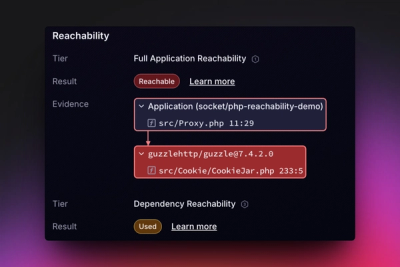
Reachability analysis for PHP is now available in experimental, helping teams identify which vulnerabilities are actually exploitable.