

Product
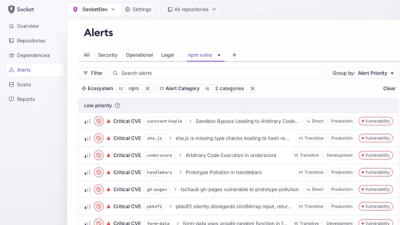
Introducing Custom Tabs for Org Alerts
Create and share saved alert views with custom tabs on the org alerts page, making it easier for teams to return to consistent, named filter sets.
By André Staltz - Jan 20, 2026


import "toolman.org/flags/tristate"
go get toolman.org/flags/tristate
Package tristate provides a custom TriState flag for use with the alternate flag package github.com/spf13/pflag. A TriState value may take one of three forms: True, False or None and is most useful when you are, for instance, filtering records based on a current boolean value -- and you need all three possibilities (e.g. True, False and I Don't Care)
There are 8 separate functions provided for defining a TriState flag with some combination of the suffixes: "Var", "P", and "FS" each having the following meaning:
Var: Accepts a TriState pointer instead of returning one.
P:   Also takes a shorthand character for use with a single dash
FS:  Accepts a *FlagSet where the flag should be added
The "Var" and "P" suffixes follow the common pflag convention. The "FS" suffix is added to allow the use of alternate FlagSets.
var (
    // CommandLine is the default FlagSet where flags will be added (unless
    // otherwise specified)
    CommandLine = pflag.CommandLine
)
var ErrBadTriStateValue = errors.New("bad tristate value")
ErrBadTriStateValue is returned by Set if if cannot parse its input.
func FlagVar(ts *TriState, name string, value TriState, usage string)
FlagVar is similar to Flag that also accepts a pointer to TriState variable where the flag value should be stored.
func FlagVarFS(fs *pflag.FlagSet, ts *TriState, name string, value TriState, usage string)
FlagVarFS is similar to FlagVar but accepts a pointer to the FlagSet where this flag should be added.
func FlagVarP(ts *TriState, name, shorthand string, value TriState, usage string)
FlagVarP is the combination of FlagVar and FlagP.
func FlagVarPFS(fs *pflag.FlagSet, ts *TriState, name, shorthand string, value TriState, usage string)
FlagVarPFS is similar to FlagVarP but accepts a pointer to the FlagSet where this flag should be added.
type TriState int
TriState is a TriState Value and may have one of three values: None, False or True. Its "zero" value is None.
const (
    None TriState = iota
    False
    True
)
The three possible tristate values
func Flag(name string, value TriState, usage string) *TriState
Flag defines a tristate.TriState flag with the specified name, default value and usage string. The return value is the address of a TriState variable the stores the values of the flag.
func FlagFS(fs *pflag.FlagSet, name string, value TriState, usage string) *TriState
FlagFS is similar to Flag but accepts a pointer to the FlagSet where this flag should be added.
func FlagP(name, shorthand string, value TriState, usage string) *TriState
FlagP is similar to Flag butl also accepts a shorthand letter to be used after a single dash.
func FlagPFS(fs *pflag.FlagSet, name, shorthand string, value TriState, usage string) *TriState
FlagPFS is similar to FlagP but accepts a pointer to the FlagSet where this flag should be added.
func (ts *TriState) Bool() *bool
Bool returns a pointer to a bool holding the value of ts. If ts is None then Bool returns nil.
func (ts *TriState) Get() interface{}
Get implements flag.Getter
func (ts *TriState) Set(s string) error
Set the tristate.Value by parsing s according to the following rules:
Value: Strings
------ ----------------------------------------------------------
True:  1, t, true, y, yes
False: 0, f, false, n, no
None:  -1, u, unknown, e, either, b, both, a, all, none, null, nil
Allstring input is case insensitive. Any string not mentioned above will return ErrBadTriStateValue.
Set contributes to the implementation of pflag.Value
func (ts TriState) String() string
String contributes to the implementation of pflag.Value
func (ts *TriState) Type() string
Type contributes to the implementation of pflag.Value
FAQs
Unknown package
Did you know?

Socket for GitHub automatically highlights issues in each pull request and monitors the health of all your open source dependencies. Discover the contents of your packages and block harmful activity before you install or update your dependencies.
Product
Create and share saved alert views with custom tabs on the org alerts page, making it easier for teams to return to consistent, named filter sets.
Product
Socket’s Rust and Cargo support is now generally available, providing dependency analysis and supply chain visibility for Rust projects.

Security News
Chrome 144 introduces the Temporal API, a modern approach to date and time handling designed to fix long-standing issues with JavaScript’s Date object.