

Product
Introducing Immutable Scans
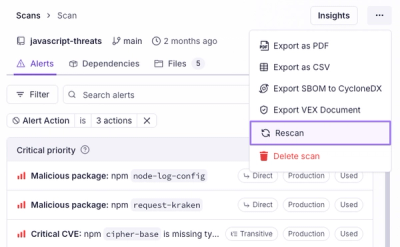
Scan results now load faster and remain consistent over time, with stable URLs and on-demand rescans for fresh security data.
By Nolan Lawson - Jan 23, 2026
@artusx/plugin-ejs
Advanced tools
ejs plugin with layout support for artusx.
ported from https://github.com/Soarez/express-ejs-layouts
Since the plugin is an independent version, you need to set the content-type of the returned data yourself.
export default {
artusx: {
enable: true,
package: '@artusx/core',
},
ejs: {
enable: true,
package: '@artusx/plugin-ejs',
},
};
import path from 'path';
import type { ArtusXConfig } from '@artusx/core';
import type { EjsConfig } from '@artusx/plugin-ejs';

export default () => {
  const artusx: ArtusXConfig = {
    port: 7001,
    middlewares: [LimitRate, checkAuth],
    static: {
      dirs: [
        {
          prefix: '/public/',
          dir: path.resolve(__dirname, '../public'),
        },
      ],
      dynamic: true,
      preload: false,
      buffer: false,
      maxFiles: 1000,
    },
    cors: {
      origin: '*',
      allowMethods: 'GET,HEAD,PUT,POST,DELETE,PATCH',
      credentials: false,
    },
  };

  const ejs: EjsConfig = {
    root: path.resolve(__dirname, '../view-ejs'),
    async: true,
    layout: {
      'layout extractScripts': true,
      'layout extractStyles': true,
      // layout: false,
    },
  };

  return {
    ejs,
    artusx,
  };
};
layout.ejs
<!DOCTYPE html>
<html lang="en">
<head>
  <meta charset="UTF-8">
  <title><%= title %></title>

  <% /* Place any styles in the page in this section. */ %>
  <%- style %>
</head>
<body>
  <header>
    <% /*
    Define an required placeholder for the header.
    If a page doesn't define a header, there will be an error when rendering.
    */ %>
    <%- header %>
  </header>

  <%- body %>

  <footer>
    <% /*
    Define an optional placeholder for the footer.
    If a page doesn't define a footer, this section will simply be empty.
    */ %>
    <%- defineContent('footer') %>
  </footer>

  <% /* Place any scripts contained in views at the end of the page. */ %>
  <%- script %>
</body>
</html>
view.ejs
<%- contentFor('header') %>
<h1 class="page-title"><%= _locals.title %></h1>

<%- contentFor('footer') %>
<h1>This is the footer</h1>

<% /*
Content for the `body` section should either be the first thing defined
in the view, or it has to be declared just like any other section.
*/ %>
<%- contentFor('body') %>

This is part of the body.

<% /*
When style extraction is enabled, any custom styles that a page defines, will
be extracted out of the content and made available in the specific placeholder.
In our example, even though we're defining a <style> within the body, this will
be placed, according to our layout, inside of the <head> element.
<link> blocks to load external stylesheets are also extracted when the option
is enabled.
*/ %>

<style>
  .page-message { color: blue }
</style>

<% /*
Like stylesheets, scripts can also be extracted.
This script block will end up at the end of the HTML document.
*/ %>
<script>
  // Script content!
</script>

<h1 class="page-message"><%= message %></h1>
import { PluginInjectEnum } from '@artusx/utils';
import {
  ArtusInjectEnum,
  ArtusApplication,
  Inject,
  Controller,
  GET,
  ContentType
} from '@artusx/core';

import type { ArtusXContext } from '@artusx/core';
import { EjsClient } from '@artusx/plugin-ejs';

@Controller('/ejs')
export default class EjsController {
  @Inject(ArtusInjectEnum.Application)
  app: ArtusApplication;

  @Inject(PluginInjectEnum.EJS)
  ejs: EjsClient;

  @GET('/')
  @ContentType('html')
  async view(ctx: ArtusXContext) {
    const locals = {
      title: 'Example',
      message: 'This is a message'
    };
    ctx.body = await this.ejs.render('view.ejs', {
      locals,
    });
  }

  @GET('/people')
  @ContentType('html')
  async people(ctx: ArtusXContext) {
    const people = ['geddy', 'neil', 'alex'];
    ctx.body = await this.ejs.render('people.ejs', {
      people,
      layout: false,
     });
  }
}
FAQs
ejs plugin for artusx
The npm package @artusx/plugin-ejs receives a total of 2 weekly downloads. As such, @artusx/plugin-ejs popularity was classified as not popular.
We found that @artusx/plugin-ejs demonstrated a healthy version release cadence and project activity because the last version was released less than a year ago. It has 1 open source maintainer collaborating on the project.
Did you know?

Socket for GitHub automatically highlights issues in each pull request and monitors the health of all your open source dependencies. Discover the contents of your packages and block harmful activity before you install or update your dependencies.
Product
Scan results now load faster and remain consistent over time, with stable URLs and on-demand rescans for fresh security data.
Product
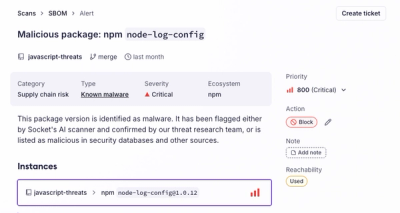
Socket's new Alert Details page is designed to surface more context, with a clearer layout, reachability dependency chains, and structured review.
Product
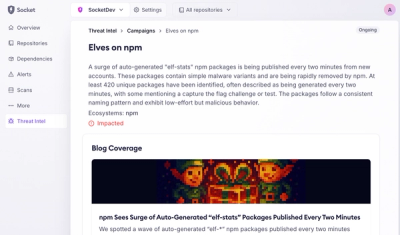
Campaign-level threat intelligence in Socket now shows when active supply chain attacks affect your repositories and packages.