


Product
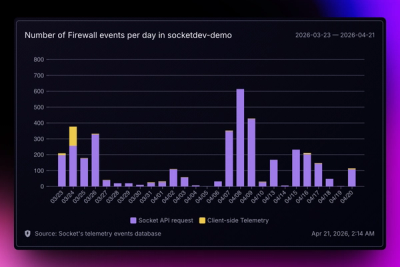
Introducing Reports: An Extensible Reporting Framework for Socket Data
Explore exportable charts for vulnerabilities, dependencies, and usage with Reports, Socket’s new extensible reporting framework.
By André Staltz - Apr 21, 2026
@asyncapi/optimizer
Advanced tools

AsyncAPI offers many ways to reuse certain parts of the document like messages or schemas definitions or references to external files, not to even mention the traits. Purpose of AsyncAPI Optimizer is to enable different ways to optimize AsyncAPI files. It is a library that can be used in UIs and CLIs.

git clone https://github.com/asyncapi/optimizer.gitnpm inpm run example. You can open examples/index.js modify it or add your own AsyncAPI document for optimization.import { Optimizer } from '@asyncapi/optimizer'
import type { Report } from '@asyncapi/optimizer'
const yaml = `
asyncapi: 3.0.0
info:
title: Example Service
version: 1.0.0
description: Example Service.
servers:
production:
host: 'test.mosquitto.org:{port}'
protocol: mqtt
description: Test broker
variables:
port:
description: Secure connection (TLS) is available through port 8883.
default: '1883'
enum:
- '1883'
- '8883'
operations:
user/deleteAccount.subscribe:
action: send
channel:
$ref: '#/channels/commentLikedChannel'
channels:
commentLikedChannel:
address: comment/liked
messages:
commentLikedMessage:
description: Message that is being sent when a comment has been liked by someone.
payload:
type: object
title: commentLikedPayload
properties:
commentId:
type: string
description: an id object
x-origin: ./schemas.yaml#/schemas/idSchema
x-origin: ./schemas.yaml#/schemas/commentLikedSchema
x-origin: ./messages.yaml#/messages/commentLikedMessage
x-origin: ./channels.yaml#/channels/commentLikedChannel`
const optimizer = new Optimizer(yaml)
const report: Report = await optimizer.getReport()
/*
the report value will be:
{
  removeComponents: [],
  reuseComponents: [],
  moveAllToComponents: [
    {
      path: 'channels.commentLikedChannel.messages.commentLikedMessage.payload.properties.commentId',
      action: 'move',
      target: 'components.schemas.idSchema'
    },
    {
      path: 'channels.commentLikedChannel.messages.commentLikedMessage.payload',
      action: 'move',
      target: 'components.schemas.commentLikedSchema'
    },
    {
      path: 'channels.commentLikedChannel.messages.commentLikedMessage',
      action: 'move',
      target: 'components.messages.commentLikedMessage'
    },
    {
      path: 'operations.user/deleteAccount.subscribe',
      action: 'move',
      target: 'components.operations.subscribe'
    },
    {
      path: 'channels.commentLikedChannel',
      action: 'move',
      target: 'components.channels.commentLikedChannel'
    },
    {
      path: 'servers.production',
      action: 'move',
      target: 'components.servers.production'
    }
  ],
  moveDuplicatesToComponents: []
}
 */
const optimizedDocument = optimizer.getOptimizedDocument({
  output: 'YAML',
  rules: {
    reuseComponents: true,
    removeComponents: true,
    moveAllToComponents: true,
    moveDuplicatesToComponents: false,
  },
  disableOptimizationFor: {
    schema: false,
  },
})
/*
the optimizedDocument value will be:

asyncapi: 3.0.0
info:
  title: Example Service
  version: 1.0.0
  description: Example Service.
servers:
  production:
    $ref: '#/components/servers/production'
operations:
  user/deleteAccount.subscribe:
    action: send
    channel:
      $ref: '#/channels/commentLikedChannel'
  user/deleteAccount:
    subscribe:
      $ref: '#/components/operations/subscribe'
channels:
  commentLikedChannel:
    $ref: '#/components/channels/commentLikedChannel'
components:
  schemas:
    idSchema:
      type: string
      description: an id object
      x-origin: ./schemas.yaml#/schemas/idSchema
    commentLikedSchema:
      type: object
      title: commentLikedPayload
      properties:
        commentId:
          $ref: '#/components/schemas/idSchema'
      x-origin: ./schemas.yaml#/schemas/commentLikedSchema
  messages:
    commentLikedMessage:
      description: Message that is being sent when a comment has been liked by someone.
      payload:
        $ref: '#/components/schemas/commentLikedSchema'
      x-origin: ./messages.yaml#/messages/commentLikedMessage
  operations: {}
  channels:
    commentLikedChannel:
      address: comment/liked
      messages:
        commentLikedMessage:
          $ref: '#/components/messages/commentLikedMessage'
      x-origin: ./channels.yaml#/channels/commentLikedChannel
  servers:
    production:
      host: test.mosquitto.org:{port}
      protocol: mqtt
      description: Test broker
      variables:
        port:
          description: Secure connection (TLS) is available through port 8883.
          default: '1883'
          enum:
            - '1883'
            - '8883'
 */
For using the optimizer to optimize file you just need to import the Optimizer class. Use its two methods to get the report (getReport()) and get the optimized document (getOptimizedDocument()).
See API documentation for more example and full API reference information.
FAQs
This library will optimize the AsyncAPI specification file.
The npm package @asyncapi/optimizer receives a total of 26,250 weekly downloads. As such, @asyncapi/optimizer popularity was classified as popular.
We found that @asyncapi/optimizer demonstrated a not healthy version release cadence and project activity because the last version was released a year ago. It has 3 open source maintainers collaborating on the project.
Did you know?

Socket for GitHub automatically highlights issues in each pull request and monitors the health of all your open source dependencies. Discover the contents of your packages and block harmful activity before you install or update your dependencies.
Product
Explore exportable charts for vulnerabilities, dependencies, and usage with Reports, Socket’s new extensible reporting framework.
Product
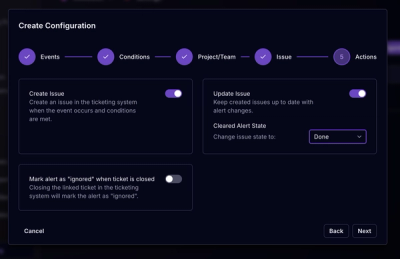
Socket for Jira lets teams turn alerts into Jira tickets with manual creation, automated ticketing rules, and two-way sync.
Company News
Socket won two 2026 Reppy Awards from RepVue, ranking in the top 5% of all sales orgs. AE Alexandra Lister shares what it's like to grow a sales career here.