Product
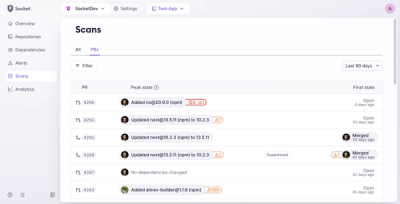
Introducing Pull Request Stories to Help Security Teams Track Supply Chain Risks
Socket’s new Pull Request Stories give security teams clear visibility into dependency risks and outcomes across scanned pull requests.
@brandonocasey/spawn-promise
Advanced tools
A wrapper around spawn that returns a promise with the similar output to spawnSync.
Install @brandonocasey/spawn-promise and in-publish via npm
$ npm install --save-dev @brandonocasey/spawn-promise in-publish
Similar to child_process.spawnSync except we return a promise and use child_process.spawn internally. See the return value of childProcess.spawnSync for what the promise will be resolved with. In addion to the usual return values we also add in stdin and combined. combined is mixed stdout/stderr output.
Currently we support 1 to 1 the spawn API from child_process, but signals, killing, and stdin support has not been tested.

FAQs
A wrapper around spawn that returns a promise with the similar output to spawnSync.
The npm package @brandonocasey/spawn-promise receives a total of 239 weekly downloads. As such, @brandonocasey/spawn-promise popularity was classified as not popular.
We found that @brandonocasey/spawn-promise demonstrated a not healthy version release cadence and project activity because the last version was released a year ago. It has 1 open source maintainer collaborating on the project.
Did you know?

Socket for GitHub automatically highlights issues in each pull request and monitors the health of all your open source dependencies. Discover the contents of your packages and block harmful activity before you install or update your dependencies.

Product
Socket’s new Pull Request Stories give security teams clear visibility into dependency risks and outcomes across scanned pull requests.

Research
/Security News
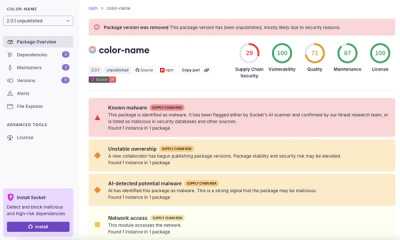
npm author Qix’s account was compromised, with malicious versions of popular packages like chalk-template, color-convert, and strip-ansi published.

Research
Four npm packages disguised as cryptographic tools steal developer credentials and send them to attacker-controlled Telegram infrastructure.