




Security News
Deno 2.6 + Socket: Supply Chain Defense In Your CLI
Deno 2.6 introduces deno audit with a new --socket flag that plugs directly into Socket to bring supply chain security checks into the Deno CLI.
By Sarah Gooding - Dec 12, 2025
@decaf-ts/logging
Advanced tools












Defaults to module, but exports to CommonJS and ESM.
With documentation, update and release mechanisms and gitlab/github workflows to match;
Defines a 'way' to write jsDocs to optimize the output
Optimized for github in terms of badges. CI is equivalent between Gitlab and Github.
Auto setup on first npm install
Will accept a .token file containing token valid for private npm dependencies, npm and docker registries
create a new project using this one as a template.
clone it git clone <project> and navigate to the root folder cd <project>
.npmrc containing:@<scope1>:registry=https://<ADDRESS>.com/api/v4/packages/npm/
@<scope2>:registry=https://<ADDRESS>.<DOMAIN>.com/api/v4/packages/npm/
//<ADDRESS>.<DOMAIN>.com/:_authToken=${TOKEN}
//<ADDRESS>.<DOMAIN>.com/api/v4/groups/<GROUP_ID>/packages/npm/:_authToken=${TOKEN}
//<ADDRESS>.<DOMAIN>.com/api/v4/projects/<PROJECT_ID>/packages/npm/:_authToken=${TOKEN}
Changing:
.);and adding a .token file containing your access token to the private registries na repositories.
Run npm install (or npm run do-install if you have private dependencies and a .token file) to install the dependencies:
If this is the first time you are running this command it will also:
.token file which you can leave empty unless you have private dependencies or publish to private registriespackage.json;package.json and deleted files (having ssh access helps here);This repo comes with eslint + prettier preconfigured to the default standards
Preconfigured Jest based testing:
tests/unit folder;
tests/integration folder;workdocs/coverage;cli.ts from coverage since that is an executable file;jest.config.ts;This repository automates releases in the following manner:
npm run release -- <major|minor|patch|version> <message>:
npm run prepare-release npm script;If publishing to a private repo's npm registry, make sure you add to your package.json:
{
  "publishConfig": {
    "<SCOPE>:registry": " https://<REGISTRY>/api/v4/projects/<PROJECT_ID>/packages/npm/"
  }
}
Where:
<SCOPE> - Is the scope of your package;<REGISTRY> - your registry host;<PROJECT_ID> - you project ID number (easy to grab via UI in gitlab or by
running $("meta[name=octolytics-dimension-repository_id]").getAttribute('content') in the repository page in github)
;Unless the -no-ci flag is passed in the commit message to the npm run release command, publishing will be handled
automatically by github/gitlab (triggered by the tag).
When the -no-ci flag is passed then you can:
npm run publish. This command assumes :
npm run release;npmrc and package.json;.token file;While the implementationfor gitlab and github are not perfectly matched, they are perfectly usable.
The template comes with ci/cd for :
package-lock.json changes, caches node modules);src/* changes, caches lib and dist);src/*, test/* changes, caches workdocs/{resources, badges, coverage});install -> build -> test loop;-no-ci string-no-ci stringThe repository proposes a way to generate documentation that while still not ideal, produces verys consitest results.
In the code you see an example on how to properly document each code object, but the overall structure is:
@module;@category and @subcategory;@namespace and @memberOf;@const and both must describe their properties as @property (when constants are objects);@method;There are 3 steps the generating the documentation (automated in CI):
npm run drawings - generates png files from each drawing in the workdocs/drawings folder and moves them to the workdocs/resources folder (requires Docker);npm run uml - generates png files from each PlantUML diagram in the workdocs/uml folder and moves them to the workdocs/resources folder (requires Docker);npm run docs - this has several stages, defined under the gulp docs (gulpfile.js):
/docs;./workdocs/{drawings, uml, assets, resources} to ./docs;The produced docs folder contains the resulting documentation;
The following npm scripts are available for development:
preinstall - will run only on the first install to trigger the dep update. will self delete;do-install - sets a TOKEN environment variable to the contents of .token and runs npm install (useful when you
have private dependencies);flash-forward - updates all dependencies. Take care, This may not be desirable is some cases;reset - updates all dependencies. Take care, This may not be desirable is some cases;build - builds the code (via gulp gulpfile.js) in development mode (generates lib and dist folder);build:prod - builds the code (via gulp gulpfile.js) in production mode (generates lib and dist folder);test - runs unit tests;test:integration - runs it tests;test:all - runs all tests;lint - runs es lint on the code folder;lint-fix - tries to auto-fix the code folder;prepare-release - defines the commands to run prior to a new tag (defaults to linting, building production code,
running tests and documentation generation);release - triggers a new tag being pushed to master (via ./bin/tag_release.sh);clean-publish - cleans the package.json for publishing;coverage - runs all test, calculates coverage and generates badges for readme;drawings - compiles all DrawIO *.drawio files in the workdocs/drawings folder to png and moves them to
the workdocs/resources folder;uml - compiles all PlantUML *.puml files in the workdocs/uml folder to png and moves them to
the workdocs/resources folder;docs - compiles all the coverage, drawings, uml, jsdocs and md docs into a readable web page under ./docs;ts-workspace
│
│ .gitignore <-- Defines files ignored to git
│ .npmignore <-- Defines files ignored by npm
│ .nmprc <-- Defines the Npm registry for this package
│ .eslintrc.cjs <-- linting for the project
│ .prettier.config.cjs <-- Code style for the project
│ .gitlab-ci.yml <-- Gillab CI/CD file
│ gulpfile.js <-- Gulp build scripts. used for building na other features (eg docs)
│ jest.config.ts <-- Tests Configuration file
│ mdCompile.json <-- md Documentation generation configuration file
│ jsdocs.json <-- jsdoc Documentation generation configuration file
│ Dockerfile <-- minimal example of a node service Dockerfile
│ LICENCE.md <-- Licence disclamer
│ package.json
│ package-lock.json
│ README.md <-- Readme File dynamically compiled from 'workdocs' via the 'docs' npm script
│ tsconfig.json <-- Typescript config file. Is overriden in 'gulpfile.js'
│
└───bin
│ │ tag_release.sh <-- Script to help with releases
│
└───docs
│ │ ... <-- Dinamically generated folder, containing the compiled documentation for this repository. generated via the 'docs' npm script
│
└───src
│ │ ... <-- Source code for this repository
│
└───tests
│ │───unit <-- Unit tests
│ └───integration <-- Integration tests
│
└───workdocs <-- Folder with all pre-compiled documentation
│ │───assets <-- Documentation asset folder
│ │───badges <-- Auto generated coverage badges folder
│ │───coverage <-- Auto generated coverage results
│ │───drawings <-- DrawIO folder. Drawings (*.drawio) here will be processed to generate documentation (requires docker)
│ │───uml <-- PlantUML folder. Diagrams (*.puml) here will be processed to generate documentation (requires docker)
│ │───tutorials <-- Tutorial folder
│ │ ... <-- Categorized *.md files that are merged to generate the final readme (via md compile)
│ │ Readme.md <-- Entry point to the README.md
│
└───dist
│ │ ... <-- Dinamically generated folder containing the bundles for distribution
│
└───lib
| ... <-- Dinamically generated folder containing the compiled code



If you have bug reports, questions or suggestions please create a new issue.
I am grateful for any contributions made to this project. Please read this to get started.
The first and easiest way you can support it is by Contributing. Even just finding a typo in the documentation is important.
Financial support is always welcome and helps keep the both me and the project alive and healthy.
So if you can, if this project in any way. either by learning something or simply by helping you save precious time, please consider donating.
This project is released under the MIT License.
FAQs
simple winston inspired wrapper for cross lib logging
The npm package @decaf-ts/logging receives a total of 169 weekly downloads. As such, @decaf-ts/logging popularity was classified as not popular.
We found that @decaf-ts/logging demonstrated a healthy version release cadence and project activity because the last version was released less than a year ago. It has 5 open source maintainers collaborating on the project.
Did you know?

Socket for GitHub automatically highlights issues in each pull request and monitors the health of all your open source dependencies. Discover the contents of your packages and block harmful activity before you install or update your dependencies.
Security News
Deno 2.6 introduces deno audit with a new --socket flag that plugs directly into Socket to bring supply chain security checks into the Deno CLI.
Security News
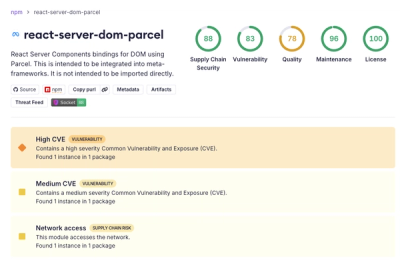
New DoS and source code exposure bugs in React Server Components and Next.js: what’s affected and how to update safely.

Security News
Socket CEO Feross Aboukhadijeh joins Software Engineering Daily to discuss modern software supply chain attacks and rising AI-driven security risks.