



Security News
Deno 2.6 + Socket: Supply Chain Defense In Your CLI
Deno 2.6 introduces deno audit with a new --socket flag that plugs directly into Socket to bring supply chain security checks into the Deno CLI.
By Sarah Gooding - Dec 12, 2025
@delvtech/drift
Advanced tools


Effortless Ethereum Development Across Web3 Libraries
Write cached Ethereum protocol interactions once with Drift and run them anywhere. Seamlessly support multiple web3 libraries like viem, web3.js, and ethers—without getting locked into a single provider or rewriting code.
With built-in caching, type-safe contract APIs, and easy-to-use testing mocks, Drift lets you build efficient and reliable applications without worrying about call optimizations or juggling countless hooks. Focus on what matters: creating great features and user experiences.
Building on Ethereum often means dealing with:
Install Drift:
npm install @delvtech/drift
Optional: To use Drift with a specific web3 library, install the corresponding adapter:
# Install one (optional)
npm install @delvtech/drift-viem
npm install @delvtech/drift-web3
npm install @delvtech/drift-ethers
npm install @delvtech/drift-ethers-v5
[!TIP]
Drift can be used without an adapter, however adapters reuse clients from their corresponding web3 library, which can improve performance depending on their configuration. For example, the
publicClientfrom Viem can automatically batch requests via Multicall.
import { createDrift } from "@delvtech/drift";

const drift = createDrift({
  rpcUrl: "[YOUR_RPC_URL]",
});
Viem adapter example:
import { createDrift } from "@delvtech/drift";
import { viemAdapter } from "@delvtech/drift-viem";
import { createPublicClient, createWalletClient, http } from "viem";

const publicClient = createPublicClient({
  transport: http(),
});

// optionally create a wallet client
const walletClient = createWalletClient({
  transport: http(),
});

const drift = createDrift({
  adapter: viemAdapter({ publicClient, walletClient }),
});
import { VaultAbi } from "./abis/VaultAbi";

// No need to wrap in separate hooks; Drift handles caching internally
const balance = await drift.read({
  abi: VaultAbi,
  address: "0xYourVaultAddress",
  fn: "balanceOf",
  args: {
    // Named type-safe arguments improve readability
    // and discoverability through IDE autocompletion
    account: "0xUserAddress",
  },
});
If Drift was initialized with a signer, you can perform write operations:
const txHash = await drift.write({
  abi: VaultAbi,
  address: "0xYourVaultAddress",
  fn: "deposit",
  args: {
    amount: BigInt(100e18),
    receiver: "0xReceiverAddress",
  },

  // Optionally wait for the transaction to be mined and invalidate cache
  onMined: () => {
    drift.cache.invalidateRead({
      abi: VaultAbi,
      address: "0xYourVaultAddress",
      fn: "balanceOf",
      args: {
        account: "0xReceiverAddress",
      },
    });
  },
});
const txHash = await drift.deploy({
  abi: ERC20.abi,
  bytecode: ERC20.bytecode,
  args: {
    decimals_: 18,
    initialSupply: 100_000_000n * 10n ** 18n, // 100M
  },
});

// Wait for the receipt to get the contract address
const receipt = await drift.waitForTransaction({ hash: txHash });

if (receipt?.status === "success" && receipt.contractAddress) {
  const totalSupply = await drift.read({
    abi: ERC20.abi,
    address: receipt.contractAddress,
    fn: "totalSupply",
  });
  // => 100000000000000000000000000n
}
Create contract instances to write your options once and get a streamlined, type-safe API to re-use across your application.
const vault = drift.contract({
  abi: VaultAbi,
  address: "0xYourVaultAddress",
  // ...other options
});

const balance = await vault.read("balanceOf", { account });

const txHash = await vault.write(
  "deposit",
  {
    amount: BigInt(100e18),
    receiver: "0xReceiverAddress",
  },
  {
    onMined: () => {
      vault.cache.invalidateRead("balanceOf", { account: "0xReceiverAddress" });
    },
  },
);
Let's build a simple library agnostic SDK with ReadVault and ReadWriteVault
clients using Drift.
Define read and read-write clients that wrap Drift's ReadContract and
ReadWriteContract abstractions.
// foobar-sdk/src/VaultClient.ts
import {
  type Address,
  type Drift,
  type EventLog,
  type Hash,
  type ReadContract,
  type ReadWriteAdapter,
  type ReadWriteContract,
  createDrift,
} from "@delvtech/drift";
import { vaultAbi } from "./abis/vaultAbi";

type VaultAbi = typeof vaultAbi;

/** A read-only Vault client */
export class ReadVault {
  contract: ReadContract<VaultAbi>;

  constructor(address: Address, drift: Drift = createDrift()) {
    this.contract = drift.contract({
      abi: vaultAbi,
      address,
    });
  }

  // Make read calls with internal caching
  getBalance(account: Address) {
    return this.contract.read("balanceOf", { account });
  }
  convertToAssets(shares: bigint) {
    return this.contract.read("convertToAssets", { shares });
  }
  async getAssetValue(account: Address) {
    const shares = await this.getBalance(account);
    return this.convertToAssets(shares);
  }

  // Fetch events with internal caching
  getDeposits(account?: Address) {
    return this.contract.getEvents("Deposit", {
      filter: {
        sender: account,
      },
    });
  }
}

/** A read-write Vault client that can sign transactions */
export class ReadWriteVault extends ReadVault {
  declare contract: ReadWriteContract<VaultAbi>;

  constructor(
    address: Address,
    drift: Drift<ReadWriteAdapter> = createDrift(),
  ) {
    super(address, drift);
  }

  // Make a deposit
  deposit(amount: bigint, account: Address) {
    return this.contract.write(
      "deposit",
      {
        assets: amount,
        receiver: account,
      },
      {
        // Optionally wait for the transaction to be mined and invalidate cache
        onMined: (receipt) => {
          if (receipt?.status === "success") {
            this.contract.cache.clearReads();
          }
        },
      },
    );
  }
}
Using an adapter, you can integrate Drift with your chosen web3 library. Here's
an example using viem:
import { createDrift } from "@delvtech/drift";
import { viemAdapter } from "@delvtech/drift-viem";
import { createPublicClient, http } from "viem";
import { ReadVault } from "@foobar/sdk";

const publicClient = createPublicClient({
  transport: http(),
  // ...other options
});

const drift = createDrift({
  adapter: viemAdapter({ publicClient }),
});

// Instantiate the ReadVault client
const readVault = new ReadVault("0xYourVaultAddress", drift);

// Fetch user balance
const userBalance = await readVault.getBalance("0xUserAddress");

// Get the asset value of the user; the balance will be fetched from the cache
const userAssetValue = await readVault.getAssetValue("0xUserAddress");
Testing smart contract interactions can be complex and time-consuming. Drift simplifies this process by providing built-in mocks that allow you to stub responses and focus on testing your application logic.
[!IMPORTANT]
Drift's testing mocks have a peer dependency on Sinon.JS. Make sure to install it before using the mocks.
npm install --save-dev sinon
In our ReadVault client, the getAssetValue method gets the total asset value
for an account by fetching their vault balance and converting it to assets.
Under the hood, this method makes multiple RPC requests.
Here's how you can use Drift's mocks to stub contract calls and test your method:
import assert from "node:assert";
import test from "node:test";
import { createMockDrift, randomAddress } from "@delvtech/drift/testing";
import { vaultAbi } from "./abis/VaultAbi";
import { ReadVault } from "./VaultClient";

test("getAssetValue returns account balances converted to assets", async () => {
  // Set up mocks
  const address = randomAddress();
  const account = randomAddress();
  const mockDrift = createMockDrift();
  const mockContract = mockDrift.contract({ abi: vaultAbi, address });

  // Stub the vault's return values using `on*` methods
  mockContract.onRead("balanceOf", { account }).resolves(
    // Return 100 shares for the account
    BigInt(100e18),
  );
  mockContract.onRead("convertToAssets").callsFake(
    // Simulate the conversion of shares to assets
    async (params) => (params.args.shares * BigInt(1.5e18)) / BigInt(1e18),
  );

  // Create your client with the mocked Drift instance
  const readVault = new ReadVault(address, mockDrift);

  // Call the method you want to test
  const accountAssetValue = await readVault.getAssetValue(account);

  // Assert the expected result
  assert.strictEqual(accountAssetValue, BigInt(150e18));
});
In most setups, you might rely on data-fetching libraries like React Query. However, to prevent redundant network requests, each contract call would need:
useBalanceOf, useTokenSymbol).Composing multiple calls becomes cumbersome, as you have to manage each hook's result separately.
Drift's internal caching means you don't need to wrap every contract call in a separate hook. You can perform multiple contract interactions within a single function or hook without worrying about redundant requests from overlapping queries.
import { useQuery } from "@tanstack/react-query";
import { ReadVault } from "sdk-core";

function useVaultData(readVault: ReadVault, userAddress: string) {
  return useQuery(["vaultData", userAddress], async () => {
    // Perform multiple reads without separate query keys.
    const [balance, symbol, deposits] = await Promise.all([
      readVault.getBalance(userAddress),
      readVault.contract.read("symbol"),
      readVault.getDeposits(userAddress),
    ]);

    return { balance, symbol, deposits };
  });
}
No need to manage multiple hooks or query keys — Drift handles caching internally, simplifying your code and development process.
Drift's caching mechanism ensures that repeated calls with the same parameters don't result in unnecessary network requests, even when composed within the same function.
// Return values are cached after the first call.
const balance = await contract.read("balanceOf", { account });

// Subsequent calls with the same parameters will return the cached value.
const fromCache = await contract.read("balanceOf", { account });

// Different parameters will trigger a network request.
const atBlock = await contract.read("balanceOf", { account }, { block: 123n });
const otherBalance = await contract.read("balanceOf", { account: "0xOtherAccount" });
Delete cached data to ensure it's re-fetched using invalidate* and clear*
methods.
// Invalidate the cache for a specific read
contract.cache.invalidateRead("balanceOf", { account });

// Invalidate all reads matching partial arguments
contract.cache.invalidateReadsMatching("balanceOf");

// Clear all reads associated with the contract
contract.cache.clearReads();

// Let it all go...
contract.cache.clear();
Add static data such as immutables from token lists using preload* methods to
avoid network requests without changing how the data is accessed.
const drift = createDrift(/* ... */);
const contract = drift.contract({
  abi: erc20Abi,
  // ...
});

// Preloading read data
contract.cache.preloadRead({ fn: "symbol", value: "DAI" });

// Preloading event data
contract.cache.preloadEvents({
  event: "Transfer",
  value: [],
  // ...
});
Drift clients will automatically check the cache before fetching new data, but
direct access to the cached data is available via get* methods.
// Get a cached read return
const cachedBalance = await contract.cache.getRead("balanceOf", { account });

// Get a cached transaction receipt
const cachedReceipt = await drift.cache.getTransactionReceipt({ hash })
The invalidate*, clear*, preload*, and get* methods are available on
both the Drift.cache and Contract.cache instances.
[!IMPORTANT]
Manipulating cache data affects all clients that share the same cache. Since Drift passes its own cache to the contracts it creates via
Drift.contract(), they'll already be preloaded with theDriftinstance's cache and any cache operations performed on the contract cache will also affect theDriftcache.
Drift is designed to be extensible. You can build additional abstractions or utilities on top of it to suit your project's requirements.
Extend support to new web3 libraries or custom providers by implementing the
Adapter interface. Drift Clients, including
Drift, extend the prototype of the Adapter they're provided,
inheriting all of it's properties and methods, extending some, and adding some
of their own. See the DefaultAdapter for an example
implementation.
import { DefaultAdapter, createDrift } from "@delvtech/drift";

class CustomAdapter extends DefaultAdapter {
  override async getChainId() {
    // Custom implementation...
  }
}

const drift = await createDrift({
  adapter: new CustomAdapter({
    rpcUrl: process.env.RPC_URL,
  }),
});
Implement a custom Store to manage caching in a way that suits your
application. The default store is an in-memory LRU cache, but you can create a
custom store that uses TTL, localStorage, IndexedDB,
QueryClient, or
any other storage mechanism, sync or async.
import { createDrift } from "@delvtech/drift";

class CustomStore extends Map {
  override set(key: string, value: unknown) {
    // Custom implementation...
  }
}

const drift = createDrift({
  store: new CustomStore(),
});
Add custom logic by intercepting and modifying client methods with hooks. Each
client method (including custom adapter methods) has type-safe before:<method>
and after:<method> hooks that can be used to inspect and modify the arguments
or results.
// Simulate writes before sending transactions
drift.hooks.on("before:write", async ({ args: [params] }) => {
  await drift.simulateWrite(params);
});

// Run middleware on reads
drift.hooks.on("before:read", async ({ args: [params], resolve }) => {
  const cachedValue = await drift.cache.getRead(params);
  const result = await readMiddleware({ drift, params, cachedValue })
  resolve(result);
});

// Run middleware to transform the result of calls
drift.hooks.on("after:call", ({ args: [params], result, setResult }) => {
  const transformedResult = callResultMiddleware({ drift, params, result });
  setResult(transformedResult);
});
Got ideas or found a bug? Check the Contributing Guide to get started.
Drift is open-source software licensed under the Apache 2.0.
FAQs
Effortless ethereum development across Web3 libraries
We found that @delvtech/drift demonstrated a healthy version release cadence and project activity because the last version was released less than a year ago. It has 1 open source maintainer collaborating on the project.
Did you know?

Socket for GitHub automatically highlights issues in each pull request and monitors the health of all your open source dependencies. Discover the contents of your packages and block harmful activity before you install or update your dependencies.
Security News
Deno 2.6 introduces deno audit with a new --socket flag that plugs directly into Socket to bring supply chain security checks into the Deno CLI.
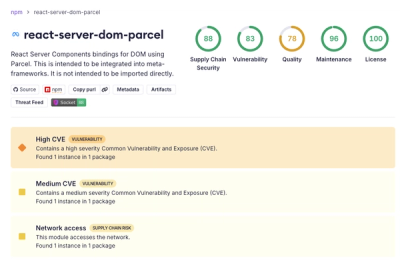
Security News
New DoS and source code exposure bugs in React Server Components and Next.js: what’s affected and how to update safely.

Security News
Socket CEO Feross Aboukhadijeh joins Software Engineering Daily to discuss modern software supply chain attacks and rising AI-driven security risks.