


Product
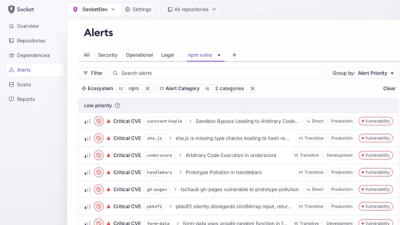
Introducing Custom Tabs for Org Alerts
Create and share saved alert views with custom tabs on the org alerts page, making it easier for teams to return to consistent, named filter sets.
By André Staltz - Jan 20, 2026
@frontmeans/doqry
Advanced tools



Doqry represents CSS selectors as data structures rather than trying to parse selectors text.
Structured CSS selector is one of:
Raw CSS selector text is never interpreted and is used verbatim.
CSS combinator is one of: >, +, or ~.
CSS selector part is a structure representing selectors like
element-name#id.class1.classN[attr1][attr2]:pseudo-class::pseudo-element.
Each selector part is represented by corresponding property:
{ e: 'element-name' } for element-name.{ ns: 'ns-prefix', e: 'element-name' } for ns-prefix | element-name.{ e: '*' }, which is the same as {} for *.{ ns: 'ns-prefix', e: '*' }, which is the same as { ns: 'ns-prefix' } for ns-prefix | *.{ i: 'element-id' } for #element-id.{ c: 'class-name' } for .class-name.{ c: ['class-1', 'class-2'] } for .class-1.class-2.{ u: ['disabled'] } for [disabled],
{ u: ['lang', '|=', 'en'] } for [lang |= "en"].{ e: 'li', u: ['::', 'after'] } for li::after.{ u: [':', 'host', { c: 'active' }] } for :host(.active),
{ u: [':', 'is', [{ e: 'ul' }, '>', { e: 'li' }], [{ c: 'menu'}, { c: 'menu-item'}]] }
for :is(ul > li, .menu > .menu-item){ e: 'a', s: '[href^=https://]:visited' } for a[href^=https://]:visited.{ s: '.my-selector' } for .my-selector.Selector part may combine multiple properties. Parts may be combined too.
E.g. [{ e: 'ul', c: 'unstyled' }, '>', { e: 'li' }] corresponds to ul.unstyled > li CSS selector.
CSS selector may include qualifiers. Qualifiers do not correspond to CSS selectors directly. Instead, they are used internally to classify selectors. E.g. they may represent at-rule selectors.
Qualifiers represented by $ property of structured CSS selector part, that may contain either one qualifier, or an
array of qualifiers:
{ c: 'sr-only', $: '@media=screen' }.
Each qualifier is a string in the <name>[=<value>] format, where the <name> may be qualified and consist of multiple
colon-separated parts like block:visibility:hidden.
The presence of q1:q2:q3=v qualifier means the same as presence of q1, q1:q2, q1:q2:q3, and q1:q2:q3=v
qualifiers.
The following operations over structure CSS selectors supported:
doqryDisplayText(selector) - Converts selector to textual representation including qualifiers.doqryEqual(first, second) - Checks whether the first selector equals to the second one.doqryPicker(selector) - Normalizes selector representation and converts it to CSS picker.doqryText(selector, format?) - Converts selector to textual representation in the given format.
By default, converts to representation that can be used in CSS (i.e. without qualifiers).FAQs
Document query notation for CSS selectors
The npm package @frontmeans/doqry receives a total of 0 weekly downloads. As such, @frontmeans/doqry popularity was classified as not popular.
We found that @frontmeans/doqry demonstrated a not healthy version release cadence and project activity because the last version was released a year ago. It has 1 open source maintainer collaborating on the project.
Did you know?

Socket for GitHub automatically highlights issues in each pull request and monitors the health of all your open source dependencies. Discover the contents of your packages and block harmful activity before you install or update your dependencies.
Product
Create and share saved alert views with custom tabs on the org alerts page, making it easier for teams to return to consistent, named filter sets.

Product
Socket’s Rust and Cargo support is now generally available, providing dependency analysis and supply chain visibility for Rust projects.

Security News
Chrome 144 introduces the Temporal API, a modern approach to date and time handling designed to fix long-standing issues with JavaScript’s Date object.