

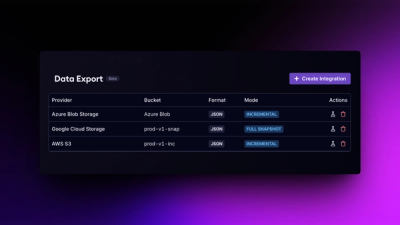
Product
Introducing Data Exports
Export Socket alert data to your own cloud storage in JSON, CSV, or Parquet, with flexible snapshot or incremental delivery.
By Ola Adekola - Apr 23, 2026
@gooddata/mock-handling
Advanced tools
The CLI tool in this project aims to automate capture and management of test data.
Given an recording directory, mock tooling with traverse the directory, looking for definitions of data to retrieve
from live backend and store in the recording directory. After this the tool will generate an index.ts file with
constants that can be used to initialize a recorded backend instance.
The mock tooling is invoked through command line and takes the following arguments:
recordingDir - directory where input and outputs of recordings liveprojectId - identifier of project from which to capture datausername - username to authenticate ashostname - GoodData backend hostnameconfig - optionally provide path to tool configuration (by default looks for .gdmockrc in current dir)Config is a JSON file containing an object with pre-defined values of the command line arguments. The keys match names of command line arguments.
If the tool does not receive mandatory argument via either CLI or from config, then it will prompt interactively.
Note: by default, the tool will fail when connecting to non-production deployment where the X.509 certificates are not setup correctly (self-signed, internal authority): node.js will reject the connection due to invalid certificates. You can use the
--accept-untrusted-ssloption to disable this check (under the covers this sets the node.js documented ENV varNODE_TLS_REJECT_UNAUTHORIZEDto0)
The recording directory passed to the tooling is expected to follow this layout:
executions subdir: this is where execution inputs and outputs are stored
The executions directory can be further organized in any way you see fit. The only hard rule is that
each unique execution is in its own subdirectory and the execution input is stored in definition.json file.
The definition.json file contains serialized IExecutionDefinition.
On top of this there is a soft rule that the directory in which the definition.json is stored should be
named after the fingerprint of the execution definition in the definition.json. This is useful convention
to have in order to keep only unique recordings.
The scenarios.json file is optional. If included in execution directory, it is expected to contain
list of vis-scenario pairs. The tool will use this metadata to generate a Scenarios mapping in the
recording index.ts file; this mapping can be used to conveniently access particular execution recordings
and create data view facades out of them.
The requests.json file is optional If included it specifies what data views should be obtained for
the execution definition.
(C) 2017-2022 GoodData Corporation
This project is under MIT License. See LICENSE.
FAQs
GoodData SDK Mock data capture and management tool
The npm package @gooddata/mock-handling receives a total of 793 weekly downloads. As such, @gooddata/mock-handling popularity was classified as not popular.
We found that @gooddata/mock-handling demonstrated a healthy version release cadence and project activity because the last version was released less than a year ago. It has 75 open source maintainers collaborating on the project.
Did you know?

Socket for GitHub automatically highlights issues in each pull request and monitors the health of all your open source dependencies. Discover the contents of your packages and block harmful activity before you install or update your dependencies.
Product
Export Socket alert data to your own cloud storage in JSON, CSV, or Parquet, with flexible snapshot or incremental delivery.
Research
/Security News
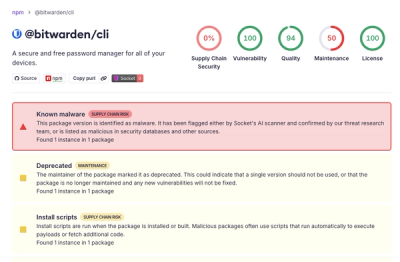
Bitwarden CLI 2026.4.0 was compromised in the Checkmarx supply chain campaign after attackers abused a GitHub Action in Bitwarden’s CI/CD pipeline.
Research
/Security News
Docker and Socket have uncovered malicious Checkmarx KICS images and suspicious code extension releases in a broader supply chain compromise.