


Security News
Deno 2.6 + Socket: Supply Chain Defense In Your CLI
Deno 2.6 introduces deno audit with a new --socket flag that plugs directly into Socket to bring supply chain security checks into the Deno CLI.
By Sarah Gooding - Dec 12, 2025
@johnls/json5
Advanced tools
This project is a fork of JSON5. See that project for the base documentation.
This fork adds the ability to parse the JSON5 into a node tree that includes type, line and column information on each element of the JSON5 text. This is useful for applications that do further semantic processing on the JSON5 and want to report error locations back to the user.
JSON5 adds features to JSON that make it more enjoyable to use JSON for data and script files that are edited by humans. The JSON5.parse method is great when you just want to read or write JSON5 with only basic syntax error checking. However, this is not ideal when using JSON5 as the storage format for more complicated data as the line, type and offset information generated during the parsing of the JSON5 file is lost. In that sense, JSON5.parse only provides a check for syntactic validity.
This library adds an additional parsing mode to help when doing semantic validity checking of the JSON5. Use it by making calling JSON5.parse("...", {withNodes: true}). This will generate an object with nodes instead of a plain old Javascript object.
For example, let's say you use the JSON5 format to store an array of items. For your data format to be valid, the items in the array must all be strings and must all be in ascending order. You read in a valid JSON5 file into an object and start going through the array. You find an entry that is out of order. Unfortunately, with the basic JSON5.parse method you can no longer tell the user what line the error occurs on because you do not have that information.
To get around this problem, this variant of the package changes the meaning of the reviver argument of the JSON5.parse method. instead parses the JSON5 file into a node tree. Each node consists of the following properties:
{
  type: "object|array|null|string|numeric|boolean|null",
  value: [...]|{...}|"..."|true|false|999|null,
  line: 999,
  column: 999,
}
Armed with this information, you can now display a line and column information to your users so that they can find and fix the problems.
Take the following simple JSON5 document in the file:
{
  // A comment
  a: 1,
  b: {
    c: 2,
    d: 3
  },
  e:[1, 2]
}
Calling JSON5.parse(..., { withNodes: true }) on this generates:
{
  "type": "object",
  "value": {
    "a": {
      "type": "numeric",
      "value": 1,
      "line": 3,
      "column": 6
    },
    "b": {
      "type": "object",
      "value": {
        "c": {
          "type": "numeric",
          "value": 2,
          "line": 5,
          "column": 8
        },
        "d": {
          "type": "numeric",
          "value": 3,
          "line": 6,
          "column": 8
        }
      },
      "line": 4,
      "column": 6
    },
    "e": {
      "type": "array",
      "value": [
        {
          "type": "numeric",
          "value": 1,
          "line": 8,
          "column": 6
        },
        {
          "type": "numeric",
          "value": 2,
          "line": 8,
          "column": 9
        }
      ],
      "line": 8,
      "column": 5
    }
  },
  "line": 1,
  "column": 1
}
As you can see, this is quite a bit more verbose, but accessing the data is really just a matter of using the .value properties. For example, if you put the results of the parse() call in a variable called obj, then instead of obj.a.c to get the value 2, you would use obj.value.a.value.c.
simplify method that turns a sub-tree into a plain old Javascript object again.FAQs
JSON for humans.
The npm package @johnls/json5 receives a total of 2 weekly downloads. As such, @johnls/json5 popularity was classified as not popular.
We found that @johnls/json5 demonstrated a not healthy version release cadence and project activity because the last version was released a year ago. It has 1 open source maintainer collaborating on the project.
Did you know?

Socket for GitHub automatically highlights issues in each pull request and monitors the health of all your open source dependencies. Discover the contents of your packages and block harmful activity before you install or update your dependencies.
Security News
Deno 2.6 introduces deno audit with a new --socket flag that plugs directly into Socket to bring supply chain security checks into the Deno CLI.
Security News
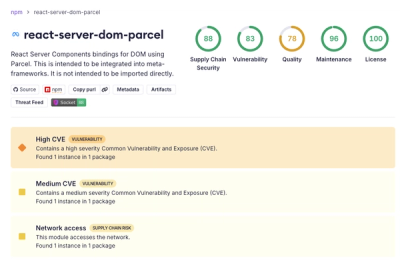
New DoS and source code exposure bugs in React Server Components and Next.js: what’s affected and how to update safely.

Security News
Socket CEO Feross Aboukhadijeh joins Software Engineering Daily to discuss modern software supply chain attacks and rising AI-driven security risks.