

Product
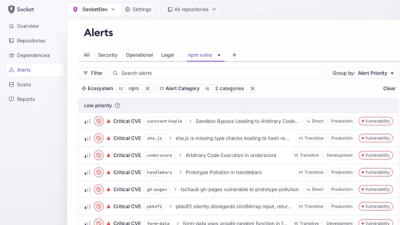
Introducing Custom Tabs for Org Alerts
Create and share saved alert views with custom tabs on the org alerts page, making it easier for teams to return to consistent, named filter sets.
By André Staltz - Jan 20, 2026
@jsforce/jsforce-node
Advanced tools
Salesforce API Library for JavaScript applications (both on web browser and Node.js)
JSforce (f.k.a. Node-Salesforce) is an isomorphic JavaScript Library utilizing Salesforce's API: It works both in the browser and with Node.js.
It capsulates the access to various APIs provided by Salesforce in asynchronous JavaScript function calls.
It also has command line interface (CLI) which gives interactive console (REPL), so you can learn the usage without hassle.
Supported Salesforce APIs are the following:
See documentation in https://jsforce.github.io/
v3 API reference: https://jsforce.github.io/jsforce/
v1 API reference: https://jsforce.github.io/jsforce/doc/
Migrating from v1 → v3? Find the migration guide here
Migrating from v2 → v3? Find the migration guide here
See Releases.
See jsforce-node.
See license (MIT License).
The SOAP login() API will be retired in Summer '27 (API version 65.0). If you are using the loginBySoap method, please migrate to OAuth 2.0 Username-Password Flow instead. For more information, see Salesforce Release Notes.
If you have any questions first file it on issues before contacting authors via e-mail.
See DEVELOPING.md
Your contributions are welcome: both by reporting issues on GitHub issues or pull-requesting patches.
If you want to implement any additional features, to be added to JSforce to our main branch, which may or may not be merged please first check current opening issues with milestones and confirm whether the feature is on road map or not.
If your feature implementation is brand-new or fixing unsupposed bugs in the library's test cases, please include additional test codes in the test/ directory.
node-salesforce is another popular library for interacting with Salesforce from Node.js. It offers similar functionalities such as authentication, CRUD operations, and SOQL queries. However, @jsforce/jsforce-node is generally considered more feature-rich and better maintained.
nforce is a lightweight Node.js library for interacting with Salesforce. It provides basic functionalities like authentication and CRUD operations but lacks some of the advanced features available in @jsforce/jsforce-node, such as bulk operations and streaming API support.
salesforce-connection is a simple library for connecting to Salesforce and performing basic operations. It is less comprehensive compared to @jsforce/jsforce-node and is suitable for simpler use cases where advanced features are not required.
FAQs
Salesforce API Library for JavaScript
The npm package @jsforce/jsforce-node receives a total of 384,149 weekly downloads. As such, @jsforce/jsforce-node popularity was classified as popular.
We found that @jsforce/jsforce-node demonstrated a healthy version release cadence and project activity because the last version was released less than a year ago. It has 1 open source maintainer collaborating on the project.
Did you know?

Socket for GitHub automatically highlights issues in each pull request and monitors the health of all your open source dependencies. Discover the contents of your packages and block harmful activity before you install or update your dependencies.
Product
Create and share saved alert views with custom tabs on the org alerts page, making it easier for teams to return to consistent, named filter sets.

Product
Socket’s Rust and Cargo support is now generally available, providing dependency analysis and supply chain visibility for Rust projects.

Security News
Chrome 144 introduces the Temporal API, a modern approach to date and time handling designed to fix long-standing issues with JavaScript’s Date object.