

Company News
Socket Has Acquired Secure Annex
Socket has acquired Secure Annex to expand extension security across browsers, IDEs, and AI tools.
By Feross Aboukhadijeh - Apr 28, 2026
@lokalise/backend-http-client
Advanced tools
Opinionated HTTP client for the Node.js backend
The library provides methods to implement the client side of HTTP protocols. Public methods available are:
buildClient(), which returns a Client instance and should be called before any of the following methods with parameters:
baseUrl;clientOptions – set of ClientOptions (optional). If none are provided, the following default options will be used to instantiate the client:
keepAliveMaxTimeout: 300_000,
keepAliveTimeout: 4000,
sendGet();sendGetWithStreamedResponse();sendPost();sendPut();sendPutBinary();sendDelete();sendPatch().All send methods accept a type parameter and the following arguments:
client, the return value of buildClient();
path;
options – (optional). Possible values are:
headers;query, query string params to be embedded in the request URL;timeout, the timeout after which a request will time out, in milliseconds. Default is 30 seconds. Pass undefined if you prefer to have no timeout;throwOnError;`reqContext;safeParseJson, used when the response content-type is application/json. If true, the response body will be parsed as JSON and a ResponseError will be thrown in case of syntax errors. If false, errors are not handled;blobResponseBody, used when the response body should be returned as Blob;requestLabel, this string will be returned together with any thrown or returned Error to provide additional context about what request was being executed when the error has happened;disableKeepAlive;`retryConfig, defined by:
maxAttempts, the maximum number of times a request should be retried;delayResolver?, an optional function that calculates retry delay: (response, attemptNumber, statusCodesToRetry) => number | undefined;statusCodesToRetry?, the status codes that trigger a retry;retryOnTimeout, whether to retry on timeout;clientOptions;responseSchema, used both for inferring the response type of the call, and also (if validateResponse is true) for validating the response structure;validateResponse;isEmptyResponseExpected, used to specify if a 204 response should be treated as an error or not. when true the response body type is adjusted to include potential nullThe following options are applied by default:
validateResponse: true,
throwOnError: true,
timeout: 30000,
retryConfig: {
    maxAttempts: 1,
    statusCodesToRetry: [],
    retryOnTimeout: false,
}
For sendDelete() isEmptyResponseExpected by default is set to true, for all other methods it is false.
Additionally, sendPost(), sendPut(), sendPutBinary(), and sendPatch() also accept a body parameter.
The response of any send method will be resolved to always have result set, but only have error set in case something went wrong. See Either for more information.
The library provides the type Either for error handling in the functional paradigm. The two possible values are:
result is defined, error is undefined;error is defined, result is undefined.It's up to the caller of the function to handle the received error or throw an error.
Read this article for more information on how Either works and its benefits.
Additionally, DefiniteEither is also provided. It is a variation of the aforementioned Either, which may or may not have error set, but always has result.
backend-http-client supports using API contracts, created with @lokalise/api-contracts in order to make fully type-safe HTTP requests.
Usage example:
import { somePostRouteDefinition, someGetRouteDefinition } from 'some-service-api-contracts'
import { sendByPayloadRoute, buildClient } from '@lokalise/backend-http-client'

const MY_BASE_URL = 'http://localhost:8080'
const client = buildClient(MY_BASE_URL)

const responseBodyPost = await sendByPayloadRoute(client, somePostRouteDefinition,
// pass contract-defined request params, such as body, query and headers here
    {
        pathParams: {
            userId: 1,
        },
        body: {
            isActive: true,
        },
    },
// pass backend-http-client options here
    {
        validateResponse: false,
        requestLabel: 'Create user',
    }
)

const responseBodyGet = await sendByGetRoute(client, someGetRouteDefinition,
// pass contract-defined request params, such as query and headers here
        {
          pathParams: {
            userId: 1,
          },
          queryParams: {
            withMetadata: true,
          },
        },
// pass backend-http-client options here
        {
          validateResponse: false,
          requestLabel: 'Retrieve user',
        }
)
The following parameters can be specified when sending API contract-based requests:
body - request body (only applicable for sendByPayloadRoute, type needs to match with contract definition)queryParams - query parameters (type needs to match with contract definition)headers - custom headers to be sent with the request (type needs to match with contract definition)pathParams – parameters used for path resolver (type needs to match with contract definition)pathPrefix - optional prefix to be prepended to the path resolved by the contract's path resolverFor scenarios where you need to process large response bodies without loading them entirely into memory (e.g., downloading large files, processing data incrementally), use the streaming variants:
sendGetWithStreamedResponse() - for direct path-based requestssendByGetRouteWithStreamedResponse() - for API contract-based requestsThese methods return a Readable stream instead of parsing the entire response body, allowing for memory-efficient processing.
Important limitations:
validateResponse) is not supported for streamed responsesresponseSchema) is not part of the options (the response is always a Readable stream)Critical: Body consumption requirement
According to the undici documentation, garbage collection in Node.js is less aggressive and deterministic compared to browsers, which means leaving the release of connection resources to the garbage collector can lead to excessive connection usage, reduced performance (due to less connection re-use), and even stalls or deadlocks when running out of connections.
Therefore, when using streaming response methods, you must either:
// ✓ GOOD - Consume the entire stream
for await (const chunk of result.result.body) {
  processChunk(chunk)
}

// ✓ GOOD - Pipe to another stream (consumes it)
result.result.body.pipe(writeStream)

// ✓ GOOD - Dump the body if not needed
await result.result.body.dump()

// ✗ BAD - Never do this (causes connection leaks)
const { headers } = result.result
// body is never consumed - CONNECTION LEAK!
Usage example:
import { sendByGetRouteWithStreamedResponse, buildClient } from '@lokalise/backend-http-client'
import { createWriteStream } from 'node:fs'

const client = buildClient('https://api.example.com')

// Using contract-based request
const result = await sendByGetRouteWithStreamedResponse(
  client,
  downloadFileRouteDefinition,
  {
    pathParams: { fileId: '12345' },
  },
  {
    requestLabel: 'Download large file',
    retryConfig: {
      maxAttempts: 3,
      statusCodesToRetry: [500, 502, 503],
      retryOnTimeout: true,
    },
  }
)

if (result.result) {
  // Stream the response to a file
  const writeStream = createWriteStream('/path/to/file')
  result.result.body.pipe(writeStream)

  // Or process chunks manually
  for await (const chunk of result.result.body) {
    // Process chunk
    console.log('Received chunk:', chunk.length)
  }
}

// Using direct path-based request
const streamResult = await sendGetWithStreamedResponse(
  client,
  '/api/files/12345',
  {
    requestLabel: 'Download file',
  }
)

if (streamResult.result) {
  // Process the stream
  for await (const chunk of streamResult.result.body) {
    // Handle chunk
  }
}
FAQs
Opinionated HTTP client for the Node.js backend
The npm package @lokalise/backend-http-client receives a total of 3,875 weekly downloads. As such, @lokalise/backend-http-client popularity was classified as popular.
We found that @lokalise/backend-http-client demonstrated a healthy version release cadence and project activity because the last version was released less than a year ago. It has 19 open source maintainers collaborating on the project.
Did you know?

Socket for GitHub automatically highlights issues in each pull request and monitors the health of all your open source dependencies. Discover the contents of your packages and block harmful activity before you install or update your dependencies.
Company News
Socket has acquired Secure Annex to expand extension security across browsers, IDEs, and AI tools.

Research
/Security News
Socket is tracking cloned Open VSX extensions tied to GlassWorm, with several updated from benign-looking sleepers into malware delivery vehicles.
Product
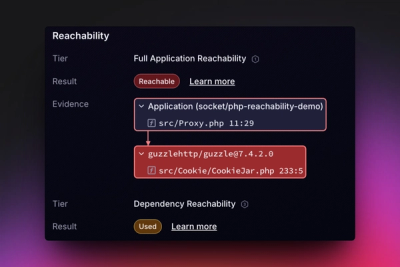
Reachability analysis for PHP is now available in experimental, helping teams identify which vulnerabilities are actually exploitable.