

Company News
Socket Has Acquired Secure Annex
Socket has acquired Secure Annex to expand extension security across browsers, IDEs, and AI tools.
By Feross Aboukhadijeh - Apr 28, 2026
@loopback/authentication
Advanced tools
A LoopBack component for authentication support.
This is a reference implementation showing how to implement an authentication component, it is not production ready.
The component demonstrates how to leverage Passport module and extension points provided by LoopBack Next to implement an authentication layer.
npm install --save @loopback/authentication
Start by decorating your controller methods with @authenticate to require
the request to be authenticated.
// controllers/my-controller.ts
import {UserProfile, authenticate, AuthenticationBindings} from '@loopback/authentication';
import {inject} from '@loopback/core';
import {get} from '@loopback/rest';

export class MyController {
  constructor(@inject(AuthenticationBindings.CURRENT_USER) private user: UserProfile) {}

  @authenticate('BasicStrategy')
  @get('/whoAmI')
  whoAmI() {
    return this.user.id;
  }
}
Next, implement a Strategy provider to map strategy names specified
in @authenticate decorators into Passport Strategy instances.
Remember to install passport, passport-http, @types/passport, and
@types/passport-http modules beforehand.
// providers/auth-strategy.ts
import {
  inject,
  Provider,
  ValueOrPromise,
} from '@loopback/context';
import {
  AuthenticationBindings,
  AuthenticationMetadata,
} from '@loopback/authentication';

import {Strategy} from 'passport';
import {BasicStrategy} from 'passport-http';

export class MyAuthStrategyProvider implements Provider<Strategy | undefined> {
  constructor(
    @inject(AuthenticationBindings.METADATA)
    private metadata: AuthenticationMetadata,
  ) {}

  value() : ValueOrPromise<Strategy | undefined> {

    // The function was not decorated, so we shouldn't attempt authentication
    if (!this.metadata) {
      return undefined;
    }

    const name = this.metadata.strategy;
    if (name === 'BasicStrategy') {
      return new BasicStrategy(this.verify);
    } else {
      return Promise.reject(`The strategy ${name} is not available.`);
    }
  }

  verify(username: string, password: string, cb: Function) {
    // find user by name & password
    // call cb(null, false) when user not found
    // call cb(null, userProfile) when user is authenticated
  }
}
In order to perform authentication, we need to implement a custom Sequence invoking the authentication at the right time during the request handling.
// sequence.ts
import {
  inject,
} from '@loopback/core';

import {
  FindRoute,
  InvokeMethod,
  ParsedRequest,
  ParseParams,
  Reject,
  Send,
  ServerResponse,
  SequenceHandler,
  RestBindings,
} from '@loopback/rest';

import {
  AuthenticateFn,
  AuthenticationBindings,
} from '@loopback/authentication';

const SequenceActions = RestBindings.SequenceActions;

export class MySequence implements SequenceHandler {
  constructor(
    @inject(SequenceActions.FIND_ROUTE) protected findRoute: FindRoute,
    @inject(SequenceActions.PARSE_PARAMS) protected parseParams: ParseParams,
    @inject(SequenceActions.INVOKE_METHOD) protected invoke: InvokeMethod,
    @inject(SequenceActions.SEND) protected send: Send,
    @inject(SequenceActions.REJECT) protected reject: Reject,
    @inject(AuthenticationBindings.AUTH_ACTION)
    protected authenticateRequest: AuthenticateFn,
  ) {}

  async handle(req: ParsedRequest, res: ServerResponse) {
    try {
      const route = this.findRoute(req);

      // This is the important line added to the default sequence implementation
      await this.authenticateRequest(req);

      const args = await this.parseParams(req, route);
      const result = await this.invoke(route, args);
      this.send(res, result);
    } catch (err) {
      this.reject(res, req, err);
    }
  }
}
Finally, put it all together in your application class:
import {
  AuthenticationComponent,
  AuthenticationBindings,
} from '@loopback/authentication';
import {RestApplication, RestServer} from '@loopback/rest';
import {MyAuthStrategyProvider} from './providers/auth-strategy';
import {MyController} from './controllers/my-controller';
import {MySequence} from './sequence';

class MyApp extends RestApplication {
  constructor() {
    super();

    this.component(AuthenticationComponent);
    this
      .bind(AuthenticationBindings.STRATEGY)
      .toProvider(MyAuthStrategyProvider);

    this.sequence(MySequence);

    this.controller(MyController);
  }

  async start() {
    await super.start();

    const server = await this.getServer(RestServer);
    console.log(`REST server running on port: ${server.getSync('rest.port')}`);
  }
}
You can try your authentication component by using your favourite REST client
and by setting the authorization header. Here is an example of what your
request might look like using curl:
curl -X GET \
  http://localhost:3000/whoami \
  -H 'authorization: Basic Zm9vOmJhcg=='
For more info about passport, see passport.js.
run npm test from the root folder.
See all contributors.
MIT
FAQs
A LoopBack component for authentication support.
The npm package @loopback/authentication receives a total of 13,512 weekly downloads. As such, @loopback/authentication popularity was classified as popular.
We found that @loopback/authentication demonstrated a healthy version release cadence and project activity because the last version was released less than a year ago. It has 7 open source maintainers collaborating on the project.
Did you know?

Socket for GitHub automatically highlights issues in each pull request and monitors the health of all your open source dependencies. Discover the contents of your packages and block harmful activity before you install or update your dependencies.
Company News
Socket has acquired Secure Annex to expand extension security across browsers, IDEs, and AI tools.

Research
/Security News
Socket is tracking cloned Open VSX extensions tied to GlassWorm, with several updated from benign-looking sleepers into malware delivery vehicles.
Product
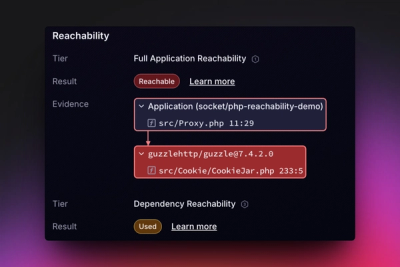
Reachability analysis for PHP is now available in experimental, helping teams identify which vulnerabilities are actually exploitable.