

Product
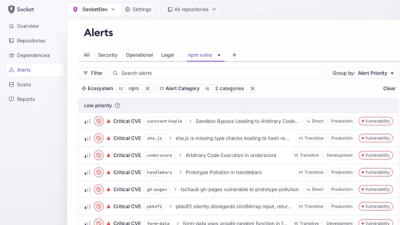
Introducing Custom Tabs for Org Alerts
Create and share saved alert views with custom tabs on the org alerts page, making it easier for teams to return to consistent, named filter sets.
By André Staltz - Jan 20, 2026
@modelcontextprotocol/server-memory
Advanced tools
MCP server for enabling memory for Claude through a knowledge graph
A basic implementation of persistent memory using a local knowledge graph. This lets Claude remember information about the user across chats.
Entities are the primary nodes in the knowledge graph. Each entity has:
Example:
{
"name": "John_Smith",
"entityType": "person",
"observations": ["Speaks fluent Spanish"]
}
Relations define directed connections between entities. They are always stored in active voice and describe how entities interact or relate to each other.
Example:
{
  "from": "John_Smith",
  "to": "Anthropic",
  "relationType": "works_at"
}
Observations are discrete pieces of information about an entity. They are:
Example:
{
  "entityName": "John_Smith",
  "observations": [
    "Speaks fluent Spanish",
    "Graduated in 2019",
    "Prefers morning meetings"
  ]
}
create_entities
entities (array of objects)
name (string): Entity identifierentityType (string): Type classificationobservations (string[]): Associated observationscreate_relations
relations (array of objects)
from (string): Source entity nameto (string): Target entity namerelationType (string): Relationship type in active voiceadd_observations
observations (array of objects)
entityName (string): Target entitycontents (string[]): New observations to adddelete_entities
entityNames (string[])delete_observations
deletions (array of objects)
entityName (string): Target entityobservations (string[]): Observations to removedelete_relations
relations (array of objects)
from (string): Source entity nameto (string): Target entity namerelationType (string): Relationship typeread_graph
search_nodes
query (string)open_nodes
names (string[])Add this to your claude_desktop_config.json:
{
  "mcp-server-memory": {
    "command": "mcp-server-memory"
  }
}
The prompt for utilizing memory depends on the use case. Changing the prompt will help the model determine the frequency and types of memories created.
Here is an example prompt for chat personalization. You could use this prompt in the "Custom Instructions" field of a Claude.ai Project.
Follow these steps for each interaction:

1. User Identification:
   - You should assume that you are interacting with default_user
   - If you have not identified default_user, proactively try to do so.

2. Memory Retrieval:
   - Always begin your chat by saying only "Remembering..." and retrieve all relevant information from your knowledge graph
   - Always refer to your knowledge graph as your "memory"

3. Memory
   - While conversing with the user, be attentive to any new information that falls into these categories:
     a) Basic Identity (age, gender, location, job title, education level, etc.)
     b) Behaviors (interests, habits, etc.)
     c) Preferences (communication style, preferred language, etc.)
     d) Goals (goals, targets, aspirations, etc.)
     e) Relationships (personal and professional relationships up to 3 degrees of separation)

4. Memory Update:
   - If any new information was gathered during the interaction, update your memory as follows:
     a) Create entities for recurring organizations, people, and significant events
     b) Connect them to the current entities using relations
     b) Store facts about them as observations
FAQs
MCP server for enabling memory for Claude through a knowledge graph
The npm package @modelcontextprotocol/server-memory receives a total of 19,958 weekly downloads. As such, @modelcontextprotocol/server-memory popularity was classified as popular.
We found that @modelcontextprotocol/server-memory demonstrated a healthy version release cadence and project activity because the last version was released less than a year ago. It has 4 open source maintainers collaborating on the project.
Did you know?

Socket for GitHub automatically highlights issues in each pull request and monitors the health of all your open source dependencies. Discover the contents of your packages and block harmful activity before you install or update your dependencies.
Product
Create and share saved alert views with custom tabs on the org alerts page, making it easier for teams to return to consistent, named filter sets.
Product
Socket’s Rust and Cargo support is now generally available, providing dependency analysis and supply chain visibility for Rust projects.

Security News
Chrome 144 introduces the Temporal API, a modern approach to date and time handling designed to fix long-standing issues with JavaScript’s Date object.