

Security News
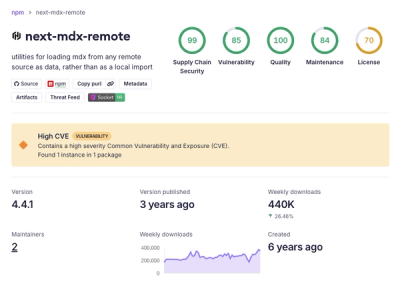
High-Severity RCE Vulnerability Disclosed in next-mdx-remote
HashiCorp disclosed a high-severity RCE in next-mdx-remote affecting versions 4.3.0 to 5.x when compiling untrusted MDX on the server.
By Sarah Gooding - Feb 12, 2026
@nerdalytics/beacon
Advanced tools
A lightweight reactive state library for Node.js backends. Enables reactive state management with automatic dependency tracking and efficient updates for server-side applications.

A lightweight reactive state library for Node.js backends. Enables reactive state management with automatic dependency tracking and efficient updates for server-side applications.
npm install @nerdalytics/beacon
import { state, derive, effect, batch, select, readonlyState, protectedState } from "@nerdalytics/beacon";

// Create reactive state
const count = state(0);
const doubled = derive(() => count() * 2);

// Read values
console.log(count()); // => 0
console.log(doubled()); // => 0

// Setup an effect that automatically runs when dependencies change
// effect() returns a cleanup function that removes all subscriptions when called
const unsubscribe = effect(() => {
  console.log(`Count is ${count()}, doubled is ${doubled()}`);
});
// => "Count is 0, doubled is 0" (effect runs immediately when created)

// Update values - effect automatically runs after each change
count.set(5);
// => "Count is 5, doubled is 10"

// Update with a function
count.update((n) => n + 1);
// => "Count is 6, doubled is 12"

// Batch updates (only triggers effects once at the end)
batch(() => {
  count.set(10);
  count.set(20);
});
// => "Count is 20, doubled is 40" (only once)

// Using select to subscribe to specific parts of state
const user = state({ name: "Alice", age: 30, email: "alice@example.com" });
const nameSelector = select(user, u => u.name);

effect(() => {
  console.log(`Name changed: ${nameSelector()}`);
});
// => "Name changed: Alice"

// Updates to the selected property will trigger the effect
user.update(u => ({ ...u, name: "Bob" }));
// => "Name changed: Bob"

// Updates to other properties won't trigger the effect
user.update(u => ({ ...u, age: 31 })); // No effect triggered

// Using lens for two-way binding with nested properties
const nested = state({
  user: {
    profile: {
      settings: {
        theme: "dark",
        notifications: true
      }
    }
  }
});

// Create a lens focused on a deeply nested property
const themeLens = lens(nested, n => n.user.profile.settings.theme);

// Read the focused value
console.log(themeLens()); // => "dark"

// Update the focused value directly (maintains referential integrity)
themeLens.set("light");
console.log(themeLens()); // => "light"
console.log(nested().user.profile.settings.theme); // => "light"

// Unsubscribe the effect to stop it from running on future updates
// and clean up all its internal subscriptions
unsubscribe();

// Using readonlyState to create a read-only view
const counter = state(0);
const readonlyCounter = readonlyState(counter);
// readonlyCounter() works, but readonlyCounter.set() is not available

// Using protectedState to separate read and write capabilities
const [getUser, setUser] = protectedState({ name: 'Alice' });
// getUser() works to read the state
// setUser.set() and setUser.update() work to modify the state
// but getUser has no mutation methods

// Infinite loop detection example (would throw an error)
try {
  effect(() => {
    const value = counter();
    // The following would throw an error because it attempts to
    // update a state that the effect depends on:
    // "Infinite loop detected: effect() cannot update a state() it depends on!"
    // counter.set(value + 1);

    // Instead, use a safe pattern with proper dependencies:
    console.log(`Current counter value: ${value}`);
  });
} catch (error) {
  console.error('Prevented infinite loop:', error.message);
}
state<T>(initialValue: T): State<T>Creates a new reactive state container with the provided initial value.
derive<T>(fn: () => T): ReadOnlyState<T>Creates a read-only computed value that updates when its dependencies change.
effect(fn: () => void): () => voidCreates an effect that runs the given function immediately and whenever its dependencies change. Returns an unsubscribe function that stops the effect and cleans up all subscriptions when called.
batch<T>(fn: () => T): TBatches multiple updates to only trigger effects once at the end.
select<T, R>(source: ReadOnlyState<T>, selectorFn: (state: T) => R, equalityFn?: (a: R, b: R) => boolean): ReadOnlyState<R>Creates an efficient subscription to a subset of a state value. The selector will only notify its subscribers when the selected value actually changes according to the provided equality function (defaults to Object.is).
lens<T, K>(source: State<T>, accessor: (state: T) => K): State<K>Creates a lens for direct updates to nested properties of a state. A lens combines the functionality of select (for reading) with the ability to update the nested property while maintaining referential integrity throughout the object tree.
readonlyState<T>(state: State<T>): ReadOnlyState<T>Creates a read-only view of a state, hiding mutation methods. Useful when you want to expose a state to other parts of your application without allowing direct mutations.
protectedState<T>(initialValue: T): [ReadOnlyState<T>, WriteableState<T>]Creates a state with access control, returning a tuple of reader and writer. This pattern separates read and write capabilities, allowing you to expose only the reading capability to consuming code while keeping the writing capability private.
# Install dependencies
npm install

# Run all tests
npm test

# Run all tests with coverage
npm run test:coverage

# Run specific test suites
# Core functionality
npm run test:unit:state
npm run test:unit:effect
npm run test:unit:derive
npm run test:unit:batch
npm run test:unit:select
npm run test:unit:lens
npm run test:unit:readonly
npm run test:unit:protected

# Advanced patterns
npm run test:unit:cleanup              # Tests for effect cleanup behavior
npm run test:unit:cyclic-dependency    # Tests for cyclic dependency handling
npm run test:unit:deep-chain           # Tests for deep chain handling
npm run test:unit:infinite-loop        # Tests for infinite loop detection

# Benchmarking
npm run benchmark    # Tests for infinite loop detection

# Format code
npm run format
npm run lint
npm run check    # Runs Bioms lint + format
Beacon supports the two most recent Node.js LTS versions (currently v20 and v22). When the package is published to npm, it includes transpiled code compatible with these LTS versions.
| Aspect | @nerdalytics/beacon | TC39 Proposal |
|---|---|---|
| API Style | Functional approach (state(), derive()) | Class-based design (Signal.State, Signal.Computed) |
| Reading/Writing Pattern | Function call for reading (count()), methods for writing (count.set(5)) | Method-based access (get()/set()) |
| Framework Support | High-level abstractions like effect() and batch() | Lower-level primitives (Signal.subtle.Watcher) that frameworks build upon |
| Advanced Features | Focused on core reactivity | Includes introspection capabilities, watched/unwatched callbacks, and Signal.subtle namespace |
| Scope and Purpose | Practical Node.js use cases with minimal API surface | Standardization with robust interoperability between frameworks |
Beacon is designed with a focus on simplicity, performance, and robust handling of complex dependency scenarios.
Infinite Loop Detection: Beacon actively detects direct infinite loops in effects by tracking which states an effect reads and writes to. If an effect attempts to update a state it depends on (directly modifying its own dependency), Beacon throws an error with a clear message: "Infinite loop detected: effect() cannot update a state() it depends on!"
Safe Cyclic Dependencies: For indirect cycles and safe update patterns, Beacon uses a queue-based update system that won't crash even with cyclical dependencies. When states form a cycle where values eventually stabilize, the system handles these updates efficiently without stack overflows.
This dual approach prevents accidental infinite loops while still supporting legitimate cyclic update patterns that eventually stabilize.
This project is licensed under the MIT License. See the LICENSE file for details.

FAQs
A lightweight reactive state library for Node.js backends. Enables reactive state management with automatic dependency tracking and efficient updates for server-side applications.
The npm package @nerdalytics/beacon receives a total of 172 weekly downloads. As such, @nerdalytics/beacon popularity was classified as not popular.
We found that @nerdalytics/beacon demonstrated a healthy version release cadence and project activity because the last version was released less than a year ago. It has 1 open source maintainer collaborating on the project.
Did you know?

Socket for GitHub automatically highlights issues in each pull request and monitors the health of all your open source dependencies. Discover the contents of your packages and block harmful activity before you install or update your dependencies.
Security News
HashiCorp disclosed a high-severity RCE in next-mdx-remote affecting versions 4.3.0 to 5.x when compiling untrusted MDX on the server.

Security News
Security researchers report widespread abuse of OpenClaw skills to deliver info-stealing malware, exposing a new supply chain risk as agent ecosystems scale.

Security News
Claude Opus 4.6 has uncovered more than 500 open source vulnerabilities, raising new considerations for disclosure, triage, and patching at scale.