Security News
curl Shuts Down Bug Bounty Program After Flood of AI Slop Reports
A surge of AI-generated vulnerability reports has pushed open source maintainers to rethink bug bounties and tighten security disclosure processes.
@nestjs/testing
Advanced tools
A progressive Node.js framework for building efficient and scalable server-side applications.
Nest is a framework for building efficient, scalable Node.js server-side applications. It uses modern JavaScript, is built with TypeScript (preserves compatibility with pure JavaScript) and combines elements of OOP (Object Oriented Programming), FP (Functional Programming), and FRP (Functional Reactive Programming).
Under the hood, Nest makes use of Express, but also provides compatibility with a wide range of other libraries, like Fastify, allowing for easy use of the myriad of third-party plugins which are available.
In recent years, thanks to Node.js, JavaScript has become the “lingua franca” of the web for both front and backend applications, giving rise to awesome projects like Angular, React, and Vue, which improve developer productivity and enable the construction of fast, testable, and extensible frontend applications. However, on the server-side, while there are a lot of superb libraries, helpers, and tools for Node, none of them effectively solve the main problem - the architecture.
Nest aims to provide an application architecture out of the box which allows for effortless creation of highly testable, scalable, and loosely coupled and easily maintainable applications. The architecture is heavily inspired by Angular.
For questions and support please use the official Discord channel. The issue list of this repo is exclusively for bug reports and feature requests.
Please make sure to read the Issue Reporting Checklist before opening an issue. Issues not conforming to the guidelines may be closed immediately.
With official support, you can get expert help straight from the Nest core team. We provide dedicated technical support, migration strategies, advice on best practices (and design decisions), PR reviews, and team augmentation. Read more about support here.
Nest is an MIT-licensed open source project. It can grow thanks to the sponsors and support from the amazing backers. If you'd like to join them, please read more here.
![]() | ![]() | ![]() |
![]() | ![]() | ![]() | ||
![]() |
![]() | ![]() | ![]() | |||
![]() |
![]() | ![]() | ||||
![]() | ![]() | ||||
![]() | ![]() | ![]() | |||
Nest is MIT licensed.

Jest is a delightful JavaScript Testing Framework with a focus on simplicity. It works with projects using: Babel, TypeScript, Node, React, Angular, Vue, and more. Jest is often used in combination with NestJS for unit and integration testing, similar to @nestjs/testing, but it is more general-purpose and not specifically tailored to NestJS.
Mocha is a feature-rich JavaScript test framework running on Node.js and in the browser, making asynchronous testing simple and fun. Mocha tests run serially, allowing for flexible and accurate reporting, while mapping uncaught exceptions to the correct test cases. It is another alternative to @nestjs/testing for writing tests in a NestJS application, but it requires more setup and configuration to integrate smoothly with NestJS.
Chai is a BDD / TDD assertion library for node and the browser that can be delightfully paired with any javascript testing framework. It's often used alongside Mocha or Jest to provide more expressive assertions. While not a testing framework itself, it complements packages like @nestjs/testing by offering a rich set of assertions that can be used in tests.
FAQs
Nest - modern, fast, powerful node.js web framework (@testing)
The npm package @nestjs/testing receives a total of 4,128,415 weekly downloads. As such, @nestjs/testing popularity was classified as popular.
We found that @nestjs/testing demonstrated a healthy version release cadence and project activity because the last version was released less than a year ago. It has 1 open source maintainer collaborating on the project.
Did you know?

Socket for GitHub automatically highlights issues in each pull request and monitors the health of all your open source dependencies. Discover the contents of your packages and block harmful activity before you install or update your dependencies.

Security News
A surge of AI-generated vulnerability reports has pushed open source maintainers to rethink bug bounties and tighten security disclosure processes.

Product
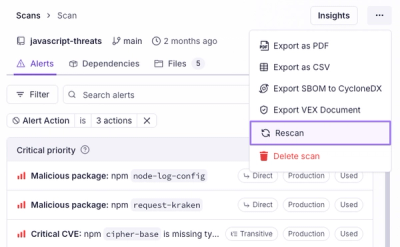
Scan results now load faster and remain consistent over time, with stable URLs and on-demand rescans for fresh security data.

Product
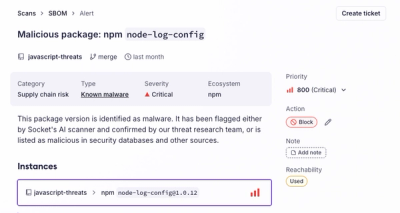
Socket's new Alert Details page is designed to surface more context, with a clearer layout, reachability dependency chains, and structured review.