

Product
Introducing Data Exports
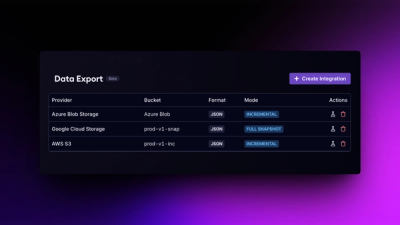
Export Socket alert data to your own cloud storage in JSON, CSV, or Parquet, with flexible snapshot or incremental delivery.
By Ola Adekola - Apr 23, 2026
@ngx-translate/http-loader
Advanced tools


A loader for ngx-translate that loads translations using http.
Get the complete changelog here: https://github.com/ngx-translate/http-loader/releases
We assume that you already installed ngx-translate.
Now you need to install the npm module for TranslateHttpLoader:
npm install @ngx-translate/http-loader --save
if you're still on Angular <4.3, please use Http from @angular/http with http-loader@0.1.0.
If you're still using Angular v5, please use ngx-translate 9.x and http-loader 2.x, version 3 and above are only compatible with Angular v6. If you need to use RxJS 5, update to 5.6 and use the rxjs-compat library (see the RxJS update guide).
TranslateModule to use the TranslateHttpLoader:The TranslateHttpLoader uses HttpClient to load translations, which means that you have to import the HttpClientModule from @angular/common/http before the TranslateModule:
import {NgModule} from '@angular/core';
import {BrowserModule} from '@angular/platform-browser';
import {HttpClientModule, HttpClient} from '@angular/common/http';
import {TranslateModule, TranslateLoader} from '@ngx-translate/core';
import {TranslateHttpLoader} from '@ngx-translate/http-loader';
import {AppComponent} from "./app";

// AoT requires an exported function for factories
export function HttpLoaderFactory(http: HttpClient) {
    return new TranslateHttpLoader(http);
}

@NgModule({
    imports: [
        BrowserModule,
        HttpClientModule,
        TranslateModule.forRoot({
            loader: {
                provide: TranslateLoader,
                useFactory: HttpLoaderFactory,
                deps: [HttpClient]
            }
        })
    ],
    bootstrap: [AppComponent]
})
export class AppModule { }
The TranslateHttpLoader also has two optional parameters:
By using those default parameters, it will load your translations files for the lang "en" from: /assets/i18n/en.json.
You can change those in the HttpLoaderFactory method that we just defined. For example if you want to load the "en" translations from /public/lang-files/en-lang.json you would use:
export function HttpLoaderFactory(http: HttpClient) {
    return new TranslateHttpLoader(http, "/public/lang-files/", "-lang.json");
}
For now this loader only support the json format.
If you are using Angular CLI (uses webpack under the hood) you can write your own TranslateLoader that always loads the latest translation file available during your application build.
// webpack-translate-loader.ts
import { TranslateLoader } from '@ngx-translate/core';
import { Observable } from 'rxjs/Observable';

export class WebpackTranslateLoader implements TranslateLoader {
  getTranslation(lang: string): Observable<any> {
    return Observable.fromPromise(System.import(`../assets/i18n/${lang}.json`));
  }
}
Cause System will not be available you need to add it to your custom typings.d.ts:
declare var System: System;
interface System {
  import(request: string): Promise<any>;
}
Now you can use the WebpackTranslateLoader with your app.module:
@NgModule({
  bootstrap: [AppComponent],
  imports: [
    TranslateModule.forRoot({
      loader: {
        provide: TranslateLoader,
        useClass: WebpackTranslateLoader
      }
    })
  ]
})
export class AppModule { }
The disadvantage of this solution is that you have to rebuild the application everytime your translate files has changes.
angular-l10n is another library for localization in Angular applications. It provides similar functionalities to @ngx-translate/http-loader, such as loading translation files and managing translations. However, it also includes additional features like locale management and date/number formatting.
angular-translate is a popular library for AngularJS (Angular 1.x) that provides similar functionalities to @ngx-translate/http-loader. It allows loading translation files via HTTP and managing translations. However, it is designed for AngularJS and not for Angular (2+).
FAQs
http loader for dynamically loading translation files for @ngx-translate/core
The npm package @ngx-translate/http-loader receives a total of 789,075 weekly downloads. As such, @ngx-translate/http-loader popularity was classified as popular.
We found that @ngx-translate/http-loader demonstrated a healthy version release cadence and project activity because the last version was released less than a year ago. It has 2 open source maintainers collaborating on the project.
Did you know?

Socket for GitHub automatically highlights issues in each pull request and monitors the health of all your open source dependencies. Discover the contents of your packages and block harmful activity before you install or update your dependencies.
Product
Export Socket alert data to your own cloud storage in JSON, CSV, or Parquet, with flexible snapshot or incremental delivery.
Research
/Security News
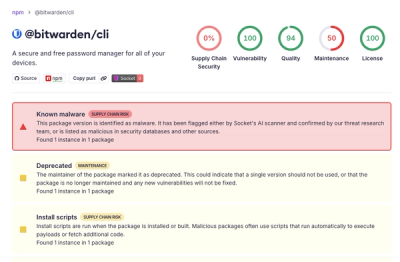
Bitwarden CLI 2026.4.0 was compromised in the Checkmarx supply chain campaign after attackers abused a GitHub Action in Bitwarden’s CI/CD pipeline.

Research
/Security News
Docker and Socket have uncovered malicious Checkmarx KICS images and suspicious code extension releases in a broader supply chain compromise.