

Product
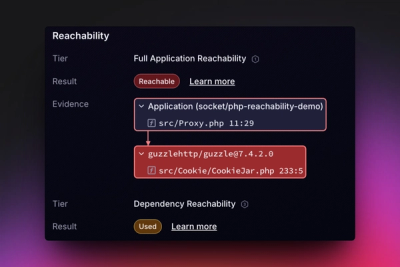
Introducing Reachability for PHP
Reachability analysis for PHP is now available in experimental, helping teams identify which vulnerabilities are actually exploitable.
By Benjamin Barslev - Apr 24, 2026
@opentelemetry/instrumentation-mongoose
Advanced tools
OpenTelemetry instrumentation for `mongoose` database object data modeling (ODM) library for MongoDB


This module provides automatic instrumentation for the mongoose module, which may be loaded using the @opentelemetry/sdk-trace-node package and is included in the @opentelemetry/auto-instrumentations-node bundle.
If total installation size is not constrained, it is recommended to use the @opentelemetry/auto-instrumentations-node bundle with @opentelemetry/sdk-node for the most seamless instrumentation experience.
Compatible with OpenTelemetry JS API and SDK 1.0+.
npm install --save @opentelemetry/instrumentation-mongoose
mongoose versions >=5.9.7 <9To load a specific plugin, specify it in the registerInstrumentations's configuration:
const { NodeTracerProvider } = require('@opentelemetry/sdk-trace-node');
const { MongooseInstrumentation } = require('@opentelemetry/instrumentation-mongoose');
const { registerInstrumentations } = require('@opentelemetry/instrumentation');

const provider = new NodeTracerProvider();
provider.register();

registerInstrumentations({
  instrumentations: [
    new MongooseInstrumentation(),
  ],
})
This instrumentation implements Semantic Conventions (semconv) v1.7.0. Since then, networking (in semconv v1.23.1) and database (in semconv v1.33.0) semantic conventions were stabilized. As of @opentelemetry/instrumentation-mongoose@0.44.0 support has been added for migrating to the stable semantic conventions using the OTEL_SEMCONV_STABILITY_OPT_IN environment variable as follows:
OTEL_SEMCONV_STABILITY_OPT_IN=http/dup,database/dup to emit both old and stable semantic conventions. (The http token is used to control the net.* attributes, the database token to control the db.* attributes.)OTEL_SEMCONV_STABILITY_OPT_IN=http,database to emit only the stable semantic conventions.By default, if OTEL_SEMCONV_STABILITY_OPT_IN includes neither of the above tokens, the old v1.7.0 semconv is used.
The intent is to provide an approximate 6 month time window for users of this instrumentation to migrate to the new database and networking semconv, after which a new minor version will use the new semconv by default and drop support for the old semconv.
See the HTTP migration guide and the database migration guide for details.
Attributes collected:
| Old semconv | Stable semconv | Description |
|---|---|---|
db.system | db.system.name | An identifier for the database management system (DBMS) product being used. Value: 'mongodb' |
db.mongodb.collection | db.collection.name | The collection being accessed within the database stated in db.name. |
db.name | db.namespace | This attribute is used to report the name of the database being accessed. |
db.operation | db.operation.name | The name of the operation being executed. |
db.statement | db.query.text | The database statement being executed. |
db.user | Removed | Username for accessing the database. |
net.peer.name | server.address | Remote hostname or similar. |
net.peer.port | server.port | Remote port number. |
Span name format:
mongoose.{modelName}.{operation} (e.g., mongoose.User.save){operation} {collection} (e.g., save users)Apache 2.0 - See LICENSE for more information.
FAQs
OpenTelemetry instrumentation for `mongoose` database object data modeling (ODM) library for MongoDB
The npm package @opentelemetry/instrumentation-mongoose receives a total of 15,174,167 weekly downloads. As such, @opentelemetry/instrumentation-mongoose popularity was classified as popular.
We found that @opentelemetry/instrumentation-mongoose demonstrated a healthy version release cadence and project activity because the last version was released less than a year ago. It has 4 open source maintainers collaborating on the project.
Did you know?

Socket for GitHub automatically highlights issues in each pull request and monitors the health of all your open source dependencies. Discover the contents of your packages and block harmful activity before you install or update your dependencies.
Product
Reachability analysis for PHP is now available in experimental, helping teams identify which vulnerabilities are actually exploitable.
Product
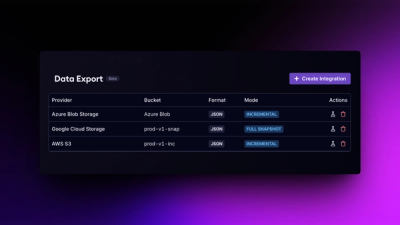
Export Socket alert data to your own cloud storage in JSON, CSV, or Parquet, with flexible snapshot or incremental delivery.
Research
/Security News
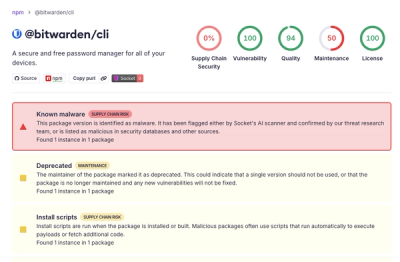
Bitwarden CLI 2026.4.0 was compromised in the Checkmarx supply chain campaign after attackers abused a GitHub Action in Bitwarden’s CI/CD pipeline.