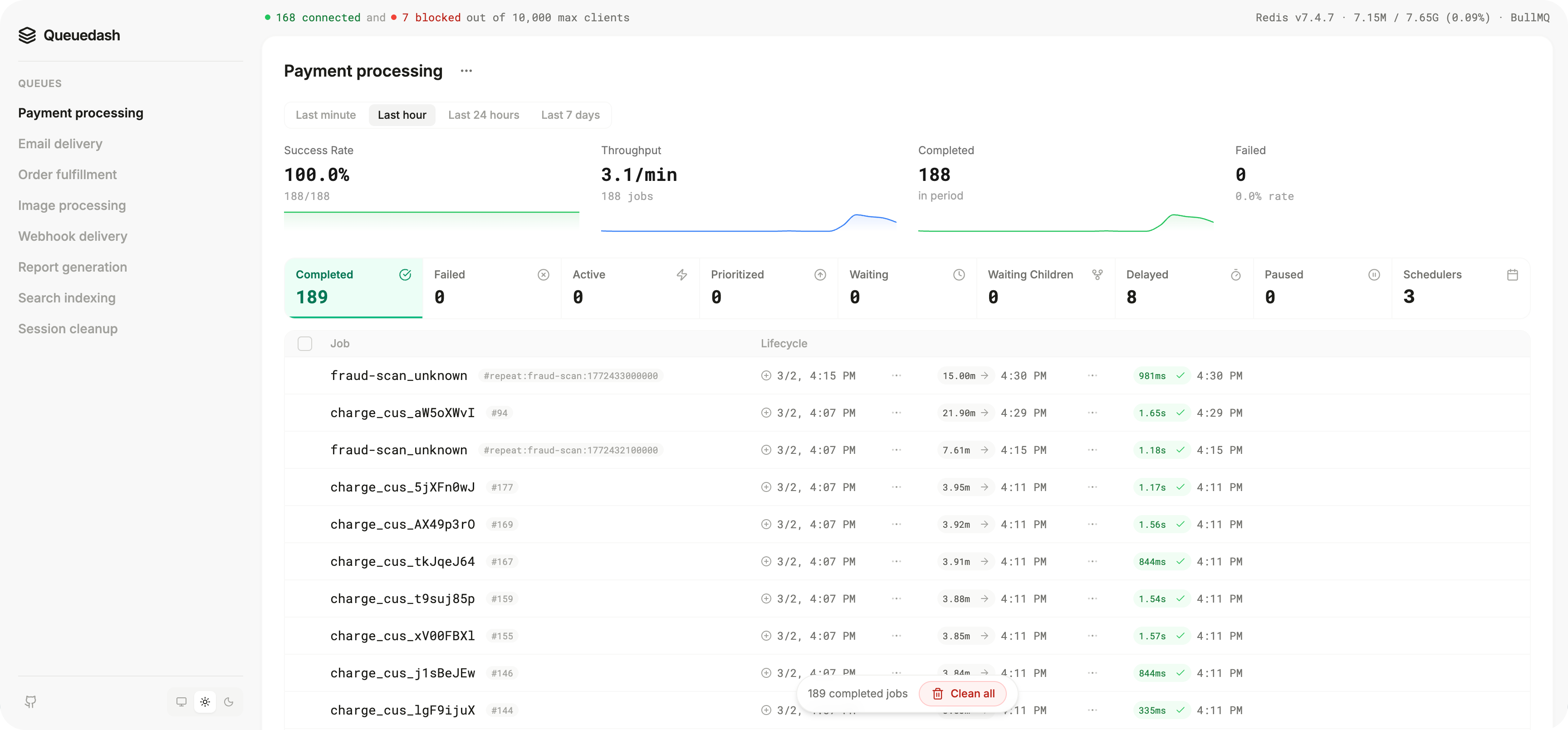
A stunning, sleek dashboard for Bull, BullMQ, Bee-Queue, and GroupMQ.


Features
- 😍 Simple, clean, and compact UI
- 🧙 Add jobs to your queue with ease
- 🪄 Retry, remove, and more convenient actions for your jobs
- 📊 Stats for job counts, job durations, and job wait times
- ✨ Top-level overview page of all queues
- 🔋 Integrates with Next.js, Express.js, and Fastify
- ⚡️ Compatible with Bull, BullMQ, Bee-Queue, and GroupMQ
- 📅 Job scheduler support
- 📈 Metrics for queue performance
Getting Started
Express
pnpm install @queuedash/api
import express from "express";
import Bull from "bull";
import { createQueueDashExpressMiddleware } from "@queuedash/api";

const app = express();

const reportQueue = new Bull("report-queue");

app.use(
  "/queuedash",
  createQueueDashExpressMiddleware({
    ctx: {
      queues: [
        {
          queue: reportQueue,
          displayName: "Reports",
          type: "bull" as const,
        },
      ],
    },
  }),
);

app.listen(3000, () => {
  console.log("Listening on port 3000");
  console.log("Visit http://localhost:3000/queuedash");
});
Next.js
pnpm install @queuedash/api @queuedash/ui
App Router
"use client";
import { QueueDashApp } from "@queuedash/ui";
import "@queuedash/ui/dist/styles.css";
function getBaseUrl() {
if (process.env.VERCEL_URL) {
return `https://${process.env.VERCEL_URL}/api/queuedash`;
}
return `http://localhost:${process.env.PORT ?? 3000}/api/queuedash`;
}
export default function QueueDashPages() {
return <QueueDashApp apiUrl={getBaseUrl()} basename="/admin/queuedash" />;
}
import { fetchRequestHandler } from "@trpc/server/adapters/fetch";
import { appRouter } from "@queuedash/api";
const reportQueue = new Bull("report-queue");
function handler(req: Request) {
return fetchRequestHandler({
endpoint: "/api/queuedash",
req,
router: appRouter,
allowBatching: true,
createContext: () => ({
queues: [
{
queue: reportQueue,
displayName: "Reports",
type: "bull" as const,
},
],
});
}
export { handler as GET, handler as POST };
Pages Router
import { QueueDashApp } from "@queuedash/ui";
function getBaseUrl() {
if (process.env.VERCEL_URL) {
return `https://${process.env.VERCEL_URL}/api/queuedash`;
}
return `http://localhost:${process.env.PORT ?? 3000}/api/queuedash`;
}
const QueueDashPages = () => {
return <QueueDashApp apiUrl={getBaseUrl()} basename="/admin/queuedash" />;
};
export default QueueDashPages;
import * as trpcNext from "@trpc/server/adapters/next";
import { appRouter } from "@queuedash/api";
const reportQueue = new Bull("report-queue");
export default trpcNext.createNextApiHandler({
router: appRouter,
batching: {
enabled: true,
},
createContext: () => ({
queues: [
{
queue: reportQueue,
displayName: "Reports",
type: "bull" as const,
},
],
}),
});
Docker
The fastest way to get started is using the official Docker image:
docker run -p 3000:3000 \
  -e QUEUES_CONFIG_JSON='{"queues":[{"name":"my-queue","displayName":"My Queue","type":"bullmq","connectionUrl":"redis://localhost:6379"}]}' \
  ghcr.io/alexbudure/queuedash:latest
Then visit http://localhost:3000
Environment Variables
QUEUES_CONFIG_JSON - Optional if QUEUES_CONFIG_FILE_PATH is set. JSON string containing queue configuration.QUEUES_CONFIG_FILE_PATH - Optional if QUEUES_CONFIG_JSON is set. Path to a JSON file containing queue configuration.
Example configuration:
{
  "queues": [
    {
      "name": "cancellation-follow-ups",
      "displayName": "Cancellation follow-ups",
      "type": "bullmq",
      "connectionUrl": "redis://localhost:6379"
    },
    {
      "name": "clustered-reports",
      "displayName": "Clustered Reports",
      "type": "bullmq",
      "clusterNodes": [
        { "host": "redis-cluster-0", "port": 6379 },
        { "host": "redis-cluster-1", "port": 6379 },
        { "host": "redis-cluster-2", "port": 6379 }
      ]
    },
    {
      "name": "email-queue",
      "displayName": "Email Queue",
      "type": "bull",
      "connectionUrl": "redis://localhost:6379"
    }
  ]
}
For bullmq queues, provide either connectionUrl (single-node Redis) or clusterNodes (Redis Cluster). clusterNodes is not supported for bull or bee.
Supported queue types: bull, bullmq, bee, groupmq
See the ./examples folder for more.
API Reference
createQueueDash<*>Middleware
type QueueDashMiddlewareOptions = {
app: express.Application | FastifyInstance;
baseUrl: string;
ctx: QueueDashContext;
};
type QueueDashContext = {
queues: QueueDashQueue[];
};
type QueueDashQueue = {
queue: Bull.Queue | BullMQ.Queue | BeeQueue;
displayName: string;
type: "bull" | "bullmq" | "bee" | "groupmq";
};
<QueueDashApp />
type QueueDashAppProps = {
apiUrl: string;
basename: string;
};
Need more?
If you need more capabilities, check out queuedash.com:
- Alerts and notifications
- Quick search and filtering
- Queue trends and analytics
- Invite team members
Acknowledgements
QueueDash was inspired by some great open source projects. Here's a few of them: