


Security News
Deno 2.6 + Socket: Supply Chain Defense In Your CLI
Deno 2.6 introduces deno audit with a new --socket flag that plugs directly into Socket to bring supply chain security checks into the Deno CLI.
By Sarah Gooding - Dec 12, 2025
@react-native-assets/navigation
Advanced tools
This package provide a component managing the navigation within your components. It is compatible with both react-native and react-native-web, making it a good tool for universal apps.

Try it here
The usual approach about navigation for React Native is to copy the hystory system from browsers. The issue is that React concept is not really compatible with the concept of retrieving data from the url. React components should depend only on the props they receive.
I created this component to provide a way to navigate between your screens on mobile and browser, compatible with React way of things.
Just run : npm i react-unavigation
The lib expects you to have the following peer dependencies in your project:
    "react-native": "^0.61.5",
    "react": "^16.13.1",
This is how you can use the navigation component:
import Navigation from 'react-unavigation'

const App = () => {
  const [active, setActive] = useState('home')
  const toHome = () => setActive('home')
  const toPage1 = () => setActive('page1')

  return (<Navigation active={active}>
    <View name='home'>
      <Text>This is the Home page</Text>
      <Button title='first page' onPress={toPage1} />
    </View>
    <View name='page1'>
      <Text>This is the first page</Text>
      <Button title='first page' onPress={toHome} />
    </View>
    <AnotherComponent name='page2' toHome={toHome} />
  </Navigation>)
}
The steps are simple:
import Navigation from 'react-unavigation'const [active, setActive] = useState('home')<Navigation active={active}>...(children)...</Navigation><Child name='pageName' />You can provide an optional duration property in ms to the Navigation component. This will change the duration of the transition between the screens.
To use this lib with typescript, you need the children to accept the name prop. If your component doesn't, react-unavigation provides 2 solutions:
You can import the Slide component which is actually a Wrapper that accepts name as prop:
import Navigation, { Slide } from 'react-unavigation'

const App = () => {
  const [active, setActive] = useState('home')
  const toHome = () => setActive('home')
  const toPage1 = () => setActive('page1')

  return (<Navigation active={active}>
    <Slide name='home' Component={View}>
      <Text>This is the Home page</Text>
      <Button title='first page' onPress={toPage1} />
    </View>
    <Slide name='page1' Component={View}>
      <Text>This is the first page</Text>
      <Button title='first page' onPress={toHome} />
    </View>
  </Navigation>)
}
The Slide component expects a name, and a Component to be displayed. It will transfer all of its other props to the Component provided.
For usage with more generic components, you can use the asSlide HOC.
import Navigation, { asSlide } from 'react-unavigation'

const Home = asSlide(View, 'home')
const Page1 = asSlide(View, 'page1')

const App = () => {

  const [active, setActive] = useState('home')
  const toHome = () => setActive('home')
  const toPage1 = () => setActive('page1')

  return (<Navigation active={active}>
    <Home>
      <Text>This is the Home page</Text>
      <Button title='first page' onPress={toPage1} />
    </Home>
    <Page1>
      <Text>This is the first page</Text>
      <Button title='first page' onPress={toHome} />
    </Page1>
  </Navigation>)
}
I encourage users to never transfer setActive to the children of Navigation but prefer using functions like toHome or toXXXScreen. This way, if you decide to change a component's name, you won't have to change the string everywhere in your application.
Of course, if you forget to add a name to your component or if you call setActive with a string that doesn't refer to an existing component, you will get a warning.
You can use nested Navigation components to match the logic of your application. By the way, Navigation component can be used to navigate within a portion of a view. You don't need to use it only to control the whole application screen. Look at this:
<Navbar>
  <Button onPress={() => setActive("tab1")} title={"To tab 1"} />
  <Button onPress={() => setActive("tab2")} title={"To tab 2"} />
  <Button onPress={() => setActive("tab3")} title={"To tab 3"} />
</Navbar>
<Navigation active={active}>
  <Tab1 name={"tab1"} />
  <Tab2 name={"tab2"} />
  <Tab3 name={"tab3"} />
</Navigation>
FAQs
Did you know?

Socket for GitHub automatically highlights issues in each pull request and monitors the health of all your open source dependencies. Discover the contents of your packages and block harmful activity before you install or update your dependencies.
Security News
Deno 2.6 introduces deno audit with a new --socket flag that plugs directly into Socket to bring supply chain security checks into the Deno CLI.
Security News
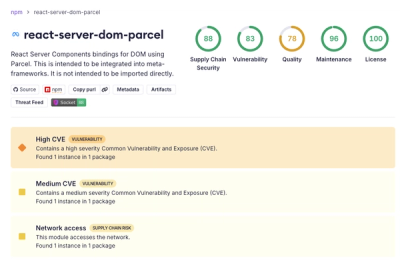
New DoS and source code exposure bugs in React Server Components and Next.js: what’s affected and how to update safely.

Security News
Socket CEO Feross Aboukhadijeh joins Software Engineering Daily to discuss modern software supply chain attacks and rising AI-driven security risks.