

Product
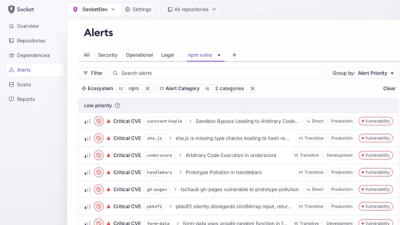
Introducing Custom Tabs for Org Alerts
Create and share saved alert views with custom tabs on the org alerts page, making it easier for teams to return to consistent, named filter sets.
By André Staltz - Jan 20, 2026
@ryanclark/ts-celery
Advanced tools


node-celery-ts is a Celery client for Node.js written in TypeScript.
node-celery-ts supports RabbitMQ and Redis result brokers and RPC (over
RabbitMQ) and Redis result backends. node-celery-ts provides
higher performance than Celery on PyPy and provides greater feature support than
node-celery, including Redis Sentinel
and Cluster, RPC result backends, YAML serialization, zlib task compression, and
Promise-based interfaces. node-celery-ts uses
amqplib and
ioredis for RabbitMQ and Redis,
respectively. node-celery-ts does not support Amazon SQS or Zookeeper message
brokers, nor does it support SQLAlchemy, Memcached, Cassandra, Elasticsearch,
IronCache, Couchbase, CouchDB, filesystem, or Consul result backends.
import * as Celery from "celery-ts";

const client: Celery.Client = Celery.createClient({
	brokerUrl: "amqp://localhost",
	resultBackend: "redis://localhost",
});

const task: Celery.Task<number> = client.createTask<number>("tasks.add");
const result: Celery.Result<number> = task.applyAsync({
	args: [0, 1],
	kwargs: { },
});

const promise: Promise<number> = result.get();

promise.then(console.log)
	.catch(console.error);
import * as Celery from "celery-ts";

const id = "7a5b72ab-03d1-47d9-8a9d-54af7c26bd59";
const brokers: Array<Celery.MessageBroker> = [
	Celery.createBroker("amqp://localhost"),
];
const backend: Celery.ResultBackend = Celery.createBackend("redis://localhost");

const client: Celery.Client = new Celery.Client({
	backend,
	brokers,
	id,
});
const id = "7a5b72ab-03d1-47d9-8a9d-54af7c26bd59";
const brokers: Array<Celery.MessageBroker> = [
	Celery.createBroker("amqp://localhost"),
	Celery.createBroker("amqp://localhost:5673"),
];
const backend: Celery.ResultBackend = Celery.createBackend("redis://localhost");

const failoverStrategy: Celery.FailoverStrategy = (
	brokers: Array<Celery.MessageBroker>,
): Celery.MessageBroker => {
	return brokers[Math.floor(Math.random() * 2)];
};

const client: Celery.Client = new Celery.Client({
	backend,
	brokers,
	failoverStrategy,
	id,
});
const client: Celery.Client = Celery.createClient({
	brokerUrl: "amqp://localhost",
	resultBackend: "redis://localhost",
});

const task: Celery.Task<number> = client.createTask<number>("tasks.add");
const result: Celery.Result<number> = task.applyAsync({
	args: [0, 1],
	compression: Celery.Compressor.Zlib,
	eta: new Date(Date.now() + 1000),
	expires: new Date(Date.now() + 5000),
	kwargs: { },
	serializer: Celery.Serializer.Yaml,
});

const promise: Promise<number> = result.get();

promise.then(console.log)
	.catch(console.error);
AmqpBrokerconst options: Celery.AmqpOptions = {
hostname: "localhost",
protocol: "amqp",
};
const broker = new Celery.AmqpBroker(options);
RpcBackendconst id = "7a5b72ab-03d1-47d9-8a9d-54af7c26bd59";
const options: Celery.AmqpOptions = {
hostname: "localhost",
protocol: "amqp",
};
const backend = new Celery.RpcBackend(id, options);
RedisBackend and RedisBroker both accept a RedisOptions object, which is
an interface that can be extended by the user to allow new creational patterns.
const tcp: RedisOptions = new Celery.RedisTcpOptions({
	host: "localhost",
	protocol: "redis",
});
const socket: RedisOptions = new Celery.RedisSocketOptions({
	path: "/tmp/redis.sock",
	protocol: "redis+socket",
});
If you so desire, you may also provide options directly to ioredis when using
a TCP or Unix Socket connection. See BasicRedisOptions for the full list.
const sentinel: RedisOptions = new Celery.RedisSentinelOptions({
	sentinels: [
		{ host: "localhost", port: 26379 },
		{ host: "localhost", port: 26380 },
	],
	name: "mymaster",
});
const cluster: RedisOptions = new Celery.RedisClusterOptions({
	nodes: [
		{ host: "localhost", port: 6379 },
		{ host: "localhost", port: 6380 },
	],
});
node-celery-ts was inspired by
node-celery. Special thanks to
Cameron Will for his guidance.
node-celery-ts is licensed under the BSD-3-Clause license.
FAQs
TypeScript Celery client for Node
The npm package @ryanclark/ts-celery receives a total of 13 weekly downloads. As such, @ryanclark/ts-celery popularity was classified as not popular.
We found that @ryanclark/ts-celery demonstrated a not healthy version release cadence and project activity because the last version was released a year ago. It has 1 open source maintainer collaborating on the project.
Did you know?

Socket for GitHub automatically highlights issues in each pull request and monitors the health of all your open source dependencies. Discover the contents of your packages and block harmful activity before you install or update your dependencies.
Product
Create and share saved alert views with custom tabs on the org alerts page, making it easier for teams to return to consistent, named filter sets.
Product
Socket’s Rust and Cargo support is now generally available, providing dependency analysis and supply chain visibility for Rust projects.

Security News
Chrome 144 introduces the Temporal API, a modern approach to date and time handling designed to fix long-standing issues with JavaScript’s Date object.