

Product
Introducing Custom Tabs for Org Alerts
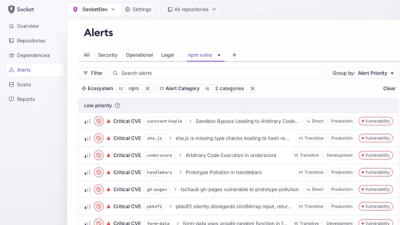
Create and share saved alert views with custom tabs on the org alerts page, making it easier for teams to return to consistent, named filter sets.
By André Staltz - Jan 20, 2026
@sentry/angular
Advanced tools

This package is a wrapper around @sentry/browser, with added functionality related to Angular. All methods available
in @sentry/browser can be imported from @sentry/angular.
To use this SDK, call Sentry.init(options) before you bootstrap your Angular application.
import { enableProdMode } from '@angular/core';
import { platformBrowserDynamic } from '@angular/platform-browser-dynamic';
import { init } from '@sentry/angular';

import { AppModule } from './app/app.module';

init({
  dsn: '__DSN__',
  // ...
});

// ...

enableProdMode();
platformBrowserDynamic()
  .bootstrapModule(AppModule)
  .then(success => console.log(`Bootstrap success`))
  .catch(err => console.error(err));
@sentry/angular exports a function to instantiate ErrorHandler provider that will automatically send Javascript errors
captured by the Angular's error handler.
import { NgModule, ErrorHandler } from '@angular/core';
import { createErrorHandler } from '@sentry/angular';

@NgModule({
  // ...
  providers: [
    {
      provide: ErrorHandler,
      useValue: createErrorHandler({
        showDialog: true,
      }),
    },
  ],
  // ...
})
export class AppModule {}
Additionally, createErrorHandler accepts a set of options that allows you to configure its behavior. For more details
see ErrorHandlerOptions interface in src/errorhandler.ts.
@sentry/angular exports a Trace Service, Directive and Decorators that leverage the @sentry/tracing Tracing
integration to add Angular related spans to transactions. If the Tracing integration is not enabled, this functionality
will not work. The service itself tracks route changes and durations, where directive and decorators are tracking
components initializations.
Registering a Trace Service is a 3-step process.
BrowserTracing integration from @sentry/tracing, including custom Angular routing
instrumentation:import { init, instrumentAngularRouting } from '@sentry/angular';
import { Integrations as TracingIntegrations } from '@sentry/tracing';
init({
dsn: '__DSN__',
integrations: [
new TracingIntegrations.BrowserTracing({
tracingOrigins: ['localhost', 'https://yourserver.io/api'],
routingInstrumentation: instrumentAngularRouting,
}),
],
tracesSampleRate: 1,
});
SentryTrace as a provider in Angular's DI system, with a Router as its dependency:import { NgModule } from '@angular/core';
import { Router } from '@angular/router';
import { TraceService } from '@sentry/angular';
@NgModule({
// ...
providers: [
{
provide: TraceService,
deps: [Router],
},
],
// ...
})
export class AppModule {}
TraceService from inside AppModule or use APP_INITIALIZER to force-instantiate Tracing.@NgModule({
// ...
})
export class AppModule {
constructor(trace: TraceService) {}
}
or
import { APP_INITIALIZER } from '@angular/core';

@NgModule({
  // ...
  providers: [
    {
      provide: APP_INITIALIZER,
      useFactory: () => () => {},
      deps: [TraceService],
      multi: true,
    },
  ],
  // ...
})
export class AppModule {}
To track Angular components as part of your transactions, you have 3 options.
TraceDirective: used to track a duration between OnInit and AfterViewInit lifecycle hooks in template:
import { TraceModule } from '@sentry/angular';

@NgModule({
  // ...
  imports: [TraceModule],
  // ...
})
export class AppModule {}
Then inside your components template (keep in mind that directive name attribute is required):
<app-header trace="header"></app-header>
<articles-list trace="articles-list"></articles-list>
<app-footer trace="footer"></app-footer>
TraceClassDecorator: used to track a duration between OnInit and AfterViewInit lifecycle hooks in components:
import { Component } from '@angular/core';
import { TraceClassDecorator } from '@sentry/angular';

@Component({
  selector: 'layout-header',
  templateUrl: './header.component.html',
})
@TraceClassDecorator()
export class HeaderComponent {
  // ...
}
TraceMethodDecorator: used to track a specific lifecycle hooks as point-in-time spans in components:
import { Component, OnInit } from '@angular/core';
import { TraceMethodDecorator } from '@sentry/angular';

@Component({
  selector: 'app-footer',
  templateUrl: './footer.component.html',
})
export class FooterComponent implements OnInit {
  @TraceMethodDecorator()
  ngOnInit() {}
}
You can also add your own custom spans by attaching them to the current active transaction using getActiveTransaction
helper. For example, if you'd like to track the duration of Angular boostraping process, you can do it as follows:
import { enableProdMode } from '@angular/core';
import { platformBrowserDynamic } from '@angular/platform-browser-dynamic';
import { init, getActiveTransaction } from '@sentry/angular';

import { AppModule } from './app/app.module';

// ...

const activeTransaction = getActiveTransaction();
const boostrapSpan =
  activeTransaction &&
  activeTransaction.startChild({
    description: 'platform-browser-dynamic',
    op: 'angular.bootstrap',
  });

platformBrowserDynamic()
  .bootstrapModule(AppModule)
  .then(() => console.log(`Bootstrap success`))
  .catch(err => console.error(err));
  .finally(() => {
    if (bootstrapSpan) {
      boostrapSpan.finish();
    }
  })
Bugsnag provides error monitoring and crash reporting for JavaScript applications. It offers similar functionalities to @sentry/angular, such as error tracking and performance monitoring, but also includes features like session tracking and release tracking.
Rollbar is another error tracking and monitoring service for JavaScript applications. It provides real-time error reporting, similar to @sentry/angular, and includes additional features like telemetry, which captures events leading up to an error, and deployment tracking.
Airbrake offers error monitoring and performance tracking for JavaScript applications. It provides similar functionalities to @sentry/angular, such as error tracking and performance monitoring, but also includes features like error grouping and detailed error reports.
FAQs
Official Sentry SDK for Angular
The npm package @sentry/angular receives a total of 221,358 weekly downloads. As such, @sentry/angular popularity was classified as popular.
We found that @sentry/angular demonstrated a healthy version release cadence and project activity because the last version was released less than a year ago. It has 1 open source maintainer collaborating on the project.
Did you know?

Socket for GitHub automatically highlights issues in each pull request and monitors the health of all your open source dependencies. Discover the contents of your packages and block harmful activity before you install or update your dependencies.
Product
Create and share saved alert views with custom tabs on the org alerts page, making it easier for teams to return to consistent, named filter sets.
Product
Socket’s Rust and Cargo support is now generally available, providing dependency analysis and supply chain visibility for Rust projects.

Security News
Chrome 144 introduces the Temporal API, a modern approach to date and time handling designed to fix long-standing issues with JavaScript’s Date object.