

Research
Active Supply Chain Attack Compromises @antv Packages on npm
Active npm supply chain attack compromises @antv packages in a fast-moving malicious publish wave tied to Mini Shai-Hulud.
By Socket Research Team - May 19, 2026
@stdlib/strided-base-quinary
Advanced tools
Apply a quinary callback to strided input array elements and assign results to elements in a strided output array.




Apply a quinary callback to strided input array elements and assign results to elements in a strided output array.
npm install @stdlib/strided-base-quinary
var quinary = require( '@stdlib/strided-base-quinary' );
Applies a quinary callback to strided input array elements and assigns results to elements in a strided output array.
var Float64Array = require( '@stdlib/array-float64' );

function add( x, y, z, w, u ) {
    return x + y + z + w + u;
}

var x = new Float64Array( [ 1.0, 2.0, 3.0, 4.0, 5.0 ] );
var y = new Float64Array( [ 1.0, 2.0, 3.0, 4.0, 5.0 ] );
var z = new Float64Array( [ 1.0, 2.0, 3.0, 4.0, 5.0 ] );
var w = new Float64Array( [ 1.0, 2.0, 3.0, 4.0, 5.0 ] );
var u = new Float64Array( [ 1.0, 2.0, 3.0, 4.0, 5.0 ] );
var v = new Float64Array( [ 0.0, 0.0, 0.0, 0.0, 0.0 ] );

quinary( [ x, y, z, w, u, v ], [ x.length ], [ 1, 1, 1, 1, 1, 1 ], add );
// v => <Float64Array>[ 5.0, 10.0, 15.0, 20.0, 25.0 ]
The function accepts the following arguments:
The shape and strides parameters determine which elements in the strided input and output arrays are accessed at runtime. For example, to index every other value in the strided input arrays and to index the first N elements of the strided output array in reverse order,
var Float64Array = require( '@stdlib/array-float64' );
var floor = require( '@stdlib/math-base-special-floor' );

function add( x, y, z, w, u ) {
    return x + y + z + w + u;
}

var x = new Float64Array( [ 1.0, 2.0, 3.0, 4.0, 5.0 ] );
var y = new Float64Array( [ 1.0, 2.0, 3.0, 4.0, 5.0 ] );
var z = new Float64Array( [ 1.0, 2.0, 3.0, 4.0, 5.0 ] );
var w = new Float64Array( [ 1.0, 2.0, 3.0, 4.0, 5.0 ] );
var u = new Float64Array( [ 1.0, 2.0, 3.0, 4.0, 5.0 ] );
var v = new Float64Array( [ 0.0, 0.0, 0.0, 0.0, 0.0 ] );

var N = floor( x.length / 2 );

quinary( [ x, y, z, w, u, v ], [ N ], [ 2, 2, 2, 2, 2, -1 ], add );
// v => <Float64Array>[ 25.0, 15.0, 5.0, 0.0, 0.0, 0.0 ]
Note that indexing is relative to the first index. To introduce an offset, use typed array views.
var Float64Array = require( '@stdlib/array-float64' );
var floor = require( '@stdlib/math-base-special-floor' );

function add( x, y, z, w, u ) {
    return x + y + z + w + u;
}

// Initial arrays...
var x0 = new Float64Array( [ 1.0, 2.0, 3.0, 4.0, 5.0, 6.0 ] );
var y0 = new Float64Array( [ 1.0, 2.0, 3.0, 4.0, 5.0, 6.0 ] );
var z0 = new Float64Array( [ 1.0, 2.0, 3.0, 4.0, 5.0, 6.0 ] );
var w0 = new Float64Array( [ 1.0, 2.0, 3.0, 4.0, 5.0, 6.0 ] );
var u0 = new Float64Array( [ 1.0, 2.0, 3.0, 4.0, 5.0, 6.0 ] );
var v0 = new Float64Array( [ 0.0, 0.0, 0.0, 0.0, 0.0, 0.0 ] );

// Create offset views...
var x1 = new Float64Array( x0.buffer, x0.BYTES_PER_ELEMENT*1 ); // start at 2nd element
var y1 = new Float64Array( y0.buffer, y0.BYTES_PER_ELEMENT*1 ); // start at 2nd element
var z1 = new Float64Array( z0.buffer, z0.BYTES_PER_ELEMENT*1 ); // start at 2nd element
var w1 = new Float64Array( w0.buffer, w0.BYTES_PER_ELEMENT*1 ); // start at 2nd element
var u1 = new Float64Array( u0.buffer, u0.BYTES_PER_ELEMENT*1 ); // start at 2nd element
var v1 = new Float64Array( v0.buffer, v0.BYTES_PER_ELEMENT*3 ); // start at 4th element

var N = floor( x0.length / 2 );

quinary( [ x1, y1, z1, w1, u1, v1 ], [ N ], [ -2, -2, -2, -2, -2, 1 ], add );
// u0 => <Float64Array>[ 0.0, 0.0, 0.0, 30.0, 20.0, 10.0 ]
Applies a quinary callback to strided input array elements and assigns results to elements in a strided output array using alternative indexing semantics.
var Float64Array = require( '@stdlib/array-float64' );

function add( x, y, z, w, u ) {
    return x + y + z + w + u;
}

var x = new Float64Array( [ 1.0, 2.0, 3.0, 4.0, 5.0 ] );
var y = new Float64Array( [ 1.0, 2.0, 3.0, 4.0, 5.0 ] );
var z = new Float64Array( [ 1.0, 2.0, 3.0, 4.0, 5.0 ] );
var w = new Float64Array( [ 1.0, 2.0, 3.0, 4.0, 5.0 ] );
var u = new Float64Array( [ 1.0, 2.0, 3.0, 4.0, 5.0 ] );
var v = new Float64Array( [ 0.0, 0.0, 0.0, 0.0, 0.0 ] );

quinary.ndarray( [ x, y, z, w, u, v ], [ x.length ], [ 1, 1, 1, 1, 1, 1 ], [ 0, 0, 0, 0, 0, 0 ], add );
// v => <Float64Array>[ 5.0, 10.0, 15.0, 20.0, 25.0 ]
The function accepts the following additional arguments:
While typed array views mandate a view offset based on the underlying buffer, the offsets parameter supports indexing semantics based on starting indices. For example, to index every other value in the strided input arrays starting from the second value and to index the last N elements in the strided output array,
var Float64Array = require( '@stdlib/array-float64' );
var floor = require( '@stdlib/math-base-special-floor' );

function add( x, y, z, w, u ) {
    return x + y + z + w + u;
}

var x = new Float64Array( [ 1.0, 2.0, 3.0, 4.0, 5.0, 6.0 ] );
var y = new Float64Array( [ 1.0, 2.0, 3.0, 4.0, 5.0, 6.0 ] );
var z = new Float64Array( [ 1.0, 2.0, 3.0, 4.0, 5.0, 6.0 ] );
var w = new Float64Array( [ 1.0, 2.0, 3.0, 4.0, 5.0, 6.0 ] );
var u = new Float64Array( [ 1.0, 2.0, 3.0, 4.0, 5.0, 6.0 ] );
var v = new Float64Array( [ 0.0, 0.0, 0.0, 0.0, 0.0, 0.0 ] );

var N = floor( x.length / 2 );

quinary.ndarray( [ x, y, z, w, u, v ], [ N ], [ 2, 2, 2, 2, 2, -1 ], [ 1, 1, 1, 1, 1, v.length-1 ], add );
// v => <Float64Array>[ 0.0, 0.0, 0.0, 30.0, 20.0, 10.0 ]
var discreteUniform = require( '@stdlib/random-base-discrete-uniform' ).factory;
var filledarray = require( '@stdlib/array-filled' );
var gfillBy = require( '@stdlib/blas-ext-base-gfill-by' );
var quinary = require( '@stdlib/strided-base-quinary' );

function add( x, y, z, w, u ) {
    return x + y + z + w + u;
}

var N = 10;

var x = filledarray( 0.0, N, 'generic' );
gfillBy( x.length, x, 1, discreteUniform( -100, 100 ) );
console.log( x );

var y = filledarray( 0.0, N, 'generic' );
gfillBy( y.length, y, 1, discreteUniform( -100, 100 ) );
console.log( y );

var z = filledarray( 0.0, N, 'generic' );
gfillBy( z.length, z, 1, discreteUniform( -100, 100 ) );
console.log( z );

var w = filledarray( 0.0, N, 'generic' );
gfillBy( w.length, w, 1, discreteUniform( -100, 100 ) );
console.log( w );

var u = filledarray( 0.0, N, 'generic' );
gfillBy( u.length, u, 1, discreteUniform( -100, 100 ) );
console.log( u );

var v = filledarray( 0.0, N, 'generic' );
console.log( v );

var shape = [ N ];
var strides = [ 1, 1, 1, 1, 1, -1 ];
var offsets = [ 0, 0, 0, 0, 0, N-1 ];

quinary.ndarray( [ x, y, z, w, u, v ], shape, strides, offsets, add );
console.log( v );
This package is part of stdlib, a standard library for JavaScript and Node.js, with an emphasis on numerical and scientific computing. The library provides a collection of robust, high performance libraries for mathematics, statistics, streams, utilities, and more.
For more information on the project, filing bug reports and feature requests, and guidance on how to develop stdlib, see the main project repository.

See LICENSE.
Copyright © 2016-2021. The Stdlib Authors.
FAQs
Apply a quinary callback to strided input array elements and assign results to elements in a strided output array.
The npm package @stdlib/strided-base-quinary receives a total of 64 weekly downloads. As such, @stdlib/strided-base-quinary popularity was classified as not popular.
We found that @stdlib/strided-base-quinary demonstrated a healthy version release cadence and project activity because the last version was released less than a year ago. It has 4 open source maintainers collaborating on the project.
Did you know?

Socket for GitHub automatically highlights issues in each pull request and monitors the health of all your open source dependencies. Discover the contents of your packages and block harmful activity before you install or update your dependencies.
Research
Active npm supply chain attack compromises @antv packages in a fast-moving malicious publish wave tied to Mini Shai-Hulud.
Security News
/Research
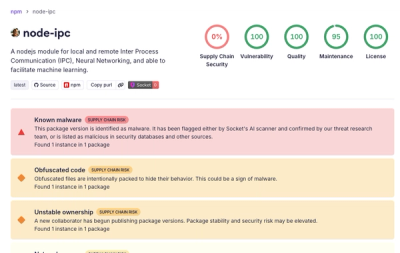
Socket detected malicious node-ipc versions with obfuscated stealer/backdoor behavior in a developing npm supply chain attack.

Security News
TeamPCP and BreachForums are promoting a Shai-Hulud supply chain attack contest with a $1,000 prize for the biggest package compromise.