

Product
Introducing Data Exports
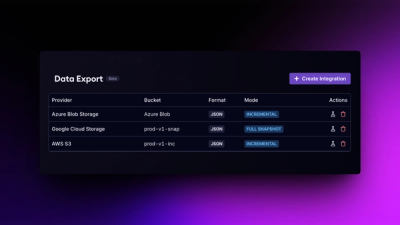
Export Socket alert data to your own cloud storage in JSON, CSV, or Parquet, with flexible snapshot or incremental delivery.
By Ola Adekola - Apr 23, 2026
@teste-luccas/devportal-plugin-vault-backend-test
Advanced tools
A Backstage backend plugin that integrates towards Vault - devportal modified test
A backend for Vault, this plugin adds a few routes that are used by the frontend plugin to fetch the information from Vault.
Vault is an identity-based secrets and encryption management system. A secret is anything that you want to tightly control access to, such as API encryption keys, passwords, or certificates. Vault provides encryption services that are gated by authentication and authorization methods.
This plugins allows you to view all the available secrets at a certain location, and redirect you to the official UI so backstage can rely on LIST permissions, which is safer.
To get started, first you need a running instance of Vault. You can follow this tutorial to install vault and start your server locally.
When your Vault instance is up and running, then you will need to install the plugin into your app:
# From your Backstage root directory
yarn add --cwd packages/backend @backstage/plugin-vault-backend
Create a file in src/plugins/vault.ts and add a reference to it in src/index.ts:
// In packages/backend/src/plugins/vault.ts
import { createRouter } from '@backstage/plugin-vault-backend';
import { Router } from 'express';
import { PluginEnvironment } from '../types';

export default async function createPlugin(
  env: PluginEnvironment,
): Promise<Router> {
  return await createRouter({
    logger: env.logger,
    config: env.config,
    scheduler: env.scheduler,
  });
}
diff --git a/packages/backend/src/index.ts b/packages/backend/src/index.ts
index f2b14b2..2c64f47 100644
--- a/packages/backend/src/index.ts
+++ b/packages/backend/src/index.ts
@@ -22,6 +22,7 @@ import { Config } from '@backstage/config';
 import app from './plugins/app';
+import vault from './plugins/vault';
 import scaffolder from './plugins/scaffolder';
@@ -56,6 +57,7 @@ async function main() {
   const authEnv = useHotMemoize(module, () => createEnv('auth'));
+  const vaultEnv = useHotMemoize(module, () => createEnv('vault'));
   const proxyEnv = useHotMemoize(module, () => createEnv('proxy'));
@@ -63,6 +65,7 @@ async function main() {

   const apiRouter = Router();
   apiRouter.use('/catalog', await catalog(catalogEnv));
+  apiRouter.use('/vault', await vault(vaultEnv));
   apiRouter.use('/scaffolder', await scaffolder(scaffolderEnv));
Add some extra configurations in your app-config.yaml.
vault:
  baseUrl: http://your-internal-vault-url.svc
  publicUrl: https://your-vault-url.example.com
  token: <VAULT_TOKEN>
  secretEngine: 'customSecretEngine' # Optional. By default it uses 'secrets'
  kvVersion: <kv-version> # Optional. The K/V version that your instance is using. The available options are '1' or '2'
Get a VAULT_TOKEN with LIST permissions, as it's enough for the plugin. You can check this tutorial for more info.
If you also want to use the renew functionality, you need to attach the following block to your custom policy, so that Backstage can perform a token-renew:
  # Allow tokens to renew themselves
  path "auth/token/renew-self" {
    capabilities = ["update"]
  }
The plugin can be integrated into each Component in the catalog. To allow listing the available secrets a new annotation must be added to the catalog-info.yaml:
apiVersion: backstage.io/v1alpha1
kind: Component
metadata:
  # ...
  annotations:
    vault.io/secrets-path: path/to/secrets
The path is relative to your secrets engine folder. So if you want to get the secrets for backstage and you have the following directory structure:
.
├── ...
├── secrets                 # Your secret engine name (usually it is `secrets`)
│   ├── test                # Folder with test secrets
│   │   ├── backstage       # In this folder there are secrets for Backstage
│   ├── other               # Other folder with more secrets inside
│   └── folder              # And another folder
└── ...
You will set the vault.io/secret-path to test/backstage. If the folder backstage contains other sub-folders, the plugin will fetch the secrets inside them and adapt the View and Edit URLs to point to the correct place.
In a secure Vault instance, it's usual that the tokens are refreshed after some time. In order to always have a valid token to fetch the secrets, it might be necessary to execute a renew action after some time. By default this is deactivated, but it can be easily activated and configured to be executed periodically (hourly by default, but customizable by the user). In order to do that, modify your src/plugins/vault.ts file to look like this one:
import { VaultBuilder } from '@backstage/plugin-vault-backend';
import { Router } from 'express';
import { PluginEnvironment } from '../types';

export default async function createPlugin(
  env: PluginEnvironment,
): Promise<Router> {
  const builder = await VaultBuilder.createBuilder({
    logger: env.logger,
    config: env.config,
    scheduler: env.scheduler,
  }).enableTokenRenew(
    env.scheduler.createScheduledTaskRunner({
      frequency: { minutes: 10 },
      timeout: { minutes: 1 },
    }),
  );

  const { router } = builder.build();

  return router;
}
The secrets cannot be edited/viewed from within Backstage to make it more secure. Backstage will only have permissions to LIST data from Vault or to renew its own token if that is needed. And the user who wants to edit/view a certain secret needs the correct permissions to do so.
FAQs
A Backstage backend plugin that integrates towards Vault - devportal modified test
We found that @teste-luccas/devportal-plugin-vault-backend-test demonstrated a not healthy version release cadence and project activity because the last version was released a year ago. It has 1 open source maintainer collaborating on the project.
Did you know?

Socket for GitHub automatically highlights issues in each pull request and monitors the health of all your open source dependencies. Discover the contents of your packages and block harmful activity before you install or update your dependencies.
Product
Export Socket alert data to your own cloud storage in JSON, CSV, or Parquet, with flexible snapshot or incremental delivery.
Research
/Security News
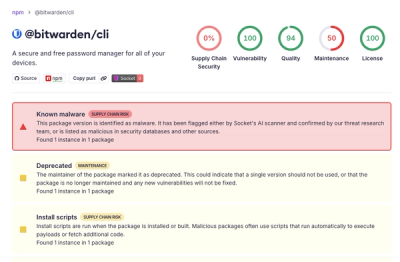
Bitwarden CLI 2026.4.0 was compromised in the Checkmarx supply chain campaign after attackers abused a GitHub Action in Bitwarden’s CI/CD pipeline.

Research
/Security News
Docker and Socket have uncovered malicious Checkmarx KICS images and suspicious code extension releases in a broader supply chain compromise.